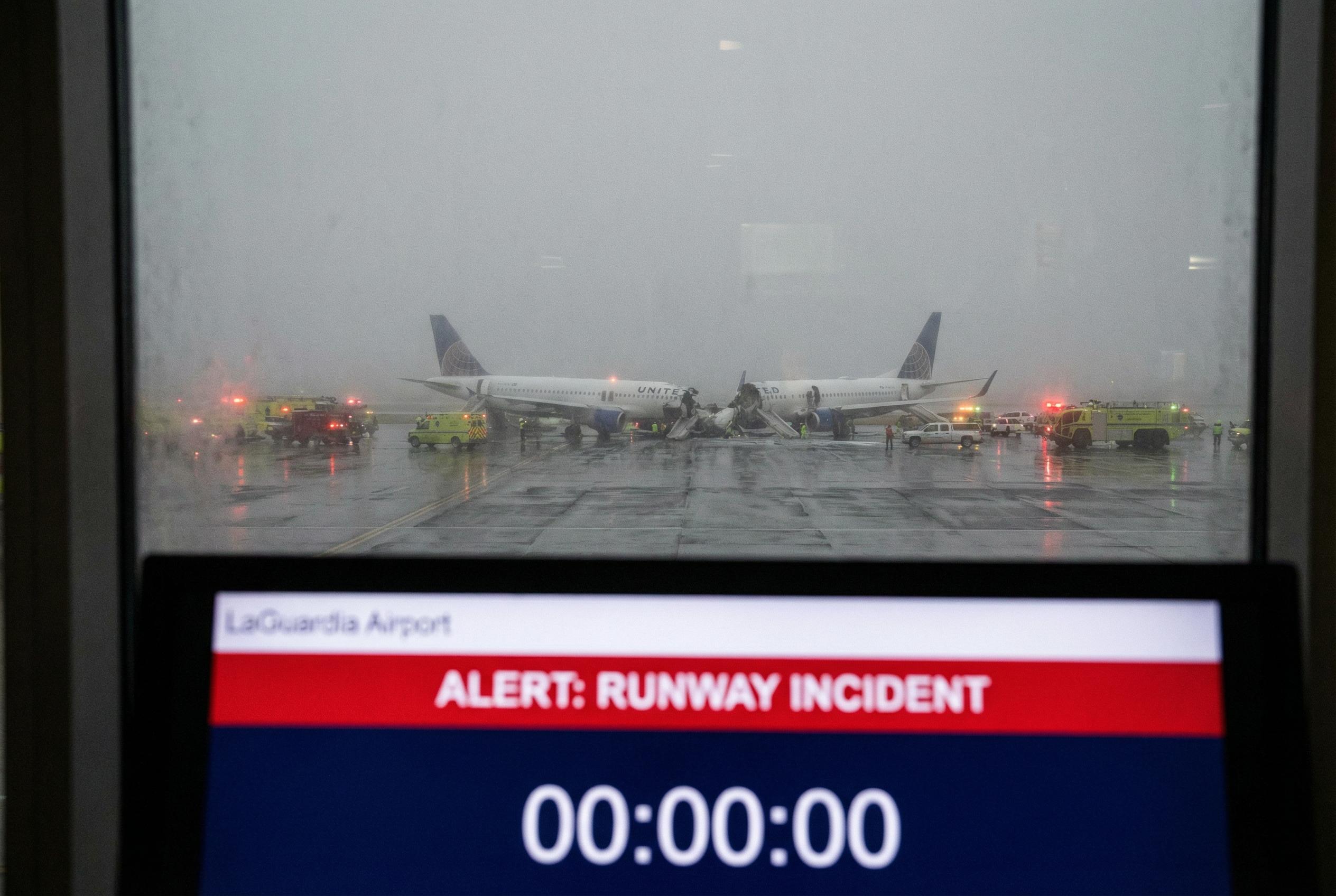
A landing Air Canada Express regional jet struck a Port Authority fire truck while touching down at LaGuardia Airport, killing the aircraft’s two pilots and injuring dozens of passengers and responders in an accident that has exposed fractures in runway operations, emergency coordination and surface surveillance at one of the United States’ busiest airports. According to reporting, the collision occurred after an emergency vehicle was cleared to cross an active runway moments before the Bombardier CRJ900 landed, and controllers attempted to halt the movement only seconds before impact.
Investigators say the flight, operated by Jazz Aviation as Air Canada Express Flight 8646, had arrived from Montreal and was delayed, contributing to congestion on the airfield; at the same time another aircraft had declared an emergency, prompting fire crews to manoeuvre on the movement area. The National Transportation Safety Board has opened a probe focusing on the sequence of clearances, the timing of communications and whether staffing and procedural choices contributed to the deadly overlap.
A recurring technical theme in accounts of the crash is the fire truck’s lack of a transponder, which left the vehicle effectively invisible to LaGuardia’s ASDE-X surface-detection system that relies in part on cooperative signals. That limitation, combined with clustered emergency vehicles and radio congestion, appears to have prevented automated alerts that might have warned controllers or the crew earlier. Sources report the controller issued a runway-crossing clearance roughly 12 seconds before touchdown and broadcast an urgent "stop" only moments later, too late to prevent the collision.
The accident has revived debate about the potential of artificial intelligence to provide anticipatory safety layers on the ground. Proponents argue AI can fuse disparate feeds, radar, non-cooperative video, motion sensors and radio transcripts, into continuous probabilistic assessments of collision risk, offering graded warnings or even automatic vetoes of conflicting clearances when human workload or ambiguity is high. Industry observers say such systems could detect anomalous vehicle trajectories even without transponder signals by recognising patterns that presage a hazardous intersection.
Pilots, controllers and emergency responders operate within tightly scripted procedures that nevertheless depend on timely, unambiguous communication; the LaGuardia event illustrates how rapidly those scripts can fragment under simultaneous emergencies and staffing pressures. Reporting has noted that only two controllers were on the tower console during the events, and that radio congestion and overlapping transmissions contributed to confusion, conditions that proponents of automated oversight say are precisely where AI assistance would be most valuable.
Beyond immediate operational fixes, commentators and safety specialists call for several policy steps: mandatory cooperative tracking for all movement-area vehicles; upgrading surface-detection platforms with sensor fusion and computer vision; routine NLP-based monitoring of radio traffic to flag ambiguous or contradictory clearances; and expanded simulation training that presents multi-agent, emergent scenarios to better prepare controllers and crews. Advocates stress these measures are extensions of existing capabilities rather than speculative inventions.
Implementing algorithmic safeguards raises legal and ethical questions that regulators and operators will need to confront. If an automated system issues, or fails to issue, a veto that might have averted harm, liability could implicate manufacturers, software designers, airport operators or regulators, requiring updates to certification standards and legal frameworks used in aviation liability. Observers say a clear accountability regime will be essential before AI assumes directive roles in safety-critical decisions.
The LaGuardia collision, the first fatal accident at the airport in more than three decades, has produced immediate operational disruption and renewed calls for systemic change. As investigators continue to reconstruct the timeline and causal chain, industry voices urge that lessons from this tragedy be translated into concrete, enforceable measures to prevent recurrence, not least because the risk factors, surface congestion, emergency vehicle movements and human cognitive limits, are well known and addressable with current technology and revised procedures.
Source Reference Map
Inspired by headline at: [1]
Sources by paragraph:
- Paragraph 1: [2], [3]
- Paragraph 2: [3], [5]
- Paragraph 3: [5], [4]
- Paragraph 4: [1], [5]
- Paragraph 5: [5], [3]
- Paragraph 6: [1], [5]
- Paragraph 7: [1], [6]
- Paragraph 8: [4], [6]
Source: Noah Wire Services