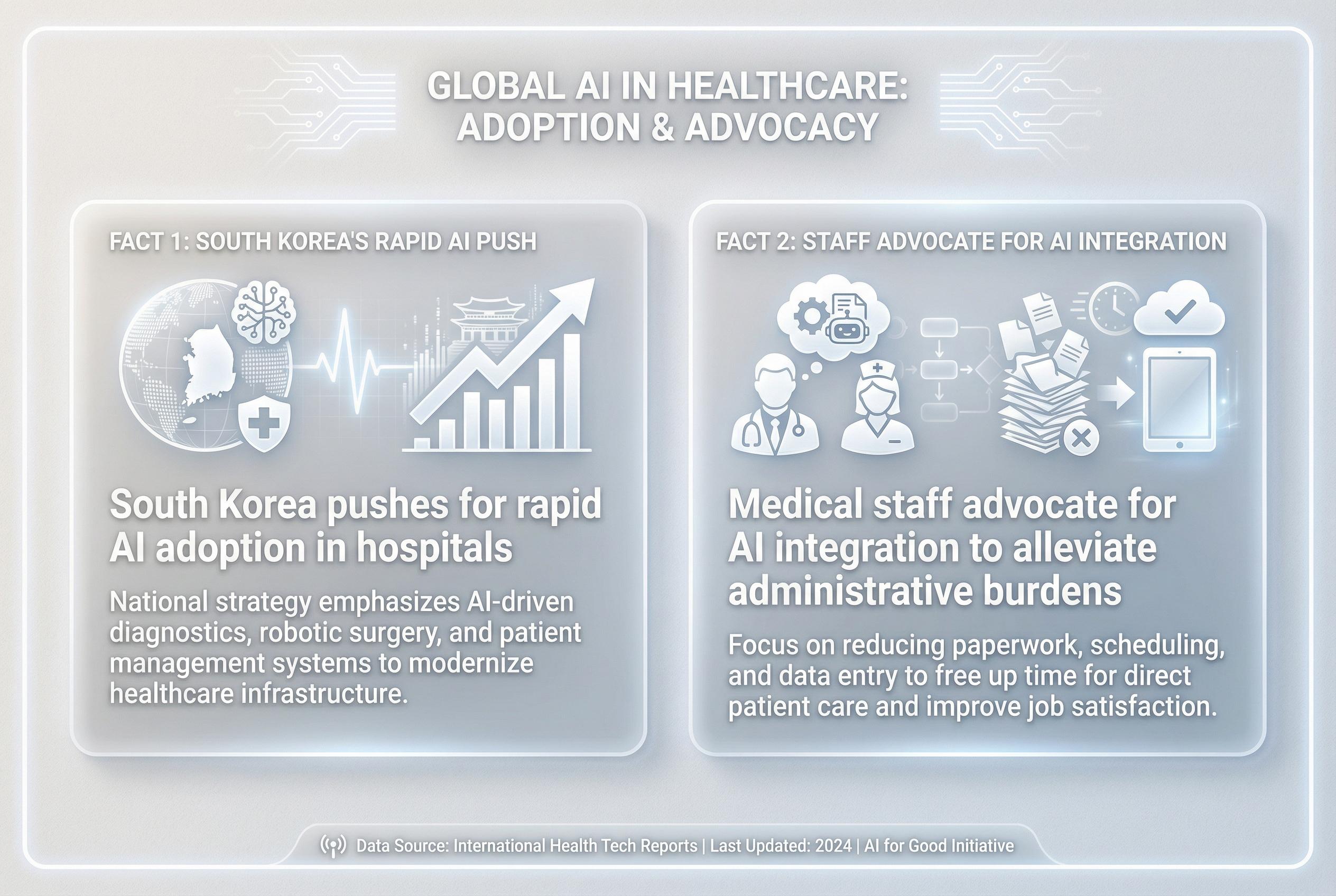
Medical staff across South Korea are pressing for rapid adoption of artificial intelligence to relieve crushing administrative burdens and to expand clinical training, arguing that automation could return time to patient care and cut costs while improving outcomes. According to industry analysis, routine hospital processes such as scheduling, billing and record-keeping are prime targets for AI-driven streamlining, and voice and ambient recognition systems are already being trialled elsewhere to capture clinical notes and referrals automatically. (Keragon; TechRadar)
Clinicians describe a daily reality in which hours are devoted to assembling fragmented patient records from insurers, emergency services and separate hospital databases, then documenting consultations to guard against litigation. Legal commentators warn that poor records expose practitioners to serious risk, underscoring why meticulous note‑taking consumes so much of a doctor’s working day. (Hinshaw & Culbertson; BMC Medical Education)
Yet practical obstacles limit deployment within hospital walls. Staff point to technical and regulatory barriers such as restrictive internal networks that block external AI services and the patchwork of patient consent rules needed to share personal data. Healthcare lawyers and administrators note that integration costs, legacy IT systems and concerns about data governance make widespread implementation complex. (Hinshaw & Culbertson; Keragon)
Many trainees want AI to supplement hands‑on experience by exposing them to rarer conditions and standardising learning. Medical educators in the United States and academic studies advocate building AI literacy into curricula, offering modules and toolkits that teach how to use decision aids responsibly and how to interpret AI outputs, while postgraduate learners show greater readiness to adopt these tools than undergraduates. (American Medical Association; BMC Medical Education)
There are concrete clinical wins. Teams in tertiary centres have combined AI modelling with augmented reality to create three‑dimensional anatomical overlays from a single scan, reducing repeated imaging and radiation exposure for children receiving central venous drug infusions. Nurses and physicians report less procedural anxiety and fewer repeat checks, which translates into lower costs and better patient experience. Technology reviews highlight similar benefits where ambient AI removes repetitive documentation tasks from frontline staff. (TechRadar; Keragon; Hinshaw & Culbertson)
Cultural resistance within the medical profession also slows adoption. Senior clinicians in some specialties remain sceptical about asking AI for clinical input, viewing it as an affront to professional expertise, while others worry about algorithmic bias and the medico‑legal implications of machine‑assisted decisions. Professional bodies have begun responding by proposing standardised AI learning objectives and continuing education so that doctors can use tools with confidence. (American Medical Association; Hinshaw & Culbertson)
Healthcare leaders and regulators face a choice: enable safe, governed access to AI and invest in training and infrastructure, or risk losing potential efficiency and educational gains. Advocates argue that changes to medical practice law and clearer guidance on data sharing, together with curated curricula and pilot programmes, would make it feasible to scale AI in hospitals without compromising patient safety. (American Medical Association; Keragon)
Source Reference Map
Inspired by headline at: [1]
Sources by paragraph:
- Paragraph 1: [6], [7]
- Paragraph 2: [5], [4]
- Paragraph 3: [5], [6]
- Paragraph 4: [2], [4]
- Paragraph 5: [7], [6], [5]
- Paragraph 6: [5], [3]
- Paragraph 7: [3], [6]
Source: Noah Wire Services