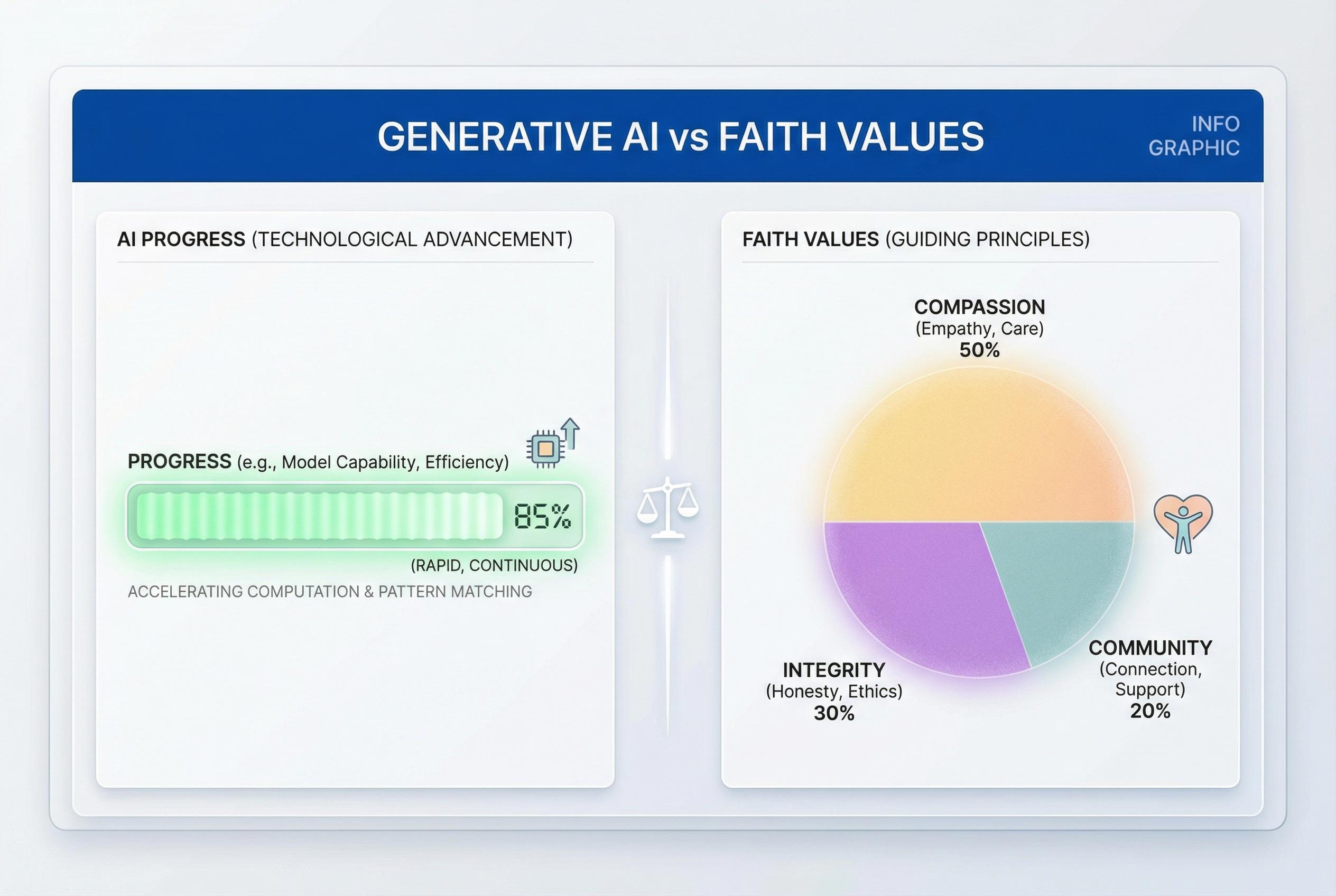
Generative artificial intelligence has become a flashpoint within parts of the Anabaptist community, provoking a debate at Mennonite institutions about whether such tools belong on campus and what their presence means for communal faith practice. According to reporting from Anabaptist World, religious leaders and scholars gathered to consider whether AI will foster peace or amplify disinformation, a tension that frames local disputes over campus policy as much more than a technical matter.
For many who trace their convictions to Plain and Anabaptist traditions, the question is not merely pragmatic but existential: how does a technology that mimics thought fit within a movement that has prized human discernment, shared labour and nonconformity for centuries? Coverage of recent gatherings of Plain Anabaptists emphasises a communal commitment to practices rooted in scripture and the early church, underscoring why some students and faculty regard rapid adoption of generative AI as out of step with their religious identity.
Proponents argue that AI delivers efficiency and frees time for deeper work. Critics on campus respond that speed is not an unalloyed good; there is value in labour that is slow, educative and communal. Roundtable conversations hosted by Anabaptist commentators have questioned what would actually be done with time supposedly saved by automation and warned against uncritically substituting machine-produced output for forms of learning and care that shape moral character.
Beyond pedagogy, ethical concerns about AI’s wider harms inform the resistance. Participants at an “AI Ethics for Peace” convening in Hiroshima urged that moral reflection must come before deployment, noting risks that include the spread of falsehoods, environmental costs and connections between advanced technologies and oppressive systems. Such assessments reinforce the position of those who say generative AI cannot be treated as neutral infrastructure on a faith-based campus.
Consent and conscience are central to the debate. Voices within Anabaptist circles draw a direct line between historic commitments to voluntary service and current demands that individuals be able to opt out of institutional uses of AI that conflict with their convictions. Media coverage of faith communities wrestling with AI emphasises the need for transparent policies so that members are not placed in the position of tacitly endorsing practices they find morally objectionable.
Administrations at Mennonite colleges that are considering or adopting AI tools face a particular test of accountability. Observers cited in faith-focused reporting urge leaders who identify as Anabaptist to explain how support for such technologies coheres with commitments to neighbourly love, peace and a third way between uncritical conformity and complete withdrawal. Where institutional change feels hurried, critics call for deliberative processes that centre theological reflection and community consultation.
The dispute unfolding on campuses is emblematic of a broader conversation across Anabaptist and Mennonite networks: whether and how to engage AI while preserving practices that sustain communal life and moral formation. As scholars in theology and science trace generative AI’s effects over time, they recommend sustained theological scrutiny and ethical frameworks that treat technology as subordinate to human flourishing, not its replacement. Those perspectives give shape to the insistence from some students and teachers that adoption should follow, not precede, collective moral reckoning.
Source Reference Map
Inspired by headline at: [1]
Sources by paragraph:
- Paragraph 1: [2], [3]
- Paragraph 2: [7], [3]
- Paragraph 3: [4], [5]
- Paragraph 4: [2], [6]
- Paragraph 5: [5], [3]
- Paragraph 6: [1], [2]
- Paragraph 7: [6], [2]
Source: Noah Wire Services