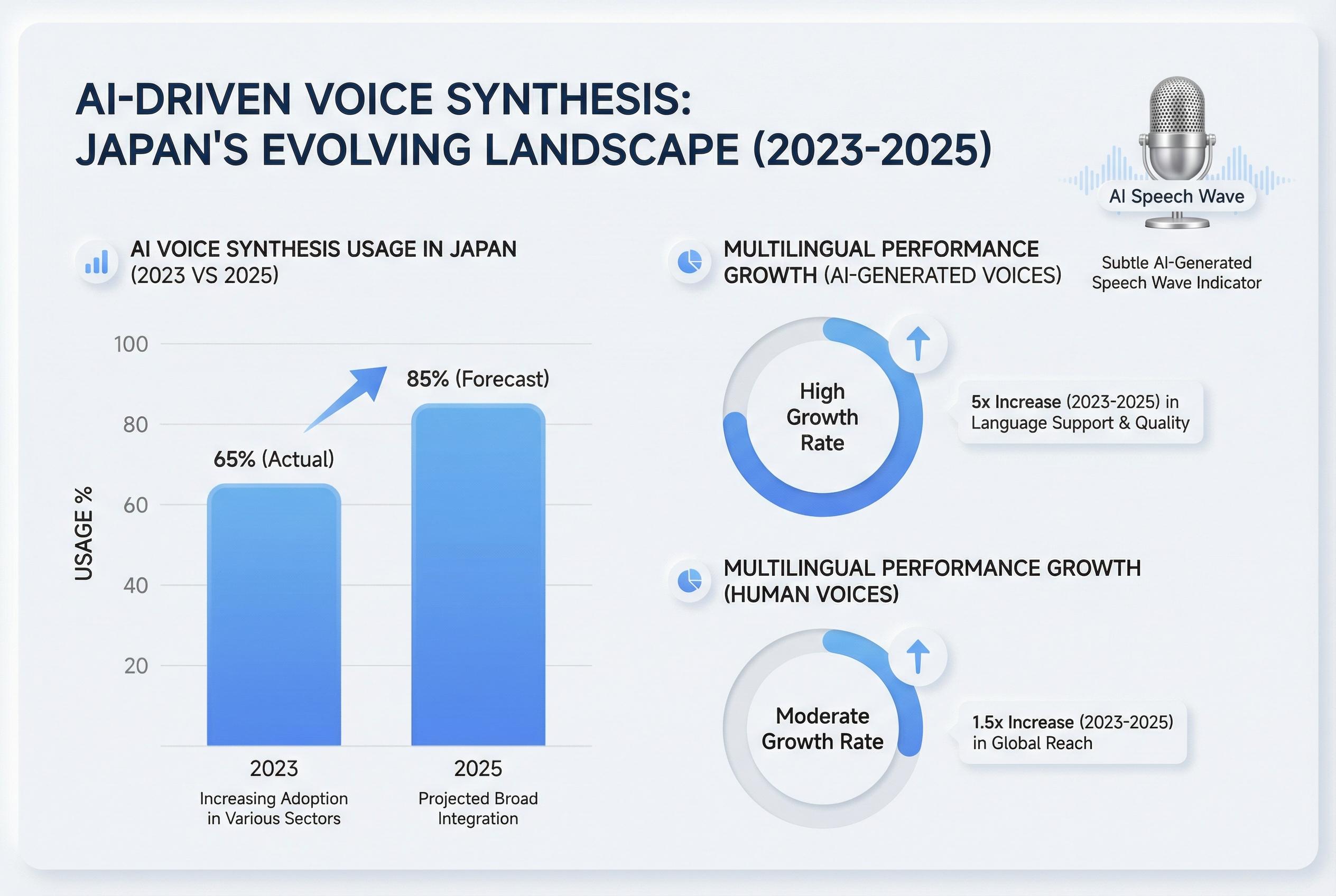
Artificial intelligence is reshaping how Japanese performances travel across the globe by allowing a single spoken line to be rendered in many languages while retaining the original performer’s vocal character. Industry groups and technology firms are racing to turn that capability into commercial opportunity while erecting technical and institutional safeguards to curb misuse.
A Tokyo association formed to address dubbing and voice protection demonstrated systems that can take a short Japanese utterance and produce versions in multiple languages that preserve timbre and inflection, a capability enabled by recent advances in speech synthesis. According to reporting on the initiative, the tools include embedded digital markers designed to trace where and how a voice file is used, creating a technical path for provenance and enforcement.
Corporate and union-led projects are seeking to operationalise those protections. A collaborative platform announced by major trading houses and performers’ organisations aims to serve as an authorised repository for actors’ voice data, requiring companies to obtain consent and pay fees for commercial uses. Backers say the database is intended to support international distribution of Japanese anime and other content while giving performers a clearer route to compensation.
The push responds to legal and economic gaps. Observers warn that existing Japanese copyright law does not recognise a voice per se as a protected work, enabling AI systems to be trained on public recordings and to generate similar-sounding voices with little legal friction. That reality, coupled with the prevalence of freelance contracts and modest average incomes among many performers, has heightened industry concern about lost revenue and unauthorised exploitation.
Technology providers have begun offering identity and consent mechanisms for professional voices. One company cited its programme with Japanese partners that issues authenticated voice IDs so actors can explicitly mark their voices as authorised for AI cloning, a measure intended to curb fraudulent or unconsented reproductions and to promote responsible use of synthesis tools.
Proponents emphasise that the same technologies expanding markets can also create socially beneficial applications beyond entertainment, from personalised in‑car guidance to audio tailored for older people with specific comprehension needs. At the same time, commentators and industry representatives stress that technical measures alone are unlikely to be sufficient to prevent harm without parallel legal reforms and active enforcement.
Voices are increasingly being treated as commercial assets that require layered protections: technical watermarking and ID systems, contractual frameworks for consent and payment, and, advocates say, statutory updates to clarify rights and remedies. The combined approach, industry figures contend, offers the best prospect of preserving performers’ creative value while allowing multilingual and AI‑enabled uses to flourish under clearer rules.
Source Reference Map
Inspired by headline at: [1]
Sources by paragraph:
- Paragraph 1: [6]
- Paragraph 2: [6]
- Paragraph 3: [2]
- Paragraph 4: [6]
- Paragraph 5: [3], [7]
- Paragraph 6: [5], [6]
- Paragraph 7: [2], [6]
Source: Noah Wire Services