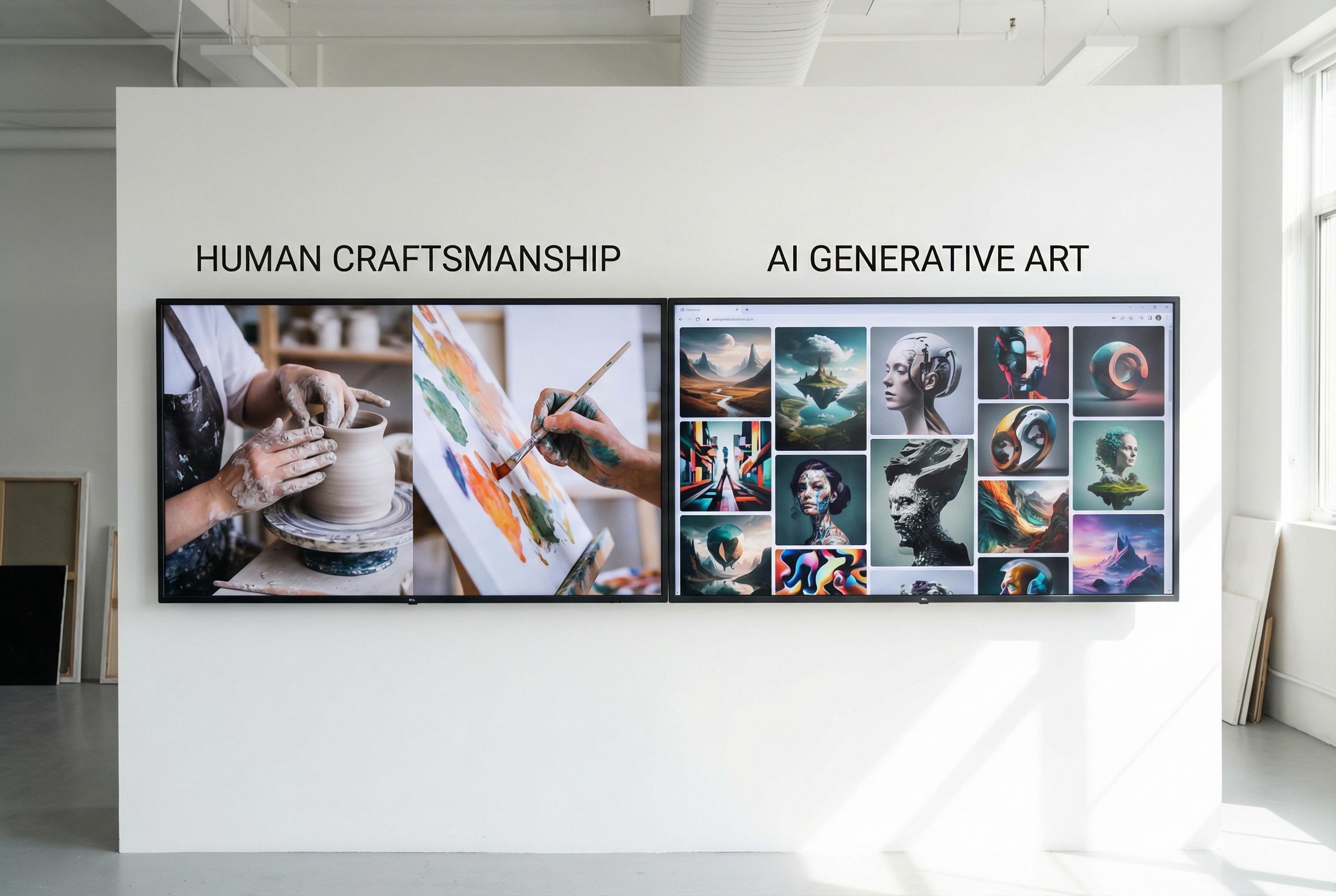
When Montreal-based filmmaker Ori Peer faced accusations that his 3D short had been produced with artificial intelligence, he responded not with legal threats or technical rebuttals but by inviting others to make visible the human labour behind image-making. According to the open call posted on xhbt.org, Peer asked artists to design short animated disclaimers declaring that their work was human-made; the responses turned into a sprawling public collage of more than a hundred contributions in every conceivable medium. [2],[3]
The site rapidly became a cabinet of creative fixes: some contributors painstakingly recreated the project’s original green-angel motif using felt, paint or stop-motion, while others abandoned that mascot altogether and offered wildly different emblems, 3D heads with propeller caps, winged frogs or hand-painted banners, each claiming space for the messy, idiosyncratic traces of manual craft. According to reports covering the project, many entries included making-of clips or time-lapse footage, emphasising process over polish. [2],[3]
Peer has framed the initiative as a defence of the “imperfect, human journey” of making art, arguing that generative models extract from living creators, worsen environmental costs and erode the pleasures and meanings of craft. Ori Magazine’s statement of editorial policy, which insists on disclosure and human authorship, echoes those concerns and situates the open-call within a broader push for transparency about AI’s role in creative industries. [2],[5]
Beyond its protest credentials, the gallery functions as a pedagogical archive. The visible seams, pixellations, brush marks, wobbling frame rates, become an instructional ledger that contrasts with the seamless, data-driven surfaces produced by many generative tools. Coverage of the project has highlighted how seeing artists reveal their methods inspired newcomers to pick up pencils or mice, turning individual rebuttals into a collective gesture. [3],[2]
The conversation around Peer’s campaign unfolds against a larger cultural moment in which entire films and virtual performers are being created with algorithmic systems. Technology outlets have explored shorts and features assembled from Midjourney-style stills and automated editing tools, and commentators point to early examples, like AI-authored screenplays and synthetic actors, to illustrate how quickly the line between human and machine authorship is shifting. Those discussions underline why some creators insist on visible provenance for their work. [4],[7]
Peer is currently developing an animated feature titled 40k Daddy, and he says the open-source gallery has fed his own imagination; a young filmmaker’s message from the UK, reporting renewed motivation after seeing the project, is one of several anecdotes Peer shares to show its ripple effects. Organisers and participants frame the effort not as a culture-war fulmination but as a practical reclaiming of creative agency: if institutions will not vouch for human craft, creators will provide their own certification. [2],[3]
The initiative is both a grassroots answer to suspicion and a statement about what many in the creative community value when they make work: contingency, error and embodied labour. As debates about AI-generated media accelerate, projects that foreground process and require artists to show how things were made may become a common way to certify human involvement even as algorithmic tools proliferate. [2],[6]
Source Reference Map
Inspired by headline at: [1]
Sources by paragraph:
- Paragraph 1: [2], [3]
- Paragraph 2: [2], [3]
- Paragraph 3: [2], [5]
- Paragraph 4: [3], [2]
- Paragraph 5: [4], [7]
- Paragraph 6: [2], [3]
- Paragraph 7: [2], [6]
Source: Noah Wire Services