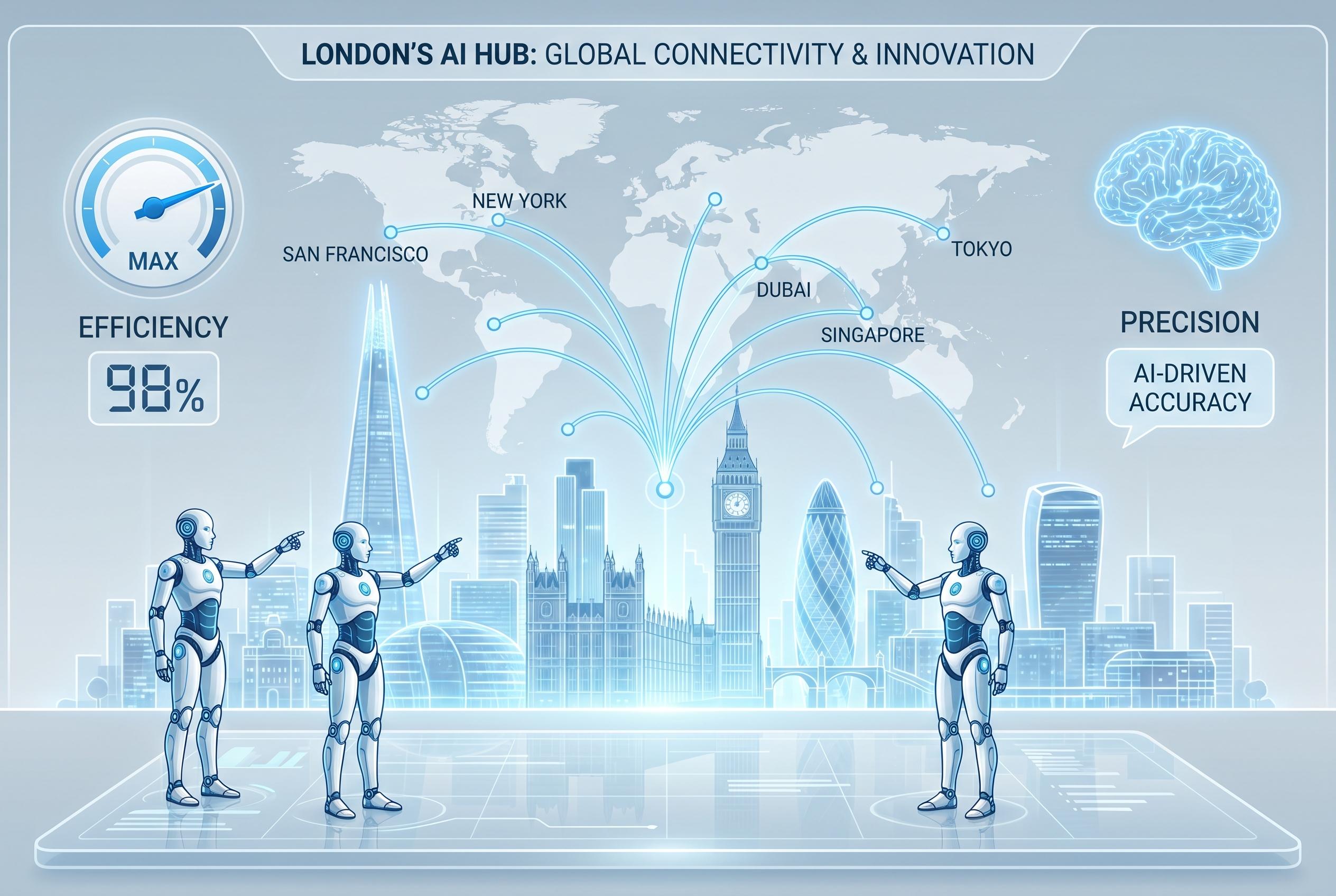
London’s advertising agencies are entering 2026 with a different kind of advantage: not simply sharper ideas, but sharper execution. What was once a market defined by creative prestige is increasingly being shaped by automation, predictive analysis and faster decision-making, as firms in the capital use AI to compete with larger rivals in New York, Singapore and beyond.
A key change is the move from basic generative tools to agentic AI. The UK government’s March 2026 report on agentic AI says these systems can interpret large volumes of data and make real-time decisions across time zones with less human intervention, reducing the cognitive load on marketing teams. That shift is helping smaller London agencies run international campaigns with a level of precision that would once have required the scale of a multinational network. Forbes has separately described the same evolution as a broader business trend, with AI agents increasingly designed to act more autonomously rather than simply produce content on command.
London’s long-standing strength in cultural fluency is also being turned into a digital asset. Agencies are using machine learning not just to localise campaigns, but to transcreate them, adjusting tone, imagery and emotional cues so that a message feels native in markets as different as Tokyo and São Paulo. In practice, that means a campaign can be adapted for different regions in hours rather than days, giving UK firms a speed advantage that can be crucial when consumer behaviour and online conversations move quickly.
The technical edge is extending to search as well. With Google’s ranking systems now placing greater value on original insight, agencies are leaning on predictive analytics to identify emerging topics before they generate significant search volume. The idea is to answer questions people are starting to think about, not just the ones they have already typed into a search bar. That approach turns content strategy into a race for attention before competitors have even recognised the trend.
Skills remain a critical part of the picture. Recent warnings from the Chartered Institute of Marketing about the AI literacy gap point to a wider challenge for the industry, while UKRI’s new AI strategy, launched in February 2026, signalled a major national push into areas where Britain could lead globally, including agentic AI. Against that backdrop, London’s advantage lies in its mix of creative talent, data expertise and proximity to universities and tech employers. The result is a workforce that can pair storytelling with prompt design, analytics and workflow automation.
At the same time, AI is changing what agencies choose to keep human. Routine work such as reporting, sorting data and technical audits is increasingly handed to machines, leaving strategists and creatives to focus on judgment, emotional resonance and brand voice. That hybrid model reflects a wider adjustment across the sector. According to JPMorgan, agencies now have to prove they can offer something beyond what the big platforms automate themselves, while The Guardian has reported on staff cuts and anxiety across UK advertising as AI reshapes roles and budgets. In that sense, London’s new edge is not just technological. It is the ability to combine machine speed with human interpretation, and to do so at global scale.
Source Reference Map
Inspired by headline at: [1]
Sources by paragraph:
- Paragraph 1: [2], [6]
- Paragraph 2: [2], [3]
- Paragraph 3: [2], [3]
- Paragraph 4: [6]
- Paragraph 5: [4], [5], [7]
- Paragraph 6: [4], [6]
Source: Noah Wire Services