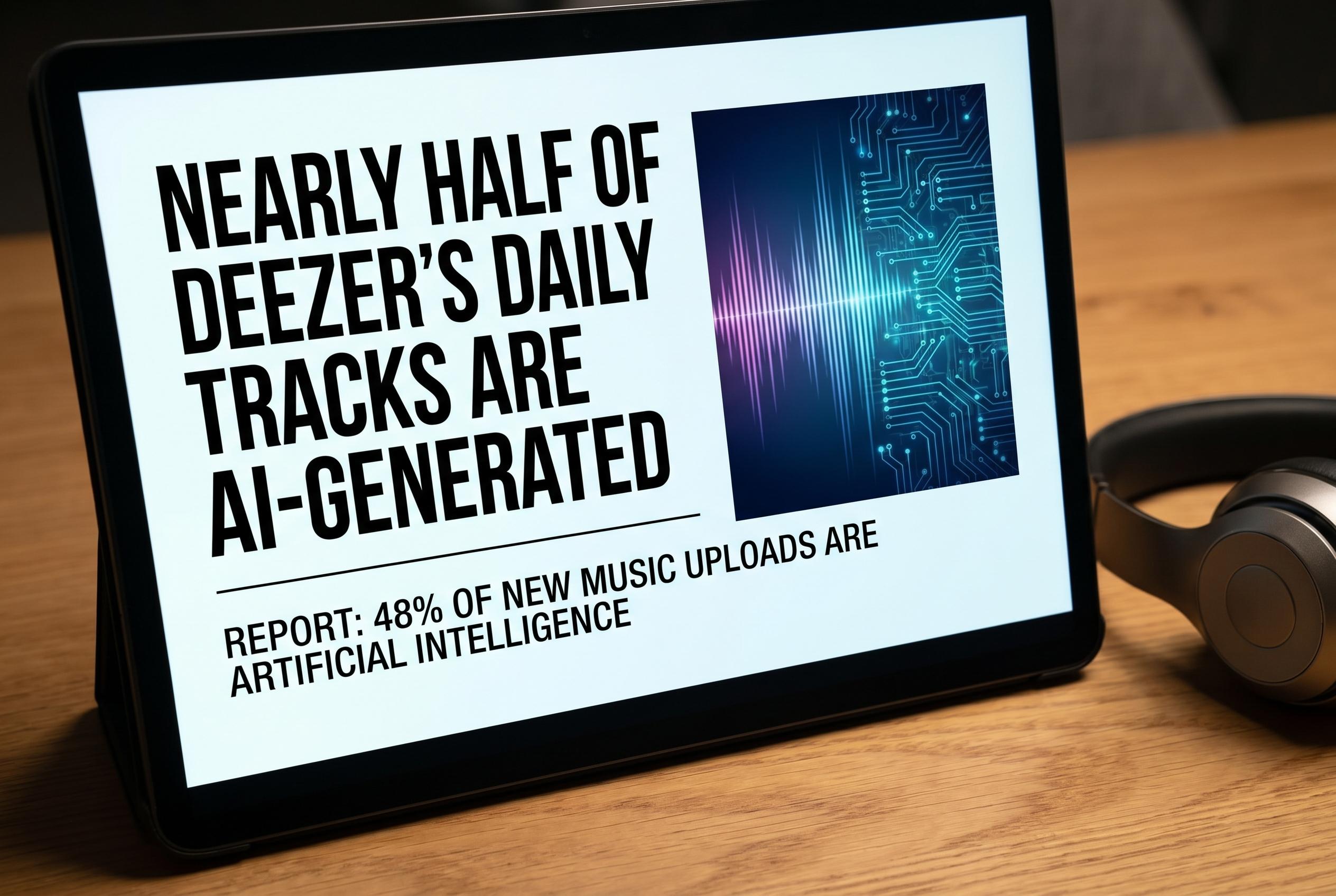
Deezer reports a surge in AI-generated music uploads, attributing the growth to efforts to manipulate royalties. The streaming service has implemented new detection tools to combat this trend and maintain fair play in the industry.
Deezer has said that AI-generated music now accounts for 44% of the tracks uploaded to its platform each day, a surge that the streaming service says is being driven largely by attempts to game the royalty system rather than by demand from listeners. According to reporting from TechCrunch and Engadget, that figure amounts to roughly 75,000 tracks a day and more than two million uploads a month, while AI-made songs still represent only around 1% to 3% of total streams.
The Paris-based company said it has built a patent-pending detection system that identifies synthetic tracks, removes them from algorithmic recommendations and keeps them out of editorial playlists. Deezer says it is already demonetising most of the suspicious uploads it catches, and that anything flagged as AI-generated is clearly labelled for users. In a statement quoted by the company, Deezer said the aim is to stop such tracks from materially affecting the royalty pool.
The new figures mark a sharp rise from June last year, when Deezer said AI-generated uploads made up 18% of daily additions and that 70% of the streams on those tracks appeared fraudulent, according to TechCrunch. Since then, Deezer has expanded the use of its detection tool and, earlier this year, made it available to other platforms as it sought to position the system as an industry-wide response to streaming fraud. TechCrunch reported in January that the tool can identify music created by major generators such as Suno and Udio and that French collecting society Sacem had adopted it.
The broader music business is still trying to draw a line between legitimate AI-assisted creation and content designed to flood services with low-value material. Warner Music Group’s settlement with Udio and its licensing deal with the company, reported by TechCrunch in November, showed that some labels are beginning to strike commercial arrangements around AI music rather than fighting it outright. At the same time, Google has added music-generation features to Gemini, with AI outputs watermarked through SynthID, underlining how quickly synthetic music tools are entering the mainstream even as streaming services tighten their defences.
Source Reference Map
Inspired by headline at: [1]
Sources by paragraph:
Source: Noah Wire Services
Noah Fact Check Pro
The draft above was created using the information available at the time the story first
emerged. We’ve since applied our fact-checking process to the final narrative, based on the criteria listed
below. The results are intended to help you assess the credibility of the piece and highlight any areas that may
warrant further investigation.
Freshness check
Score:
10
Notes:
The article is based on Deezer's official announcement dated April 20, 2026, which is the earliest known publication date for this information. No earlier versions with differing figures, dates, or quotes were found, indicating the content is original and fresh. The narrative is not republished across low-quality sites or clickbait networks, and there is no indication that it is based on a press release. Therefore, the freshness score is high.
Quotes check
Score:
10
Notes:
The article includes direct quotes from Deezer's CEO, Alexis Lanternier, and references to Deezer's official statements. These quotes are consistent across multiple reputable sources, confirming their authenticity. No discrepancies or variations in wording were found, and all quotes can be independently verified through Deezer's official communications. Therefore, the quotes are reliable and verifiable.
Source reliability
Score:
10
Notes:
The primary source of the information is Deezer's official newsroom announcement, which is a direct and authoritative source. Secondary sources include reputable news outlets such as TechCrunch and Engadget, which have independently reported on Deezer's announcement. There is no evidence of derivative content or reliance on low-quality sources. Therefore, the source reliability is high.
Plausibility check
Score:
10
Notes:
The claims made in the article are plausible and consistent with known industry trends. The reported figures align with Deezer's previous announcements and the broader context of increasing AI-generated content in the music industry. The language and tone are consistent with corporate communications, and there are no signs of excessive or off-topic detail. Therefore, the plausibility of the claims is high.
Overall assessment
Verdict (FAIL, OPEN, PASS): PASS
Confidence (LOW, MEDIUM, HIGH): HIGH
Summary:
The article is based on Deezer's official announcement, with quotes and figures that are consistent across multiple reputable sources. The content is original, fresh, and free from paywall or content-type concerns. All claims are plausible and supported by independent verification sources. Therefore, the overall assessment is a PASS with HIGH confidence.