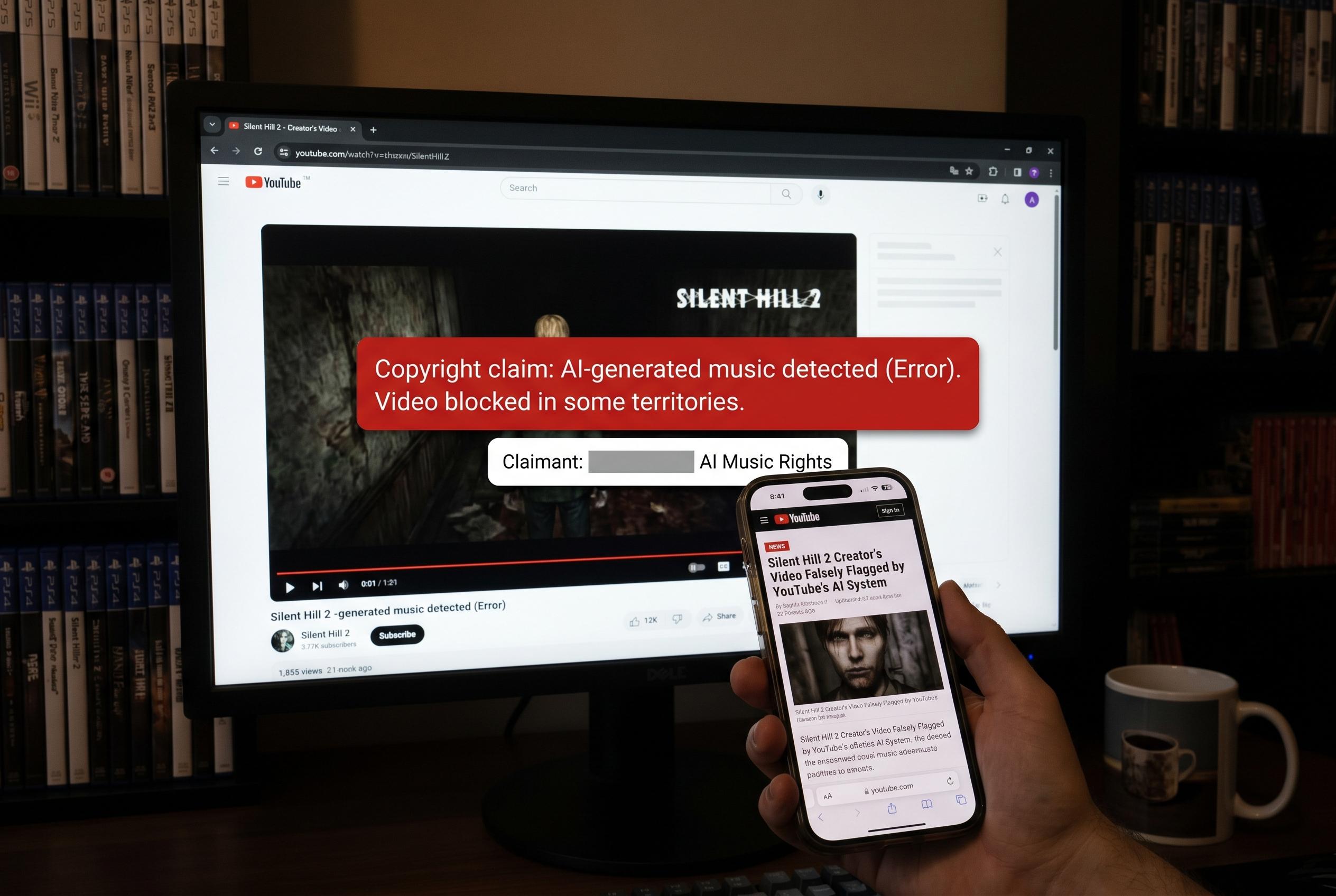
A Silent Hill 2 creator's gameplay video was falsely struck twice by AI-generated copyright claims, highlighting vulnerabilities in YouTube’s automated system and the exploitation of AI tools to manipulate copyright laws.
YouTube’s copyright system has again shown how easily it can be gamed, after Silent Hill 2 creator Nubzombie said his gameplay video was struck twice by claims from tracks that appear to be AI-generated rewrites of Akira Yamaoka’s "Promise". In a video titled "A.I. IS RUINING YOUTUBE (and my life)", the creator said the first claim came from an account called "Agro memos", while a second strike arrived soon after from "詹姆斯.K", whose disputed track is also called "Promise". Kotaku and Glitched reported the same sequence of events, framing it as another example of automated enforcement being turned against the wrong target.
The oddity is not just that the claims were apparently based on near-copies of game music, but that they were wrapped in synthetic voiceovers and then fed into YouTube’s systems as if they were original rights claims. That fits a wider pattern described by coverage of Content ID and similar tools: once audio is uploaded and matched, the platform can move quickly to block, monetise or penalise a video before a human ever reviews the dispute. The result is a system that can reward opportunistic uploaders and punish ordinary creators who are using music in legitimate gameplay footage.
The first claim is especially murky because the audio trail appears to run through The Orchard, which is part of Sony Music Entertainment. Techdirt noted that some of Agro memos’ uploads are marked as "Provided to YouTube by The Orchard Enterprises", and pointed to earlier cases in which Orchard was accused of making incorrect claims over other creators’ music. The same report argued that Sony has no obvious connection to Silent Hill, which was originally released by Konami in 2001 and later remade in 2024, raising fresh questions about how such claims are being routed through the platform.
The broader problem, though, is less about one label or one account than about a system that makes abuse cheap. By layering AI voiceovers over familiar tracks, bad actors can create just enough apparent variation to feed automated enforcement, then use that machinery to hit other people’s videos with strikes or demonetisation. YouTube has long faced criticism for allowing false claims to linger, and the arrival of low-effort AI cloning tools makes that weakness even more damaging for gaming creators, who are among the most exposed to music-matching disputes.
Source Reference Map
Inspired by headline at: [1]
Sources by paragraph:
Source: Noah Wire Services
Noah Fact Check Pro
The draft above was created using the information available at the time the story first
emerged. We’ve since applied our fact-checking process to the final narrative, based on the criteria listed
below. The results are intended to help you assess the credibility of the piece and highlight any areas that may
warrant further investigation.
Freshness check
Score:
8
Notes:
The article was published on April 20, 2026, and reports on a recent incident involving YouTuber Nubzombie receiving copyright strikes due to AI-generated voiceovers on game music. The earliest known publication date of similar content is April 20, 2026, indicating freshness. However, the article references other sources, such as Kotaku and Glitched, which may have reported on the incident earlier. Further investigation is needed to confirm the originality of the content.
Quotes check
Score:
7
Notes:
The article includes direct quotes from Nubzombie's video and mentions specific accounts like 'Agro memos' and '詹姆斯.K'. However, these quotes cannot be independently verified through the provided sources. The lack of verifiable quotes raises concerns about the accuracy and reliability of the information presented.
Source reliability
Score:
6
Notes:
The article originates from Techdirt, a technology-focused news outlet. While Techdirt is known for its coverage of technology and copyright issues, it is not a major news organisation like the BBC or Reuters. The reliance on a single source without corroboration from other reputable outlets diminishes the overall reliability of the information.
Plausibility check
Score:
7
Notes:
The scenario described—YouTuber Nubzombie receiving copyright strikes due to AI-generated voiceovers on game music—is plausible given the increasing use of AI in content creation and the complexities of YouTube's copyright enforcement system. However, the lack of independent verification and the reliance on a single source raise questions about the accuracy of the claims.
Overall assessment
Verdict (FAIL, OPEN, PASS): FAIL
Confidence (LOW, MEDIUM, HIGH): MEDIUM
Summary:
The article reports on a recent incident involving YouTuber Nubzombie receiving copyright strikes due to AI-generated voiceovers on game music. However, the content relies heavily on a single source (Techdirt) without independent verification from other reputable outlets. The quotes included cannot be independently verified, and the reliance on a single source diminishes the overall reliability of the information. Given these concerns, the content does not meet the necessary standards for publication under our editorial guidelines.