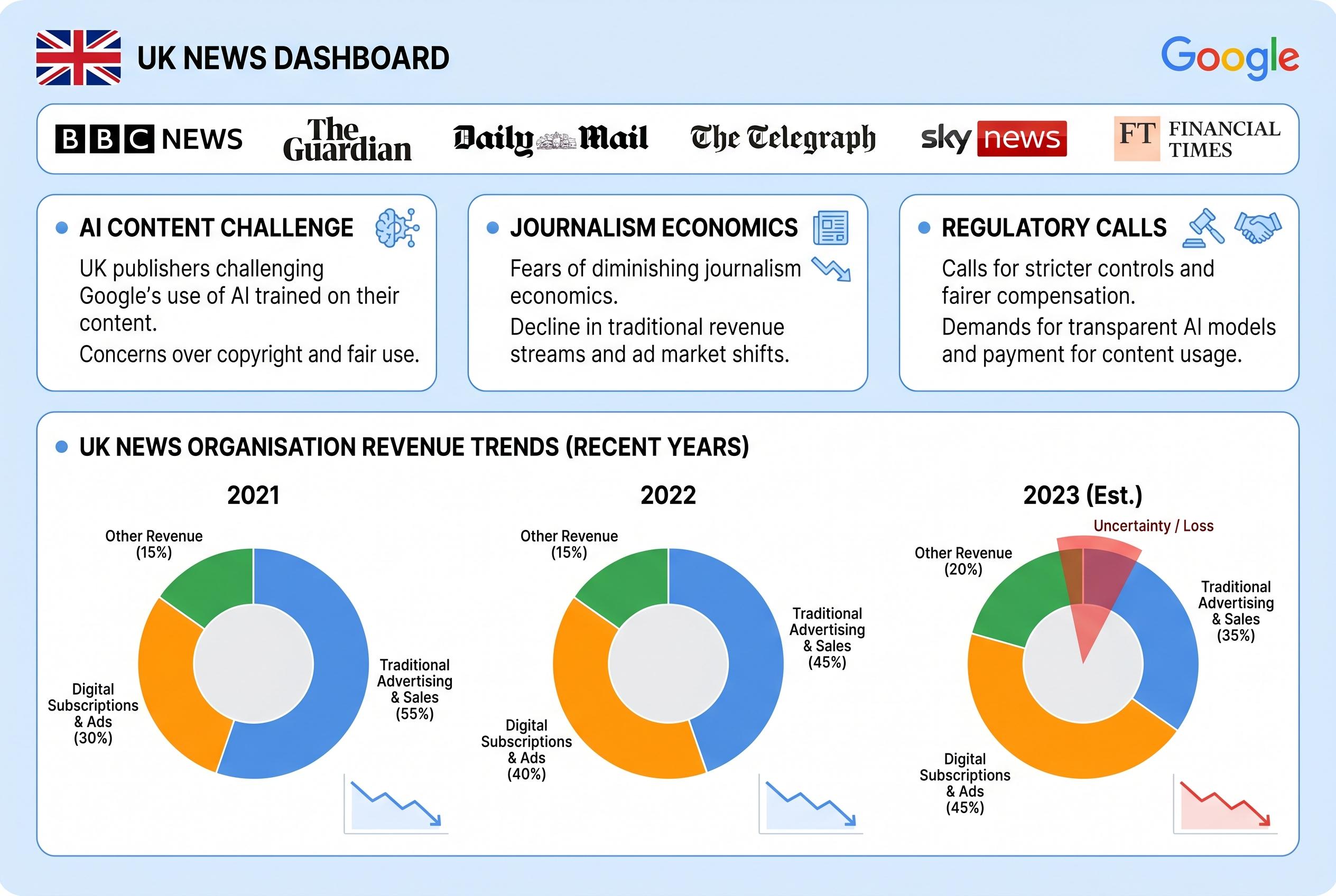
Google is facing renewed pressure from UK news publishers over the way it uses their journalism to train and refine its AI products, with media groups arguing that the company’s own submissions to the Competition and Markets Authority understate the commercial damage. The dispute forms part of the regulator’s wider consultation on conduct requirements for Google under the Digital Markets, Competition and Consumers Act 2024, a process intended to improve terms for publishers and increase transparency around search.
At the centre of the row is Google’s claim that there is “no realistic prospect of harm” to publishers from training and fine-tuning its AI models on their content. News organisations disagree. Guardian Media Group told the CMA that the use of publisher material at every stage of model development shows its value, but also reinforces the risk that AI outputs could become substitutes for the original reporting. The Guardian also warned that more frequent fine-tuning could make models more current and, in turn, weaken emerging markets for retrieval-based licensing deals.
Other publishers say Google should not be allowed to bundle different forms of content use together. DMG Media, which publishes the Daily Mail, Metro and The i Paper, argued that separate crawlers and separate opt-out settings are needed for training, retrieval-augmented generation and fine-tuning. The Financial Times made a similar case for granular controls at both directory and page level, while the News Media Association said weak controls could encourage Google to rely on fine-tuning instead of grounding, reducing the need to negotiate with publishers over payment.
The CMA has said it is not currently minded to impose separate controls for fine-tuning, but that position has not satisfied publishers. The News/Media Alliance, a US trade group, said publishers should be able to opt out of fine-tuning altogether, warning that continuous updates based on journalistic content could make Google’s AI responses more complete while keeping users inside its own ecosystem. The group also argued that if Google values the content enough to improve text generation and ranking, then a fair exchange should follow.
Publishers are also pushing the regulator not to delay action on compensation. The CMA said in January that it would wait 12 months to assess the impact of its initial steps before deciding whether to go further on fair and reasonable terms for content. DMG Media and the News Media Association want that timetable accelerated, saying the imbalance in bargaining power between Google and news businesses is already harming the economics of journalism. The CMA has also proposed that Google should make AI Overviews and AI Mode more clearly attribute publisher content, but the NMA wants links that are prominent enough to drive readers back to the original source.
The publishers’ submissions also revisit Google’s site reputation abuse policy, introduced in 2024, which penalised some sites for hosting paid third-party content. DMG Media said the policy had wiped out a revenue stream overnight, while one anonymised publisher told the CMA it may be costing more than £1m a year. Publishers are now asking for stronger notice periods before ranking changes, clearer explanations of major algorithm updates, and a complaints mechanism with teeth rather than what they see as a slow and uncertain after-the-fact review.
Source Reference Map
Inspired by headline at: [1]
Sources by paragraph:
- Paragraph 1: [2], [3]
- Paragraph 2: [1]
- Paragraph 3: [1], [5]
- Paragraph 4: [1], [2], [4], [6], [7]
- Paragraph 5: [1], [3], [5]
Source: Noah Wire Services