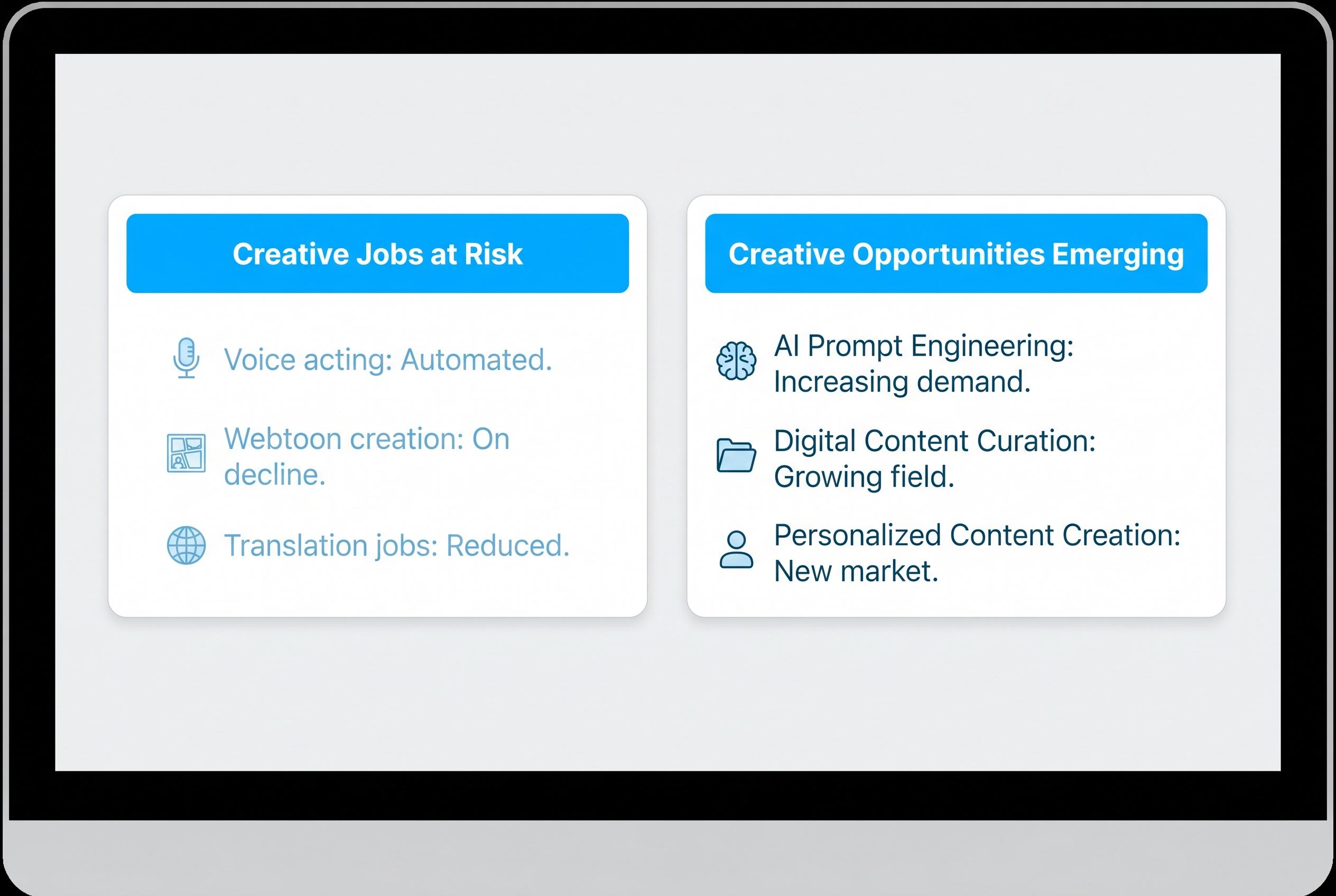
In South Korea’s voice studios, comic workshops and translation booths, artificial intelligence is no longer a distant prospect but a direct rival. The Korea Times reported that voice actors, webtoon creators and interpreters are already seeing work disappear or change shape as companies and public institutions turn to AI tools for faster, cheaper output, often without fresh consent from the people whose labour helped train those systems.
For voice actors, the shift has been especially abrupt. Choi Jae-ho, who heads the Korea Voice Performance Association, told The Korea Times that members’ income has fallen sharply as synthetic narration spreads through advertising, public relations clips and broadcast disclaimers. He said many contracts signed years ago gave companies broad rights to reuse recordings for future technologies, while some firms later collected voices in bulk to build Korean AI models. The association is now pushing for standard AI-era contracts and a new legal right over the commercial use of a person’s voice.
Webtoon artists face a different but related threat. The Korea Times said the recent attention around AI-generated series such as "Mongletoon" has sharpened anxieties over what counts as real authorship and how much of the market can be automated. Kwon Hyuk-joo, who leads the Korea Cartoonists’ Association, said demand for simple illustrations and promotional comics has fallen, hitting assistants hardest, while also raising alarm over scraped training data used without disclosure or payment. That concern has been echoed in earlier reporting on the webtoon sector, which showed a growing split between artists eager to use AI for efficiency and those worried about originality, reader backlash and weak rules around disclosure.
At the same time, some major companies are moving in the opposite direction. Korea JoongAng Daily reported in March 2025 that Naver Webtoon planned to fully integrate AI across its operations, arguing that the technology could improve productivity and the user experience. Industry debate has therefore shifted from whether AI will enter the sector to how it should be governed. A Statista survey of South Korean webtoon artists in October 2024 suggested opinion remains divided, underscoring that acceptance is far from universal. More recently, a Korea Cartoonists Association forum in March 2026 heard some creators praise generative AI for speeding production, while also stressing the need to document the creative process for copyright protection.
Interpreters and translators are under similar pressure. Huh Ji-un, who leads the Korean Association of Translators and Interpreters, told The Korea Times that the market is becoming more polarised, with top-tier professionals likely to survive but routine mid-level work increasingly vulnerable to automated captions, machine translation and post-editing. She also warned that public bodies and state agencies should not simply select the cheapest AI-enabled bidder for court, parliamentary or other official interpretation, because that could weaken access to justice while shrinking the pipeline of trained human interpreters. Across all three professions, the message is the same: Korea is pressing ahead with AI adoption, but the protections for workers whose voices, drawings and language skills feed those systems have yet to catch up.
Source Reference Map
Inspired by headline at: [1]
Sources by paragraph:
- Paragraph 1: [2]
- Paragraph 2: [1]
- Paragraph 3: [1], [3], [5]
- Paragraph 4: [4], [5], [6]
- Paragraph 5: [1], [2], [7]
Source: Noah Wire Services