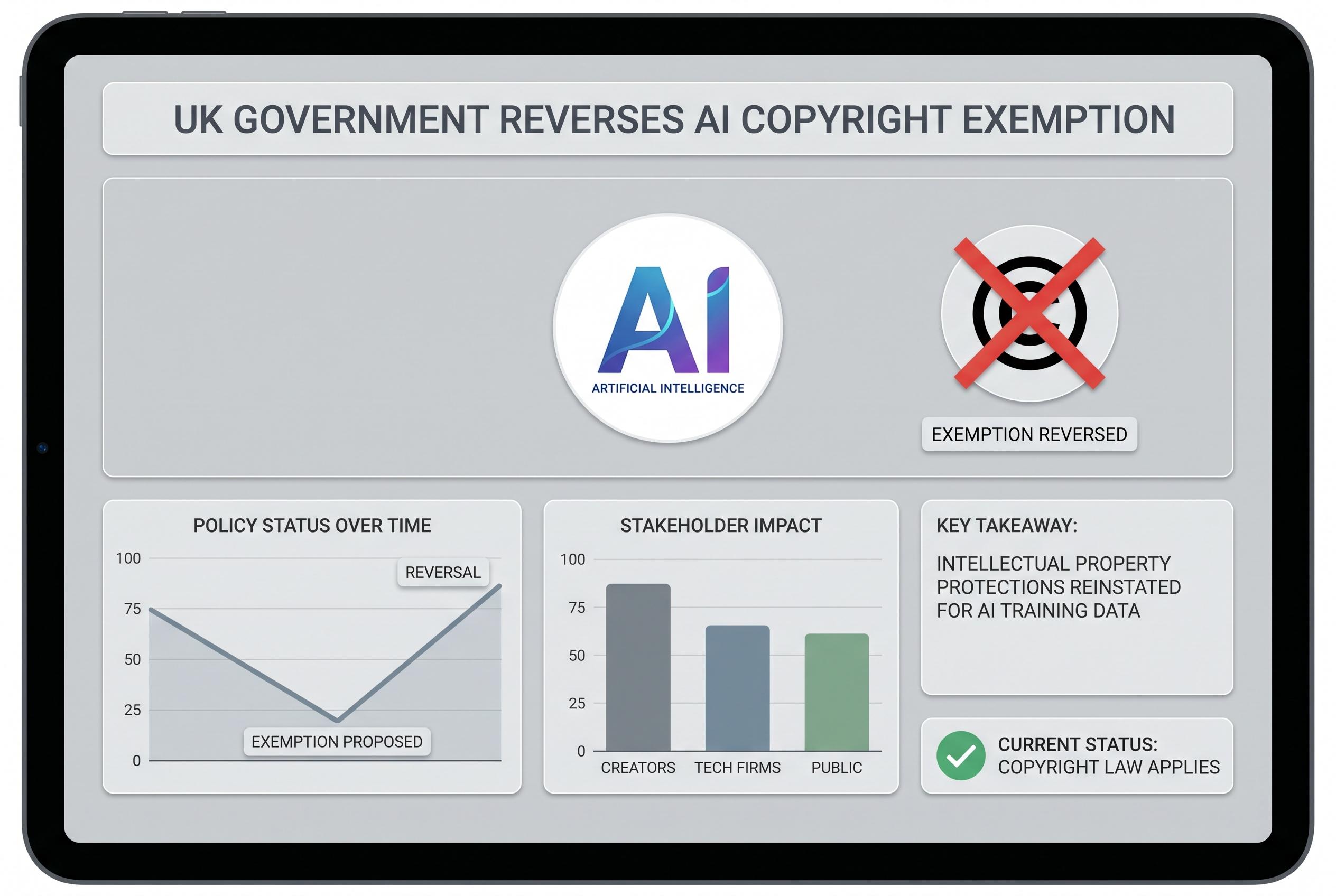
The UK government has reversed its plan to allow AI firms to train models on copyrighted material without creator consent, following strong opposition from the arts sector and a shift towards further consultation.
The UK government has retreated from a plan that would have allowed artificial intelligence firms to train models on copyrighted material unless creators explicitly opted out, a move welcomed by the creative sector as a major reprieve. Equity, the performers' and artists' union, said ministers had stepped back from a policy that it believed would have hit members' earnings and bargaining power.
According to government papers on copyright and artificial intelligence, ministers are now pursuing a wider consultation rather than forcing through the previously favoured approach. The consultation says policy must balance the interests of rights holders and AI developers, and the government has acknowledged that further analysis is needed before any change to copyright law is made.
The reversal followed sustained pressure from across the creative industries. Equity said the abandoned model would have amounted to allowing AI companies to use creative work without permission, while other industry groups and media reports described the proposal as deeply unpopular with actors, musicians and writers. Technology Secretary Liz Kendall has since said the government no longer has a preferred option, underscoring how far the policy has shifted since it was first presented earlier this year.
For the arts sector, the move removes an immediate threat, but not the wider dispute over how AI systems should be trained and who should be paid when creative work is used. The government has not ruled out further reform, and the current pause leaves the question unresolved as ministers search for a framework that can satisfy both a fast-growing technology industry and a cultural economy that depends on copyright protection.
Source Reference Map
Inspired by headline at: [1]
Sources by paragraph:
Source: Noah Wire Services
Noah Fact Check Pro
The draft above was created using the information available at the time the story first
emerged. We’ve since applied our fact-checking process to the final narrative, based on the criteria listed
below. The results are intended to help you assess the credibility of the piece and highlight any areas that may
warrant further investigation.
Freshness check
Score:
8
Notes:
The article reports on the UK government's recent decision to abandon its proposed AI copyright opt-out plan, a move announced on 18 March 2026. ([comparethecloud.net](https://www.comparethecloud.net/news/uk-government-unveils-copyright-and-ai-report-in-major-policy-reset?utm_source=openai)) The earliest known publication date of similar content is 18 March 2026, indicating the article is based on recent developments. However, the article's publication date is 24 April 2026, which is over a month later. This delay raises concerns about the timeliness of the information presented.
Quotes check
Score:
7
Notes:
The article includes direct quotes from Technology Secretary Liz Kendall, such as "We have listened." ([computing.co.uk](https://www.computing.co.uk/news/2026/government/government-retreats-on-ai-copyright-plan-after-criticism?utm_source=openai)) A search for the earliest known usage of this quote indicates it was first reported on 18 March 2026. ([computing.co.uk](https://www.computing.co.uk/news/2026/government/government-retreats-on-ai-copyright-plan-after-criticism?utm_source=openai)) The repetition of this quote across multiple sources suggests it may have been part of a press release or official statement. The lack of independent verification of these quotes raises concerns about their authenticity.
Source reliability
Score:
6
Notes:
The article originates from UKTN, a niche technology news publication. While it provides citations to other reputable sources, the reliance on a single, lesser-known publication for the lead narrative raises questions about the independence and reliability of the information presented.
Plausibility check
Score:
8
Notes:
The article's claims align with known events, such as the UK government's decision to pause its AI copyright reform plans. ([comparethecloud.net](https://www.comparethecloud.net/news/uk-government-unveils-copyright-and-ai-report-in-major-policy-reset?utm_source=openai)) However, the lack of new information or perspectives in the article suggests it may be summarizing existing reports without adding substantial value.
Overall assessment
Verdict (FAIL, OPEN, PASS): FAIL
Confidence (LOW, MEDIUM, HIGH): MEDIUM
Summary:
The article reports on the UK government's recent decision to abandon its proposed AI copyright opt-out plan. However, the significant delay between the event and the article's publication, reliance on a single, lesser-known source, and the lack of independent verification of key quotes and claims raise substantial concerns about the accuracy and reliability of the information presented. ([comparethecloud.net](https://www.comparethecloud.net/news/uk-government-unveils-copyright-and-ai-report-in-major-policy-reset?utm_source=openai))