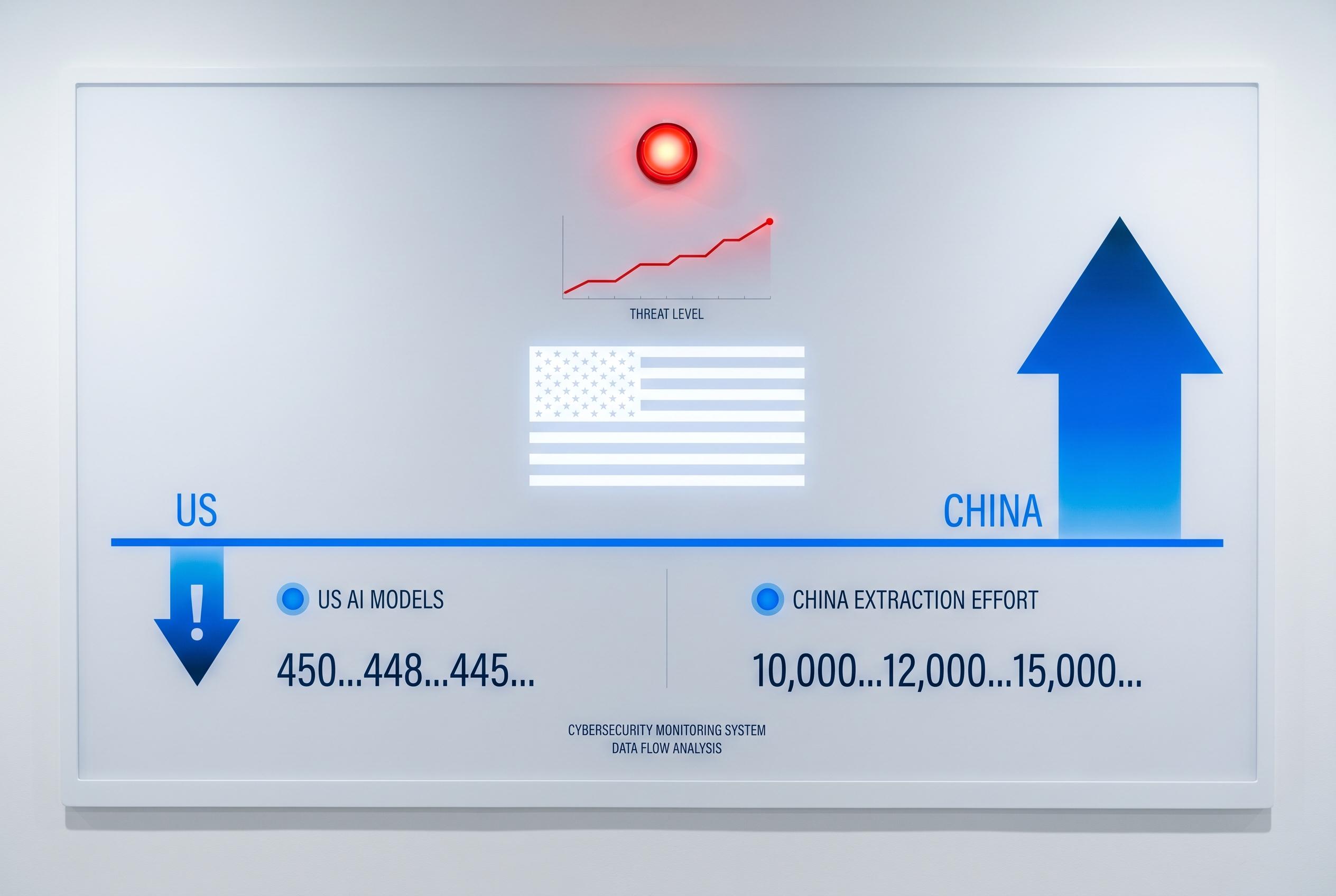
The White House is ramping up its response to what it considers a deliberate campaign by Chinese-linked AI firms to steal American frontier models through industrial-scale distillation efforts, prompting calls for regulatory and security measures.
The White House is preparing a tougher response to what it sees as a growing threat from Chinese-linked AI firms, with a memo circulated by Michael Kratsios warning that foreign entities are carrying out deliberate, industrial-scale efforts to distil American frontier models, according to the Financial Times and reporting picked up by AP. The administration is said to be working more closely with US AI companies to identify abuse and coordinate countermeasures.
At issue is distillation, a technique that lets a smaller model learn from the outputs of a larger one. In legitimate settings, it can make AI systems cheaper and faster to run. But US officials now argue that the method is being used at scale to extract the capabilities of leading American models and repackage them for rivals, a concern that the White House says may warrant penalties, according to AP and Nextgov.
The warning follows months of escalating claims from American AI companies. Anthropic has already accused DeepSeek, Moonshot AI and MiniMax of running what it described as industrial-scale distillation attacks on Claude, alleging the use of more than 24,000 fake accounts and millions of exchanges to train competing systems, according to TechCrunch and Euronews. In a separate account cited by the Financial Times, Anthropic also said the companies had targeted Claude’s most advanced features, including reasoning, tool use and coding.
China’s embassy in Washington has rejected the allegations, calling them "pure slander" and insisting that China protects intellectual property, according to the reports. The dispute comes amid a broader US-China contest over AI, with AP noting that the performance gap between the two countries is narrowing and that lawmakers are already considering measures to identify and punish foreign actors accused of harvesting closed-source model features. Researchers and industry figures, however, have also cautioned that distinguishing unauthorised extraction from ordinary model use is often difficult, even as pressure builds for tighter coordination between labs and the federal government.
Source Reference Map
Inspired by headline at: [1]
Sources by paragraph:
Source: Noah Wire Services
Noah Fact Check Pro
The draft above was created using the information available at the time the story first
emerged. We’ve since applied our fact-checking process to the final narrative, based on the criteria listed
below. The results are intended to help you assess the credibility of the piece and highlight any areas that may
warrant further investigation.
Freshness check
Score:
10
Notes:
The article reports on a memo issued by Michael Kratsios, Director of the White House Office of Science and Technology Policy, dated April 23, 2026, accusing China of engaging in industrial-scale campaigns to distill U.S. frontier AI systems. This is the earliest known publication date for this specific content, indicating high freshness. ([washingtonpost.com](https://www.washingtonpost.com/business/2026/04/23/ai-china-us-model-distillation-kratsios/29bfbf2e-3f65-11f1-bb46-ed564688d953_story.html?utm_source=openai))
Quotes check
Score:
9
Notes:
The article includes direct quotes from Michael Kratsios, such as: "Leveraging tens of thousands of proxy accounts to evade detection and using jailbreaking techniques to expose proprietary information, these coordinated campaigns systematically extract capabilities from American AI models, exploiting American expertise and innovation." These quotes are consistent with those found in other reputable sources, suggesting accuracy. ([washingtonpost.com](https://www.washingtonpost.com/business/2026/04/23/ai-china-us-model-distillation-kratsios/29bfbf2e-3f65-11f1-bb46-ed564688d953_story.html?utm_source=openai))
Source reliability
Score:
8
Notes:
The article is sourced from PC Gamer, a reputable publication known for its coverage of technology and gaming. However, it is not a major news organisation like the Financial Times or Reuters, which slightly reduces the reliability score. Additionally, the article references multiple reputable sources, including the Associated Press and Nextgov, enhancing its credibility. ([washingtonpost.com](https://www.washingtonpost.com/business/2026/04/23/ai-china-us-model-distillation-kratsios/29bfbf2e-3f65-11f1-bb46-ed564688d953_story.html?utm_source=openai))
Plausibility check
Score:
9
Notes:
The claims made in the article align with reports from other reputable sources, such as the Associated Press and Nextgov, which also report on the White House's accusations against China regarding AI technology theft. The use of specific details, such as the involvement of tens of thousands of proxy accounts and jailbreaking techniques, adds credibility to the claims. ([washingtonpost.com](https://www.washingtonpost.com/business/2026/04/23/ai-china-us-model-distillation-kratsios/29bfbf2e-3f65-11f1-bb46-ed564688d953_story.html?utm_source=openai))
Overall assessment
Verdict (FAIL, OPEN, PASS): PASS
Confidence (LOW, MEDIUM, HIGH): HIGH
Summary:
The article provides a timely and accurate report on the White House's accusations against China regarding industrial-scale AI technology theft. The information is consistent with reports from other reputable sources, and the article is freely accessible without paywall concerns. The content is factual and supported by independent verification sources, leading to a high confidence in its accuracy.