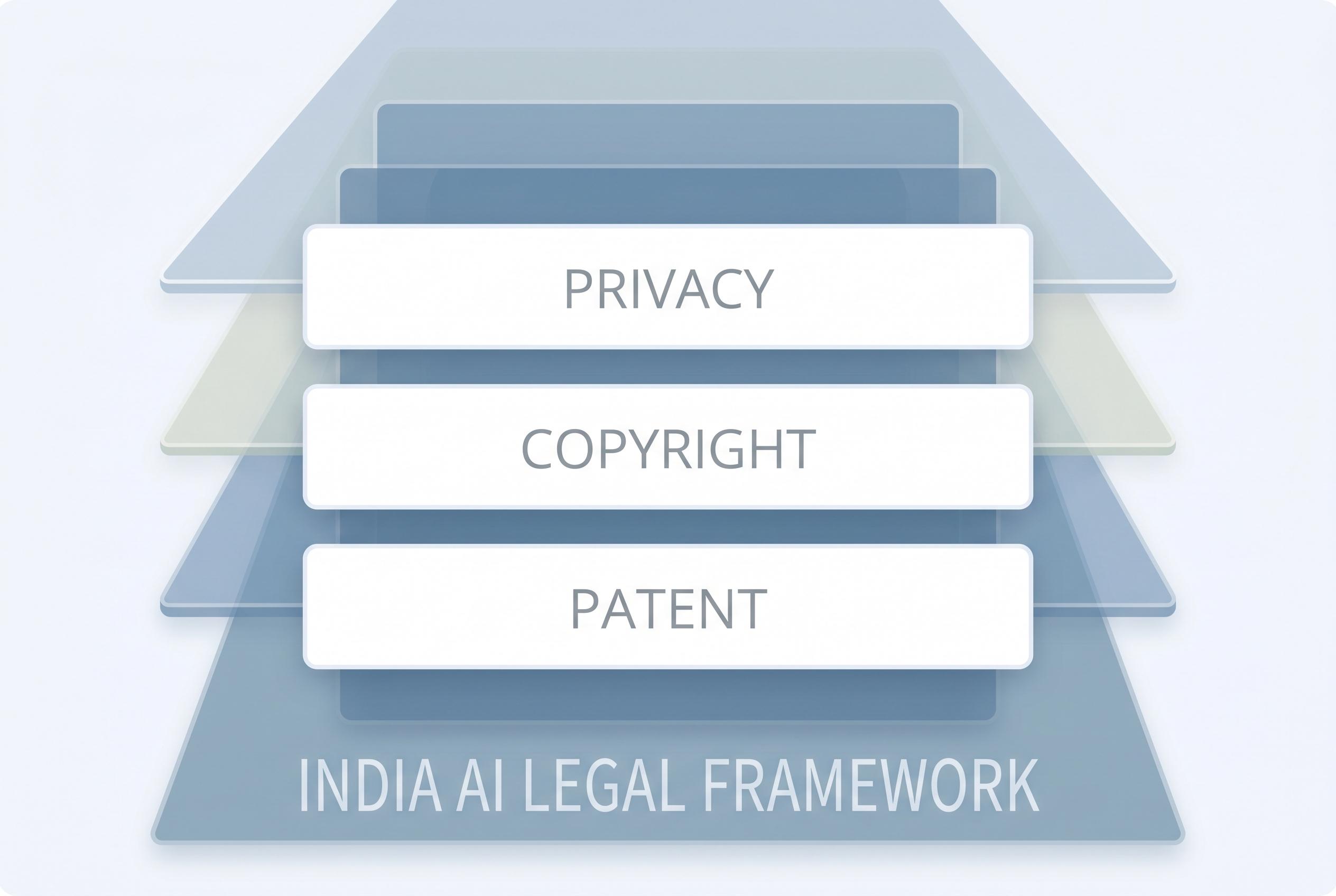
India’s approach to artificial intelligence is best understood as a three-part legal test, not a single regime. Intellectual property, privacy and patent law each bite at a different stage of the AI stack, and complying with one does not neutralise the others. For developers and investors building or deploying AI products in India, that distinction matters because the same model can raise separate issues over training data, personal data and the inventiveness of the system itself.
At the privacy level, the Digital Personal Data Protection Act 2023 gives India its first broad digital data protection framework. The law turns on familiar roles: a Data Fiduciary decides why and how personal data is processed, while a Data Principal is the person the data is about. Its reach is not limited to firms located in India; it can also apply to overseas businesses offering goods or services to people in India. The Act is intended to balance lawful processing with individual rights, and its obligations on notices, consent, security and breach handling form the privacy baseline for AI companies.
Copyright law creates a different set of constraints. The Copyright Act 1957 protects the reproduction of expression, and in India that can extend to storing works electronically during training. There is no clear text-and-data-mining exception for AI training, which leaves a live question over whether scraping, copying or caching protected material for model development infringes. That uncertainty is especially relevant because a dataset may be lawful under privacy law and still be problematic under copyright law.
The overlap becomes most visible in training corpora that contain personal data. According to the existing Indian framework, personal information scraped from public sources does not automatically fall outside the privacy statute simply because it is online. The law makes a narrow exception for material made public by the individual concerned, or by someone under a legal duty to publish it. That leaves commercial AI training on broad web-scale datasets in a difficult position, particularly where the corpus includes names, images, voices or other identifiable attributes.
Policy discussion in India is moving, but not yet into binding law. The Department for Promotion of Industry and Internal Trade released a working paper in December 2025 proposing a mandatory collective-licensing model for generative AI training, described as a “One Nation, One Licence, One Payment” framework. The idea would require commercial developers to pay for access to copyrighted material through a central mechanism. But the paper remains a consultation document, and the later response from the Esya Centre argued that the proposal may not solve the practical tensions between creators, platforms and innovators. Business Standard has also reported that a second paper on AI-generated content is expected, suggesting the policy conversation is still evolving.
Patent law sits alongside those debates but answers a separate question: whether the model or method itself can be patented. India’s Patents Act 1970 excludes a mathematical method, business method or computer program per se, yet the courts have accepted that AI-related inventions may qualify if they show a technical effect or technical contribution. The result is a narrow path for AI patents, but not a closed one. By contrast, Indian law still assumes a human inventor, which means fully autonomous AI systems do not fit neatly within the present filing framework.
For practitioners, the practical lesson is that an AI product must be reviewed on three tracks at once. The dataset may need privacy analysis, copyright clearance and data-minimisation controls. The model architecture may raise patentability questions. The output may create fresh exposure if it reproduces protected expression or reveals personal data. India’s law is therefore not a single AI code, but an interlocking set of rules that will shape how products are trained, deployed and commercialised.
Source Reference Map
Inspired by headline at: [1]
Sources by paragraph:
- Paragraph 1: [2], [3]
- Paragraph 2: [2], [3]
- Paragraph 3: [1], [4]
- Paragraph 4: [1], [3]
- Paragraph 5: [4], [5], [7]
- Paragraph 6: [1], [2], [3]
- Paragraph 7: [1], [3]
Source: Noah Wire Services