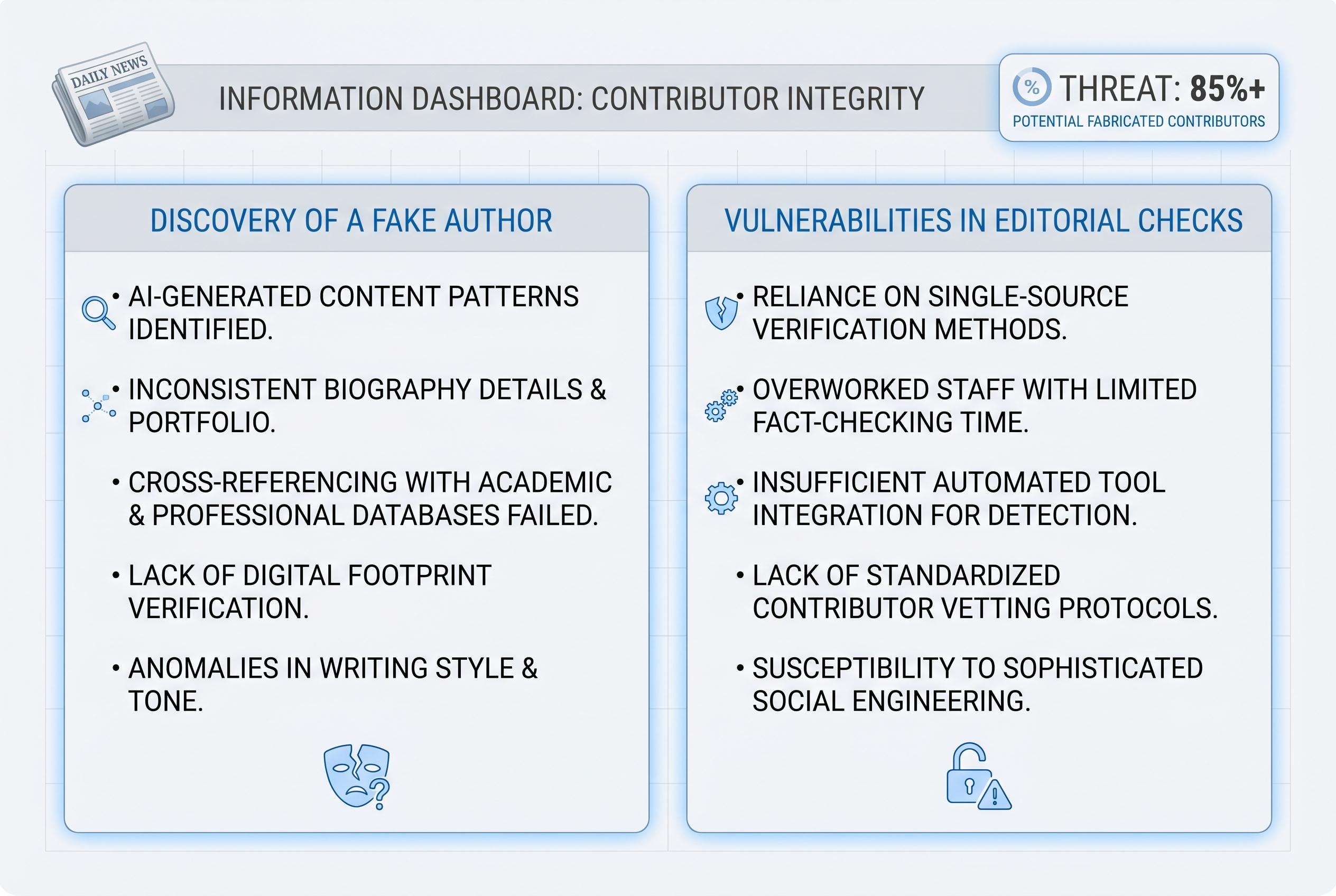
The Mississippi Free Press has admitted that it unknowingly published an AI-generated opinion piece written under a fictitious name, exposing how easily synthetic content can slip through even at a local newsroom with editorial oversight. Assistant editor Kevin Edwards, who also oversees the site’s Voices section, said he only became suspicious after an invoice arrived from someone whose name did not match the byline, prompting a closer investigation.
That review, according to the publication’s editor’s note, found that the supposed author did not exist and that the headshot supplied with the column had also been created by AI. Edwards said the outlet has removed the article and is now looking at ways to tighten its scrutiny, while also acknowledging that automated detection tools are not dependable enough to solve the problem on their own.
The episode fits into a wider pattern that news organisations in the UK and US are increasingly confronting: AI-written material and fabricated contributors are slipping into publication before being caught. Recent reporting by Press Gazette and other industry outlets has documented a growing list of retractions and corrections involving fake bylines, including cases at larger publishers such as Wired, Business Insider and the Chicago Sun-Times.
What makes the Mississippi case notable is not only the use of AI, but the way the deception was uncovered. The appearance of a mismatched invoice revealed that the writer behind the column could not be verified, underscoring the importance of basic contributor checks before publication. In journalism, where freelancers and outside columnists are often part of the workflow, that kind of vetting can be resource-intensive, but the alternative is that a fake identity can evade accountability altogether.
The broader challenge is especially acute for smaller newsrooms, which are already operating under the strain of reduced staffing and heavier workloads. The Mississippi Free Press said it had been backed into the problem despite doing what it could to respond quickly once the irregularities emerged. Its experience suggests that the danger is not limited to AI-assisted writing itself, but extends to the creation of entirely fabricated authors, a development that could do lasting damage to trust if publishers do not adapt their safeguards.
Source Reference Map
Inspired by headline at: [1]
Sources by paragraph:
- Paragraph 1: [2], [3]
- Paragraph 2: [2], [5]
- Paragraph 3: [4], [5]
- Paragraph 4: [2], [3]
- Paragraph 5: [1], [4]
Source: Noah Wire Services