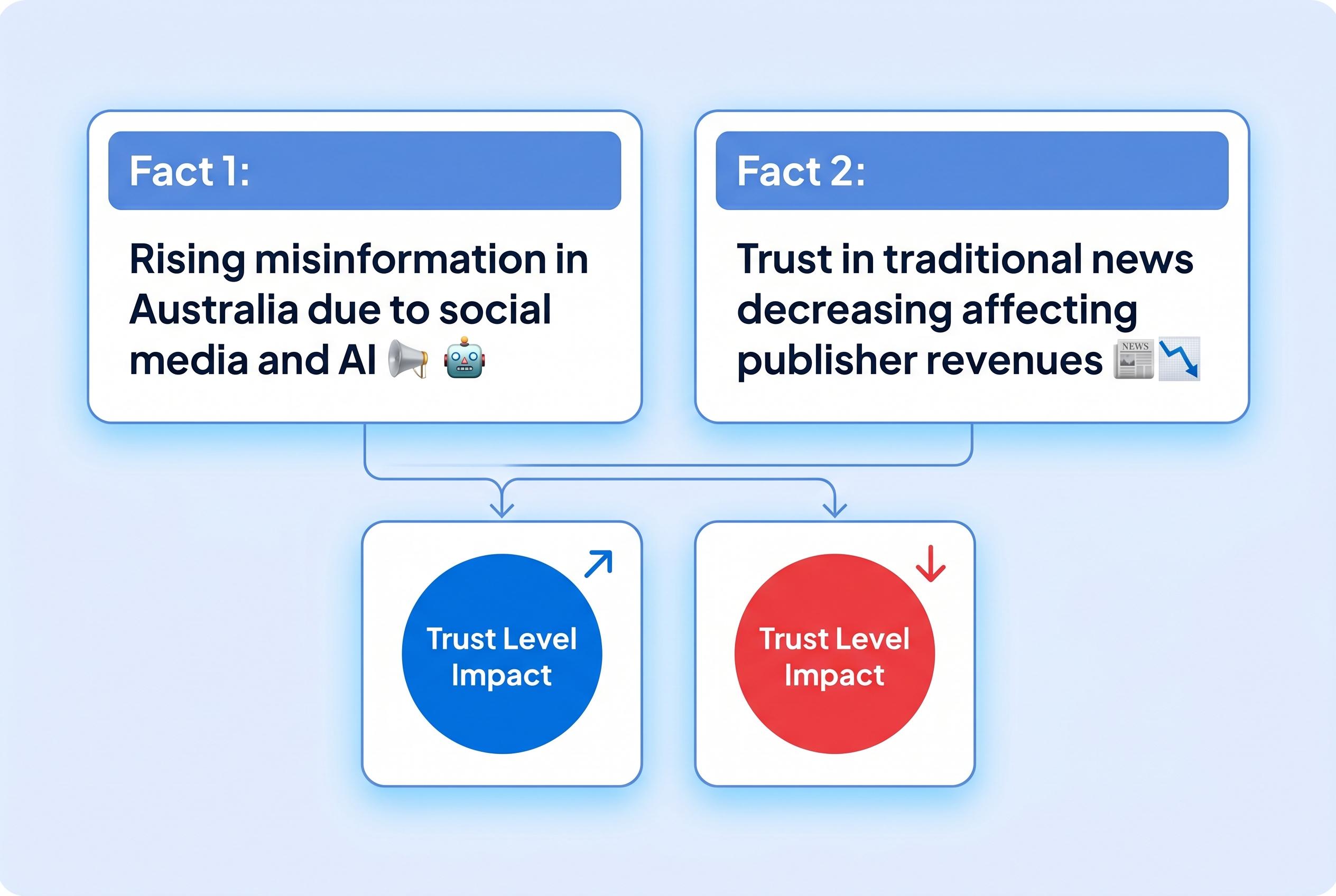
Australians face increasing exposure to low-quality content and AI-generated misinformation, eroding trust in traditional news and impacting publisher revenues, as calls grow for transparency and media literacy improvements.
Australians are being pushed further into a fragmented information landscape as social media feeds, influencers and generative AI tools increasingly compete with traditional news. The concern, according to a new Conversation article, is not simply that people are seeing more low-quality material, but that opaque ranking systems and AI-generated summaries are reshaping what audiences encounter before they ever reach a newsroom’s own reporting.
That warning is reinforced by recent evidence from the Australian Communications and Media Authority, which found that 72% of Australian adults using digital platforms in the first half of 2025 came across misinformation online. The regulator also reported a rise in content labelled as created by artificial intelligence, underlining how quickly machine-generated material is becoming part of the problem. Separate research from Queensland University of Technology found that Australians meet misleading information in everyday browsing, not just in politics or health, and that mainstream outlets are often perceived as part of the misinformation problem, a pattern that appears to be corroding trust in credible news.
The broader economic threat is also intensifying. A study on large language models and online news consumption found a continuing decline in traffic to publishers from August 2024 onwards, with blocking generative AI bots linked to lower website visits and reduced consumer traffic. That matters because zero-click search results and AI summaries can satisfy users without sending them to the original source, weakening the audience and revenue base that supports reporting in the first place.
Against that backdrop, the roundtable described in The Conversation report calls for tougher transparency rules for platforms, clearer labelling of AI-generated material, fairer compensation for news used in AI systems and much stronger media literacy efforts. The article argues that without those changes, Australia risks letting invisible algorithms and low-trust content further hollow out the public-interest journalism that underpins democratic debate.
Source Reference Map
Inspired by headline at: [1]
Sources by paragraph:
Source: Noah Wire Services
Noah Fact Check Pro
The draft above was created using the information available at the time the story first
emerged. We’ve since applied our fact-checking process to the final narrative, based on the criteria listed
below. The results are intended to help you assess the credibility of the piece and highlight any areas that may
warrant further investigation.
Freshness check
Score:
8
Notes:
The article was published on April 29, 2026, making it current. However, the content references research from November 2025 and March 2026, which may affect the perceived freshness of the information. ([acma.gov.au](https://www.acma.gov.au/articles/2025-11/majority-australians-encountering-misinformation-online?utm_source=openai))
Quotes check
Score:
7
Notes:
The article includes direct quotes from experts and researchers. However, without access to the original sources, it's challenging to verify the accuracy and context of these quotes. ([phys.org](https://phys.org/news/2026-04-ai-online-digital-platforms.html?utm_source=openai))
Source reliability
Score:
6
Notes:
The article is published on Phys.org, which is a reputable science news website. However, the content is based on a report from The Conversation, an independent news and analysis website. The Conversation's content is often republished on Phys.org, which may raise concerns about originality and source independence. ([phys.org](https://phys.org/news/2026-04-ai-online-digital-platforms.html?utm_source=openai))
Plausibility check
Score:
7
Notes:
The claims about Australians encountering misinformation online and the role of AI in this process are plausible and supported by previous research. However, the article's reliance on a single source for these claims reduces the ability to cross-verify the information. ([phys.org](https://phys.org/news/2026-04-ai-online-digital-platforms.html?utm_source=openai))
Overall assessment
Verdict (FAIL, OPEN, PASS): FAIL
Confidence (LOW, MEDIUM, HIGH): MEDIUM
Summary:
The article presents current information on Australians encountering misinformation online and the role of AI in this process. However, it heavily relies on a single source, The Conversation, which raises concerns about source independence and verification. The inclusion of quotes without accessible original sources further complicates verification. Given these issues, the content cannot be fully verified, leading to a FAIL verdict with MEDIUM confidence.