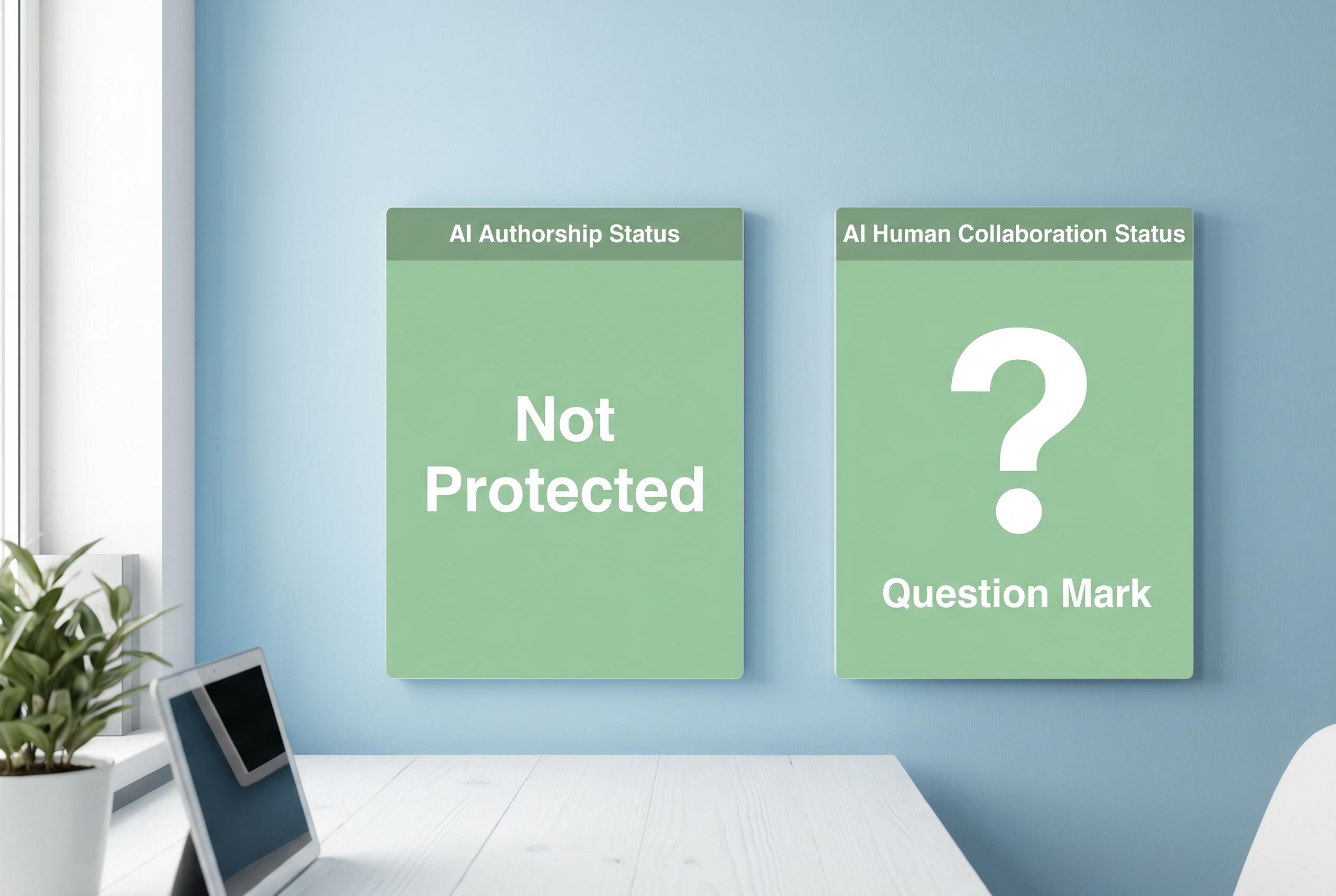
The Supreme Court’s denial to review Thaler v. Perlmutter clarifies that works created solely by AI are not protected under US copyright law, but leaves questions on human-AI collaborations unresolved.
The Supreme Court’s refusal to hear Thaler v. Perlmutter has settled one narrow point and left everything else open: a work produced with no human author cannot claim copyright under current US law. Courts in Washington have now made clear that an image generated entirely by artificial intelligence does not meet the Copyright Act’s authorship requirement, but that does not amount to a blanket ruling on the many forms of human-AI collaboration now common in creative and technical work.
That distinction matters because Stephen Thaler’s case was unusually stark. His "Creativity Machine" produced a single static image, "A Recent Entrance to Paradise", and he insisted that the machine alone should be treated as the author. He also gave up any argument that he himself had created the work through prompting, editing or training choices. In other words, the case tested pure machine authorship, not the murkier territory where a person uses AI as a tool.
According to legal commentaries published after the March 2025 appellate ruling and the Supreme Court’s March 2026 denial of review, the D.C. Circuit’s reasoning is straightforward: copyright protection requires human authorship, and a machine cannot be the sole creator under the statute. But several observers say the practical fight is likely to come later, when examiners and judges are asked to decide whether works drafted with AI assistance, then revised by a human, should be treated differently. That could include code written with autocomplete tools, substantial machine-generated text that is edited by a developer, or AI-assisted rewrites of existing software.
For now, the more consequential issue may be how far the Thaler decision is stretched in practice. The Copyright Office has already shown a somewhat more permissive approach to human-directed AI use than the public debate suggests, and that leaves room for future disputes over derivative works, substantial human selection and creative control. The danger is less the Supreme Court’s silence than the temptation to read this narrow case as a broad answer to questions it never decided.
Source Reference Map
Inspired by headline at: [1]
Sources by paragraph:
Source: Noah Wire Services
Noah Fact Check Pro
The draft above was created using the information available at the time the story first
emerged. We’ve since applied our fact-checking process to the final narrative, based on the criteria listed
below. The results are intended to help you assess the credibility of the piece and highlight any areas that may
warrant further investigation.
Freshness check
Score:
8
Notes:
The article was published on April 29, 2026, discussing the Supreme Court's denial of certiorari in Thaler v. Perlmutter on March 2, 2026. The content is current and relevant, with no evidence of recycled news. However, the article references multiple sources, including a podcast from March 17, 2026, which may indicate some information is not entirely fresh. ([jonesday.com](https://www.jonesday.com/en/insights/2026/03/jones-day-talks-women-in-ip--supreme-court-denies-review-of-thaler-v-perlmutter-ai-authorship-questions-remain?utm_source=openai))
Quotes check
Score:
7
Notes:
The article includes direct quotes from legal commentaries and podcasts. While the quotes are attributed, their earliest known usage is not specified, making independent verification challenging. The lack of verifiable sources for some quotes raises concerns about their authenticity.
Source reliability
Score:
6
Notes:
The article cites various sources, including legal firms and podcasts. However, the primary source, 'The Build,' is a niche publication with limited reach and may not be considered a major news organisation. The reliance on a single, less reputable source diminishes the overall reliability of the information presented.
Plausibility check
Score:
7
Notes:
The article discusses the Supreme Court's denial of certiorari in Thaler v. Perlmutter, a real case with verifiable details. However, the article's tone and structure, including the use of phrases like 'Thaler Is Dead,' may indicate a more opinionated piece rather than a straightforward news report. The inclusion of a podcast from March 17, 2026, suggests that some information may not be entirely fresh. ([jonesday.com](https://www.jonesday.com/en/insights/2026/03/jones-day-talks-women-in-ip--supreme-court-denies-review-of-thaler-v-perlmutter-ai-authorship-questions-remain?utm_source=openai))
Overall assessment
Verdict (FAIL, OPEN, PASS): FAIL
Confidence (LOW, MEDIUM, HIGH): MEDIUM
Summary:
The article presents information on the Supreme Court's denial of certiorari in Thaler v. Perlmutter, but its reliance on a single, less reputable source, lack of independently verifiable quotes, and opinionated tone raise significant concerns about its credibility and reliability.