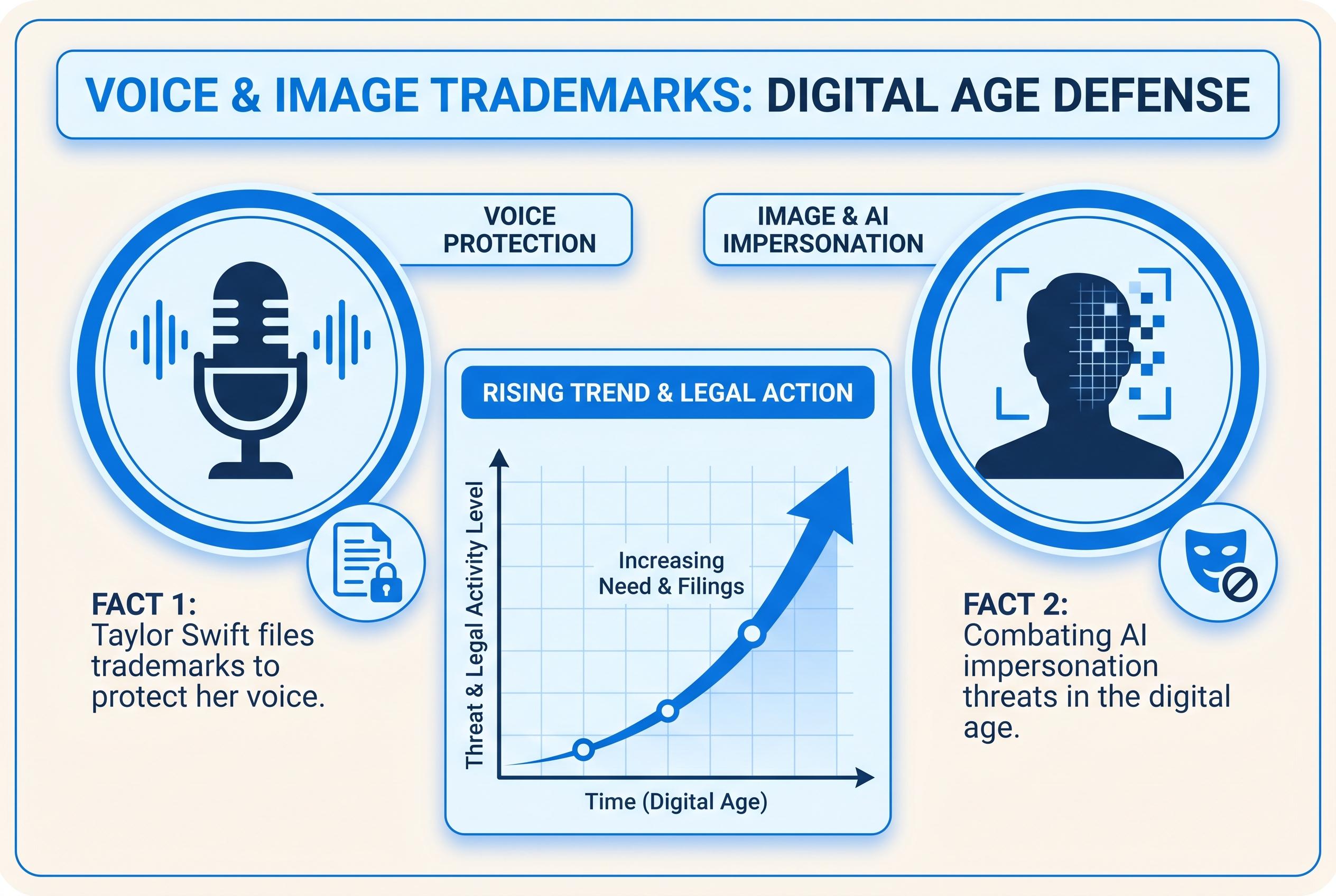
Taylor Swift has moved to put both her voice and her image into the trademark system, filing three applications with the US Patent and Trademark Office on 24 April in what appears to be a pre-emptive response to AI-generated impersonation. According to reporting from The Guardian, CBS News, the Los Angeles Times and other outlets, two of the filings cover the spoken phrases "Hey, it's Taylor Swift" and "Hey, it's Taylor" as sound marks, while the third protects a stage photograph of Swift holding a pink guitar. Legal observers say the filings are notable not just for their subject matter, but for the strategy behind them: using federal trademark law to create a more uniform shield than the patchwork of state publicity rights.
The move reflects a growing concern in entertainment that generative AI can cheaply recreate recognisable voices and likenesses for commercial use. According to CBS News, intellectual property lawyer Josh Gerben, who first flagged the applications, believes the filings could help Swift challenge AI content that mimics her identity without permission. The Washington Post noted that the trademark claims could be useful in cases involving false endorsement or deepfake-style promotions, where the issue is not only whether a voice has been copied, but whether the imitation causes confusion about who is behind the content.
That matters because trademark law can be broader, in practice, than many publicity-rights claims. As The Guardian and the Los Angeles Times reported, the filings seek protection through a federal system that applies across the US, rather than relying on state-by-state rules that vary significantly. The sound mark route is also unusual: it is more commonly associated with brief, highly distinctive audio cues such as network chimes or studio signatures. Applying that category to a celebrity phrase linked to a specific voice is a novel step, and one that has not yet been tested in court in the AI context.
Swift is not alone in exploring that path. CBS News and the Los Angeles Times reported that actor Matthew McConaughey has also pursued trademark protection tied to his own likeness, suggesting a wider trend among public figures who want clearer legal tools as AI cloning becomes easier to deploy. The Washington Post cited legal commentary that the filings may be aimed at deterring misuse before it spreads, rather than waiting to chase individual infringements after the fact.
Even so, the legal endgame remains uncertain. The filings may strengthen Swift’s hand if a commercial clone of her voice or image begins circulating, but courts will still have to decide whether an AI-generated imitation can be treated as trademark infringement, or merely as a resemblance that falls outside current doctrine. For now, the applications underline a simple reality: in the absence of a settled AI law, high-profile figures are increasingly turning to the tools already available to them.
Source Reference Map
Inspired by headline at: [1]
Sources by paragraph:
- Paragraph 1: [2], [3], [4], [5], [6]
- Paragraph 2: [3], [5], [7]
- Paragraph 3: [2], [4], [6]
- Paragraph 4: [3], [4], [7]
- Paragraph 5: [1], [2], [3], [5]
Source: Noah Wire Services