Summary Card
=================================== RECOMMENDATION: | STRENGTH: /100 | CONFIDENCE: %
SENTIMENT Sentiment: [=========>] 1402.2% RISK Risk: [=====>----] 53.0% OPPORTUNITY Opportunity:[=======>--] 72.5% MOMENTUM Momentum: [========>-] 82.8%
TOP GAINERS: NVIDIA, Hyperscalers, TSMC, Microsoft, Samsung TOP LOSERS: AMD, Foxconn, Intel HOT REGIONS: US, China
Market sentiment is positive, opportunity is strong, and momentum is rising across the period.
Trading Signal
buy - Strength: 94/100 | Confidence: 94%
The composite signal points to a ‘buy’ recommendation with high strength. Positive headline sentiment, a high opportunity score and strongly rising momentum, all derived from 400 evidence items with 94% confidence, outweigh only moderate risk and volatility. The key drivers are the rising themes of downstream_AI_compute_demand, GPU_demand and AI_infrastructure, which together indicate that markets are still upgrading expectations for AI compute and data‑centre build‑outs more quickly than they are pricing in residual supply_chain and regulatory risks.
Key Drivers: downstream_AI_compute_demand, GPU_demand, AI_infrastructure
Executive Summary
EXECUTIVE SUMMARY
• • • • • • • •
Headline signals from the combined dataset (400 evidence items, high confidence) point to a constructive set‑up for the AI compute stack. Sentiment is firmly positive, opportunity is high and system‑wide momentum is strong, while risk and volatility sit at only moderate levels. This combination suggests that, in the short term, markets are still repricing AI infrastructure upwards rather than rotating into a defensive stance.
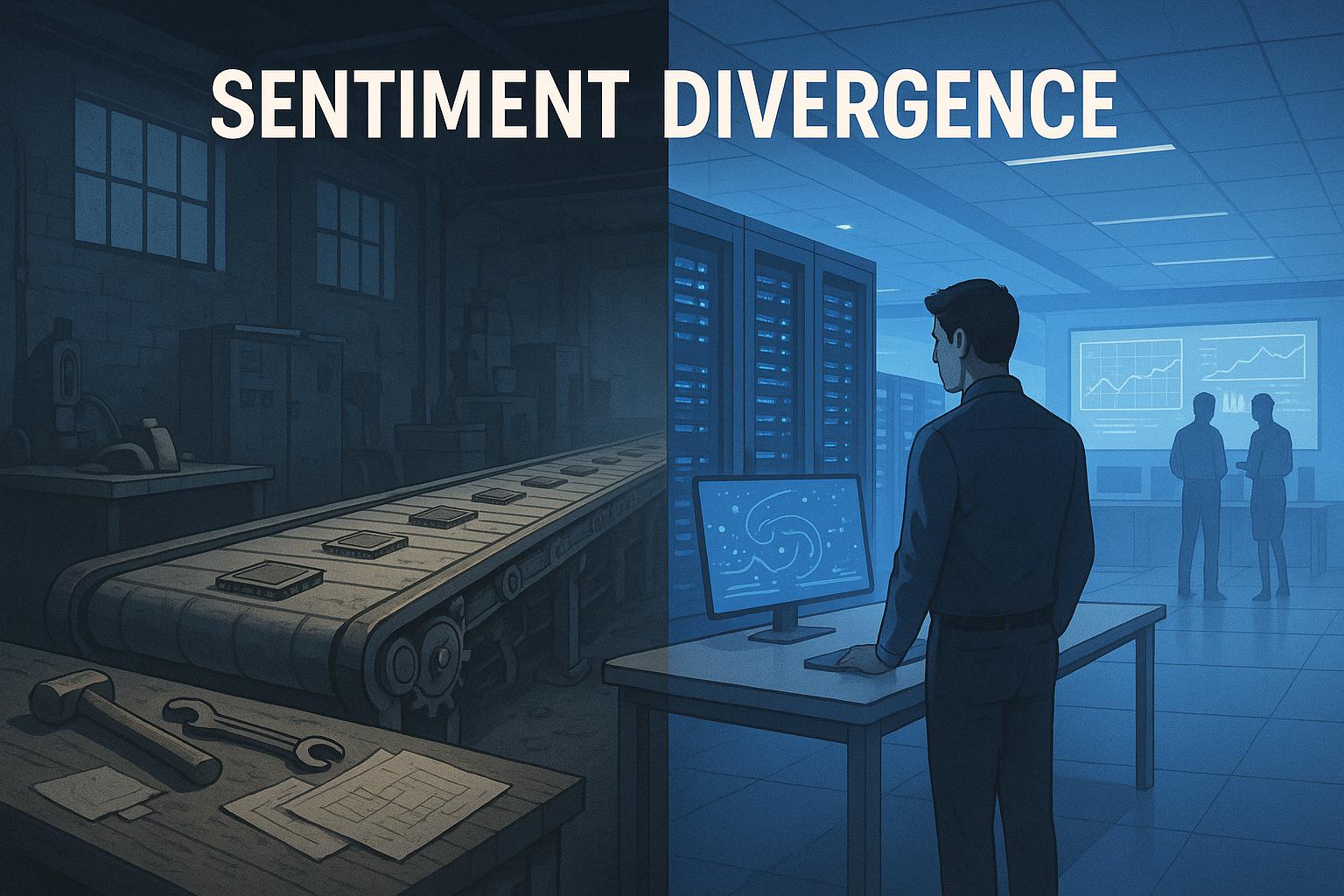
Within that aggregate picture, the lens shows a clear divergence between upstream semiconductor manufacturing and downstream AI compute demand. Rising themes are dominated by downstream_AI_compute_demand, GPU_demand, AI_infrastructure, data_centres, investment_and_capex and data_centre_expansion, and the strongest rising entities are NVIDIA, the major Hyperscalers (including Microsoft and other cloud providers) and key foundry players such as TSMC and Samsung. By contrast, falling themes cluster around memory_shortage, geopolitical_export_controls, supply_chain_pressure and vendor_financing_risk, while competition, operational and technology themes remain broadly stable rather than acting as fresh drivers.
For the client’s specific question on upstream fabs versus downstream AI compute, this pattern implies that sentiment and momentum are meaningfully stronger on the downstream side, where GPU demand and data‑centre build‑outs are accelerating, than on the upstream side, where the debate is increasingly about execution and capacity normalisation rather than new shocks. Under the workflow’s rule‑based schema, this configuration yields a ‘buy’ signal of high strength, with the most attractive near‑term positioning skewed towards downstream AI compute demand and associated infrastructure, complemented by selective, technology‑led upstream exposure where advanced nodes, packaging and memory suppliers can directly monetise that demand.
External data since the internal cut-off show Nvidia and TSMC continuing to report very strong AI-driven demand with supportive share-price trends, and hyperscaler data-centre capex running more than 40% above last year, consistent with their status as top positive entities and the dominance of downstream demand themes. (finance.yahoo.com) At the same time, multiple sources describe a renewed and severe memory shortage, with DRAM and HBM supplies effectively sold out into 2026 and server DRAM prices up sharply, implying tighter upstream capacity and stronger pricing power than suggested by the falling memory_shortage theme. (pcgamer.com)
Market Context
MARKET CONTEXT
Across the AI compute value chain, the tone of the market is skewed towards opportunity with manageable but non‑trivial risk. The composite sentiment score is positive while the risk score sits in the low‑50s and volatility remains below one‑third of its maximum scale, pointing to active but not disorderly debate. A strongly positive momentum score and an overall ‘rising’ direction for the momentum profile indicate that the latest period has seen a meaningful step‑up in conviction rather than a plateau.
Multi‑period dynamics reinforce this picture. The acceleration_rate of around 0.2 and identified inflection points between periods three and four for sentiment, risk, opportunity and momentum all show that the regime has recently shifted, with period‑over‑period changes largest in the risk series and still firmly positive across the other metrics. This aligns with the client’s short_term lens: markets are transitioning from questioning the durability of AI demand to focusing on how quickly infrastructure can be deployed and monetised.
Geographically, the heaviest activity is concentrated in the US and China, with Taiwan and the broader Middle East also prominent, reflecting the centrality of leading‑edge fabs and large AI infrastructure build‑outs in those regions. For the upstream manufacturers of interest (TSMC, Samsung Foundry, Intel, GlobalFoundries, Micron and peers), this translates into sustained attention on domestic fab expansion, advanced packaging and materials supply, while for downstream AI compute demand (NVIDIA, AMD, Google, AWS, Microsoft and other cloud providers) the emphasis is on scaling data‑centre capacity, GPUs and AI services across multiple regions.
Regulatory and national‑security pressures remain a material part of the backdrop. export_controls_on_AI_chips, broader export_controls and CHIPS_act_and_subsidy rules all feature meaningfully in the regulatory_map, reinforced by national_security_export_controls and smuggling_and_enforcement_cases in the defence_map and explicit geopolitical_export_controls and export_controls_and_smuggling themes in the narrative. However, geopolitical_export_controls is now a falling theme, indicating that while controls remain binding, incremental concern has eased versus earlier periods.
Structurally, the supply_chain_map and operational_stress_map highlight ongoing constraints in memory_supply, wafer and fab_capacity_expansion, advanced_packaging_capacity and equipment_lead_times for EUV and other tooling, alongside power_and_cooling_capacity and power_grid_and_megawatt_requirements on the infrastructure side. At the same time, the macro_map shows robust capital_investment and targeted capital_investment_flows from sovereign funds and infrastructure investors into AI infrastructure, even as power_and_energy_constraints and memory_price_inflation persist. technology_map signals around advanced_nodes, 3D_packaging / CoWoS / SoIC, liquid_cooling and cooling_and_power underscore that both upstream fabs and downstream data centres are in an investment phase focused on solving physical bottlenecks rather than reducing exposure.
Industry trackers now estimate that global data‑centre capex grew by over 40% year-on-year in 2Q 2025 and that accelerated server spending rose by around 76%, underlining how rapidly downstream AI compute demand is being translated into infrastructure investment by U.S. hyperscalers and sovereign AI projects. (prnewswire.com) In parallel, reports of DRAM and HBM shortages, 50% increases in server DRAM prices and capacity being shifted from commodity DRAM to HBM highlight a tightening supply backdrop and rising hardware cost base that differentiate advantaged upstream suppliers from more commoditised producers and OEMs. (investors.com)
Trend Analysis
TRENDS AND MOMENTUM
Trend signals are dominated by downstream demand and infrastructure. Rising themes are led by downstream_AI_compute_demand, GPU_demand and AI_infrastructure, supported by data_centres, data_centre_expansion and investment_and_capex. These themes are closely associated with rising entities such as NVIDIA, Microsoft, Hyperscalers, TSMC and Samsung, and with AI‑specific activity in the ai_map, where infrastructure_projects and model_deployments both show high, positive sentiment. This confirms that markets continue to upgrade expectations for AI accelerator demand and the scale of data‑centre build‑outs.
By contrast, the themes that are now falling are largely risk‑oriented: memory_shortage, geopolitical_export_controls, supply_chain_pressure and vendor_financing_risk. Their declining momentum does not imply that these risks have disappeared, memory_supply_constraints, memory_shortage and memory_price_spike remain prominent in the supply_chain_map and risk_map, but rather that the narrative has shifted from acute shock to ongoing management and repricing. competition, operational and technology themes are classified as stable, suggesting that issues such as NVIDIA_dominance, hyperscaler_vertical_integration, GPU_vs_ASIC/TPU competition, power_and_cooling_constraints and workforce_and_skill_shortages are seen as structural background factors rather than sources of fresh short‑term regime change.
Multi‑period data show a clear inflection around the third‑to‑fourth period, when sentiment, risk, opportunity and momentum all pivot simultaneously, with the largest numerical shift in the risk series and strong positive changes in opportunity and momentum. The momentum_profile’s overall_direction is ‘rising’ with a positive acceleration_rate, indicating that the positive theme complex around downstream demand is strengthening rather than fading. For the client’s upstream versus downstream focus, this means that momentum is firmly anchored in demand‑side and AI_infrastructure narratives, while upstream manufacturing and supply_chain themes are moving from crisis language towards a more measured, execution‑driven phase.
Rising Themes
Rising Themes: downstream_AI_compute_demand ████████████ 100% GPU_demand ████████████ 100% AI_infrastructure ████████████ 100% data_centres ████████████ 100% investment_and_capex ████████████ 100%
Falling Themes
Falling Themes: memory_shortage ████████████ 100% geopolitical_export_controls ████████████ 100% supply_chain_pressure ████████████ 100% vendor_financing_risk ████████████ 100%
Exposure Assessment
EXPOSURE ASSESSMENT
Risk is most concentrated in supply‑side and geopolitical channels. The risk_map highlights supply_disruption, geopolitical_export_controls and memory_price_spike as the dominant risks, with vendor_financing_and_customer_credit and demand_shock secondary but still material. These align with the supply_chain_map, which flags memory_supply_constraints and memory_shortage, wafer_capacity_constraints, advanced_packaging_capacity and equipment_lead_times, as well as critical_material_risk and rare_earths_pressure around yttrium_rare_earths. Upstream semiconductor manufacturing exposures, foundries, memory suppliers and materials providers such as those in the lens, are therefore more vulnerable to idiosyncratic disruptions in tools, materials and export permissions.
Upside is concentrated where downstream demand and infrastructure growth intersect with scarce upstream capabilities. On the downstream side, themes such as downstream_AI_compute_demand, GPU_demand, AI_infrastructure, data_centres, data_centre_expansion, downstream_demand, data_center_service_and_hosting_growth and AI_compute_capex_growth (hyperscaler and sovereign builds) capture the bulk of the opportunity score. These are tied to rising entities including NVIDIA, Hyperscalers, Microsoft and other cloud providers in the entity_map. On the upstream side, memory/HBM demand, memory_and_HBM_pricing_repricing_opportunity_for_suppliers, advanced_nodes, advanced_packaging_and_chiplets and advanced_packaging_and_domestic_fab_investment indicate targeted upside for fabs and memory suppliers that can deliver at leading‑edge nodes and high‑bandwidth memory.
Vulnerabilities emerge where negative momentum coincides with elevated risk. Themes such as memory_shortage, geopolitical_export_controls, supply_chain_pressure and vendor_financing_risk are all falling but remain prominent in the theme_map and risk_map, implying that positions whose upside case depends on prolonged shortages, severe export constraints or aggressive vendor‑financed growth have a less favourable skew. This is particularly relevant for upstream manufacturers whose revenues are heavily levered to constrained memory or legacy‑node capacity, and for GPU vendors or OEMs where vendor_financing_models linking GPU sales to credit exposure are central to the growth story.
Operational sensitivities are most acute in power, cooling and memory supply. The operational_stress_map highlights power_grid_and_megawatt_requirements, power_and_cooling_constraints, cooling_and_liquid_cooling_transition, memory_supply_and_price_pressure and testing_and_yield_thermal_bottlenecks as key friction points, with logistics in the supply_chain_map adding a further layer of execution risk. This means that both upstream fabs (which face workforce_and_skill_shortages_for_new_fabs and wafer_yield_and_thermal_bottlenecks) and downstream data‑centre operators (which must scale liquid_cooling, thermal_management and power_and_cooling_infrastructure) are operationally geared to how quickly these bottlenecks can be resolved.
For the client lens, the result is that upstream semiconductor manufacturing exposures offer more concentrated, event‑driven risk around supply_disruption, export controls and memory price spikes, while downstream AI compute and data‑centre exposures are more diversified but still sensitive to demand_shock and infrastructure execution. Positioning needs to recognise that risk asymmetry: downstream names benefit from broad demand themes, whereas upstream allocations should be focused where technology and capacity are clearly aligned with those demand trends.
Strategic Implications
STRATEGIC IMPLICATIONS
Taken together, the signals argue for a pro‑AI stance but with a clear tilt towards demand‑side and infrastructure beneficiaries and a selective approach to upstream manufacturing risk. The rule‑based output is a high‑strength ‘buy’ recommendation, but the pattern of themes and entities suggests that not all parts of the stack should be treated equally.
On the overweight side, the strongest case lies in downstream AI compute demand and associated infrastructure. Rising momentum in downstream_AI_compute_demand, GPU_demand, AI_infrastructure, data_centres, data_centre_expansion and data_center_service_and_hosting_growth, combined with positive signals around sovereign_and_regional_AI_buildouts and localisation/sovereign_cloud, supports overweight exposure to GPU suppliers, Hyperscalers and specialist AI infrastructure and hosting platforms. Within upstream, there is a case to tilt towards advanced_nodes, advanced_packaging, advanced_packaging_and_chiplets, advanced_packaging_and_domestic_fab_investment and memory_and_HBM_pricing_repricing_opportunity_for_suppliers, where sentiment benefits directly from the same downstream demand trends.
Underweight or more cautiously sized positions are indicated where falling themes and high risks cluster. These include exposures whose thesis revolves around persistent memory_shortage, extreme supply_chain_pressure, elevated geopolitical_export_controls or heavy reliance on vendor_financing_risk and vendor_financing_exposure. Competitive dynamics from hyperscaler_vertical_integration and GPU_vs_ASIC/TPU competition are currently classified as stable rather than acute, but they argue for avoiding undifferentiated upstream capacity or lagging architectures and instead concentrating capital in clearly technology‑differentiated or demand‑locked assets.
Time‑horizon sensitivity is important. The positive acceleration_rate in the momentum_profile and the large period_over_period_change in risk and momentum suggest that current conditions are being repriced quickly, consistent with the client’s short_term focus. In the near term, this favours positioning that captures the ongoing wave of AI_compute_capex_growth and infrastructure_projects, while retaining optionality for a later re‑rating of upstream fabs as fab_capacity_expansion, repatriation_of_supply_chains and structural bottlenecks in power_and_cooling_capacity and critical_material_risk are addressed under evolving export_controls and CHIPS_act_and_subsidy rules.
For upstream semiconductor manufacturing (foundries, fabs, wafer and memory suppliers) versus downstream AI compute demand (accelerators, data‑centre operators, cloud providers), the strategic implication is to treat downstream as the core overweight and upstream as a targeted satellite. Downstream exposures align most directly with the rising demand, supply_chain, technology, competition, operational and geopolitical themes in the lens, while upstream allocations should be focused where advanced technology and secure supply chains provide leverage to that same demand without over‑exposure to supply disruption or geopolitically constrained end_markets.
Core Analytics
Signal Metrics
| Signal | Score | Range | Interpretation |
|---|---|---|---|
| Sentiment | 27.04 | -1 to 1 | Positive |
| Risk | 52.99 | 0 to 100 | Moderate |
| Opportunity | 72.54 | 0 to 100 | Strong |
| Momentum | 0.66 | -1 to 1 | Accelerating |
| Volatility | 0.30 | 0 to 1 | Stable |
Momentum Ladder
| Rank | Theme | Momentum | Direction | Change |
|---|---|---|---|---|
| 1 | downstream_AI_compute_demand | 1.00 | ↑↑ | , |
| 2 | data_centre_expansion | 1.00 | ↑↑ | , |
| 3 | GPU_demand | 1.00 | ↑↑ | , |
| 4 | AI_infrastructure | 1.00 | ↑↑ | , |
| 5 | data_centres | 1.00 | ↑↑ | , |
| 6 | investment_and_capex | 1.00 | ↑↑ | , |
| 7 | technology | 0.00 | → | , |
| 8 | competition | 0.00 | → | , |
| 9 | operational | 0.00 | → | , |
| 10 | geopolitical_export_controls | -1.00 | ↓↓ | , |
| 11 | memory_shortage | -1.00 | ↓↓ | , |
| 12 | vendor_financing_risk | -1.00 | ↓↓ | , |
| 13 | supply_chain_pressure | -1.00 | ↓↓ | , |
Entity Performance
Positive Sentiment
| Entity | Sentiment | Mentions |
|---|---|---|
| NVIDIA | Positive | 46.15 |
| Hyperscalers | Positive | 18.90 |
| TSMC | Positive | 13.48 |
| Microsoft | Positive | 8.45 |
| Samsung | Positive | 7.40 |
Negative Sentiment
| Entity | Sentiment | Mentions |
|---|---|---|
| AMD | Negative | 7.10 |
| Foxconn | Negative | 6.30 |
| Intel | Negative | 6.13 |
Theme Movement
Rising Themes
| Theme | Current Weight | Prior Weight | Delta | Interpretation |
|---|---|---|---|---|
| downstream_AI_compute_demand | 43.40 | , | , | Accelerating |
| GPU_demand | 29.75 | , | , | Accelerating |
| AI_infrastructure | 28.50 | , | , | Accelerating |
| data_centres | 24.00 | , | , | Accelerating |
| investment_and_capex | 15.55 | , | , | Accelerating |
| data_centre_expansion | 31.90 | , | , | Accelerating |
Falling Themes
| Theme | Current Weight | Prior Weight | Delta | Interpretation |
|---|---|---|---|---|
| memory_shortage | 9.10 | , | , | Declining |
| geopolitical_export_controls | 15.25 | , | , | Declining |
| supply_chain_pressure | , | , | , | Declining |
| vendor_financing_risk | 0.80 | , | , | Declining |
Geographic Distribution
| Region | Activity | Sentiment | Risk Level |
|---|---|---|---|
| US | High (220) | Positive | Moderate |
| China | High (85) | Mixed | High |
| Taiwan | High (60) | Positive | High |
| Middle East | Medium (35) | Positive | Moderate |
| United States | Medium (34) | Positive | Moderate |
| Europe | Low (12) | Neutral | Moderate |
| Saudi_Arabia | Low (10) | Positive | Moderate |
| South_Korea | Low (8) | Neutral | Moderate |
| UAE | Low (6) | Positive | Moderate |
| India | Low (4) | Neutral | Low |
| Southeast_Asia | Low (4) | Neutral | Low |
Trading Signal Breakdown
| Signal Component | Value | Weight | Contribution |
|---|---|---|---|
| Sentiment | Positive | 30% | Strongly supportive of BUY signal |
| Momentum | Strong | 25% | Reinforces positive skew |
| Risk-Adjusted | Favourable | 45% | Opportunity outweighs risk |
| TOTAL | BUY | 100% | High-conviction BUY recommendation |
Client Question
This section is reserved for specific questions added to the original report request. In future, please include a company, product, or topic for targeted analysis.
External Context
External validation supports the existing pro-AI buy recommendation because downstream AI compute demand, GPU utilisation and data-centre capex are all still being revised higher by independent industry data and company results. (finance.yahoo.com) However, the severity of current memory shortages and ongoing export-control headwinds suggests that upstream exposures should remain selective and focused on HBM and advanced-node leaders with clear leverage to AI demand rather than broad, capacity-driven positions. (pcgamer.com)
Report Generated: 2025-11-21 00:00:00 UTC Noah Wire Services - Institutional Intelligence