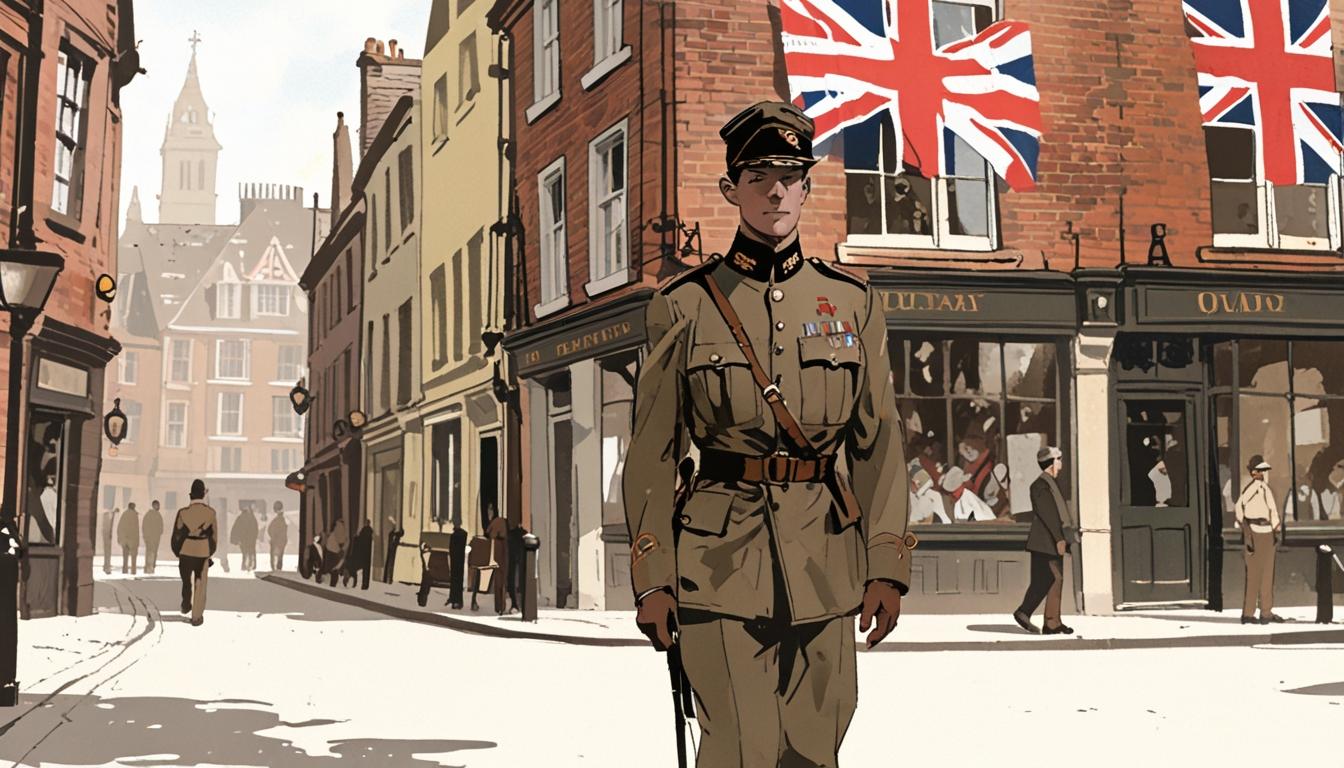
As the United Kingdom approaches the 80th anniversary of Victory in Europe (VE) Day on 8 May, the nation is preparing to honour perhaps its greatest historic moment with ceremonies reflecting pride in the Armed Forces. Soldiers, sailors, and aviators will don full dress uniforms, a sight that once was common but has become increasingly rare in everyday British public spaces.
Christopher Welsh, a former Captain in the Royal Artillery who served for six years, reflects on this significant occasion with a mixture of pride and concern about the current status and visibility of the military in British society. He observes that outside official commemorations, the public presence of uniformed service personnel has diminished markedly in recent years. Historically, the sight of soldiers in towns and cities was a familiar and reassuring element of daily life, with uniformed personnel engaging with community members and often inspiring younger generations.
Welsh traces the visible decline in uniformed personnel on the streets to a tragic turning point in 2013, when Fusilier Lee Rigby was murdered outside his barracks in Woolwich, south-east London. Though Rigby was not wearing full uniform at the time, elements such as his ‘Help for Heroes’ sweatshirt and camouflage rucksack identified him with the military, making him a target for a brutal terrorist attack by two Islamist perpetrators. The incident shocked the nation and led the Ministry of Defence (MoD) to issue temporary orders prohibiting soldiers from wearing their uniforms in public except at official events, citing concerns about potential risks posed by members of the public.
This directive heralded a cultural shift within the armed forces. Welsh recalls that soldiers were often advised or required to change into civilian clothes before leaving their barracks, and many felt exposed and vulnerable when wearing uniform in public. The reduction in public uniform visibility was compounded by budgetary and personnel cuts that reduced recruitment activities such as leaflet distribution. Today, while the MoD states that service personnel are "encouraged" to wear uniforms outside official engagements—except in Northern Ireland due to security concerns—many soldiers find it difficult or undesirable to do so, with some units continuing to ban wearing uniform off-duty. Additionally, soldiers lack insurance coverage if harmed while in uniform and off duty, increasing the deterrent effect.
Welsh highlights the broader implications of this retreat from public visibility, notably a recruitment crisis within the Armed Forces. Despite a diminished total strength of about 70,000 troops, the Army struggles to attract sufficient new recruits. Defence Secretary John Healey disclosed in November of the previous year that the forces were experiencing a net loss of roughly 300 full-time personnel monthly. With geopolitical tensions heightening globally, Welsh emphasises the critical need to maintain and bolster troop numbers even as significant funding increases and creation of a new Armed Forces Recruitment Service aim to improve the situation.
Drawing upon his own personal history, Welsh details his motivations for joining the military and the enriching experiences afforded by his service. Inspired initially by encounters with servicemen at events and by family veterans from World War II and the Suez Crisis, he chose to enlist at age 14. His military career included varied postings, such as desert operations in Oman and exercises in Norway, as well as leadership challenges and even moments of levity, such as being misdirected into a farmer’s field during a navigation exercise.
Welsh underscores the value of soldiers being visibly present in civilian life, suggesting that it offers opportunities for public engagement, community assistance, and inspiration—particularly for younger people who may otherwise be influenced by social media personalities rather than real-life military role models. He acknowledges concerns within the military hierarchy about potential confrontations or hostility faced by uniformed personnel in public but argues there is merit in trusting soldiers’ professionalism and resilience.
“The top brass fear the risks of uniformed soldiers in public, of people goaded into confrontation—or worse. It can be sinister,” Welsh said. He recounted how a friend running a COVID testing centre suffered repeated verbal abuse yet noted that most who challenge soldiers online tend to retreat when confronted face-to-face. “I would encourage all those in the Armed Forces to wear their uniforms proudly,” he added, saying it would demonstrate readiness and presence. “After all, if they can't cope with Crawley High Street, do we seriously believe they could hack the steppes of Ukraine and face down Putin's murderous mob?”
Welsh also recalls his grandfather’s dedication to public remembrance as a veteran, who annually laid wreaths on Remembrance Sunday, maintaining a living connection to the sacrifices of the Second World War. Though his grandfather passed away during Welsh’s officer training, he felt a profound moment laying a wreath in his place, wearing the Royal Artillery uniform that symbolised continuity across generations.
As the nation approaches eight decades since the end of the war in Europe, Welsh acknowledges the passing of the last veterans of that era, describing them as “irreplaceable.” He stresses the importance of finding new ways to inspire the young to carry forward the legacy, a mission now shaped by a complex mix of historical reverence, current security realities, and societal attitudes toward the military.
Christopher Welsh’s reflections thus provide both a commemoration of Britain’s military heritage on the 80th anniversary of VE Day and a candid assessment of contemporary challenges facing the visibility, recruitment, and public perception of the Armed Forces.
Source: Noah Wire Services