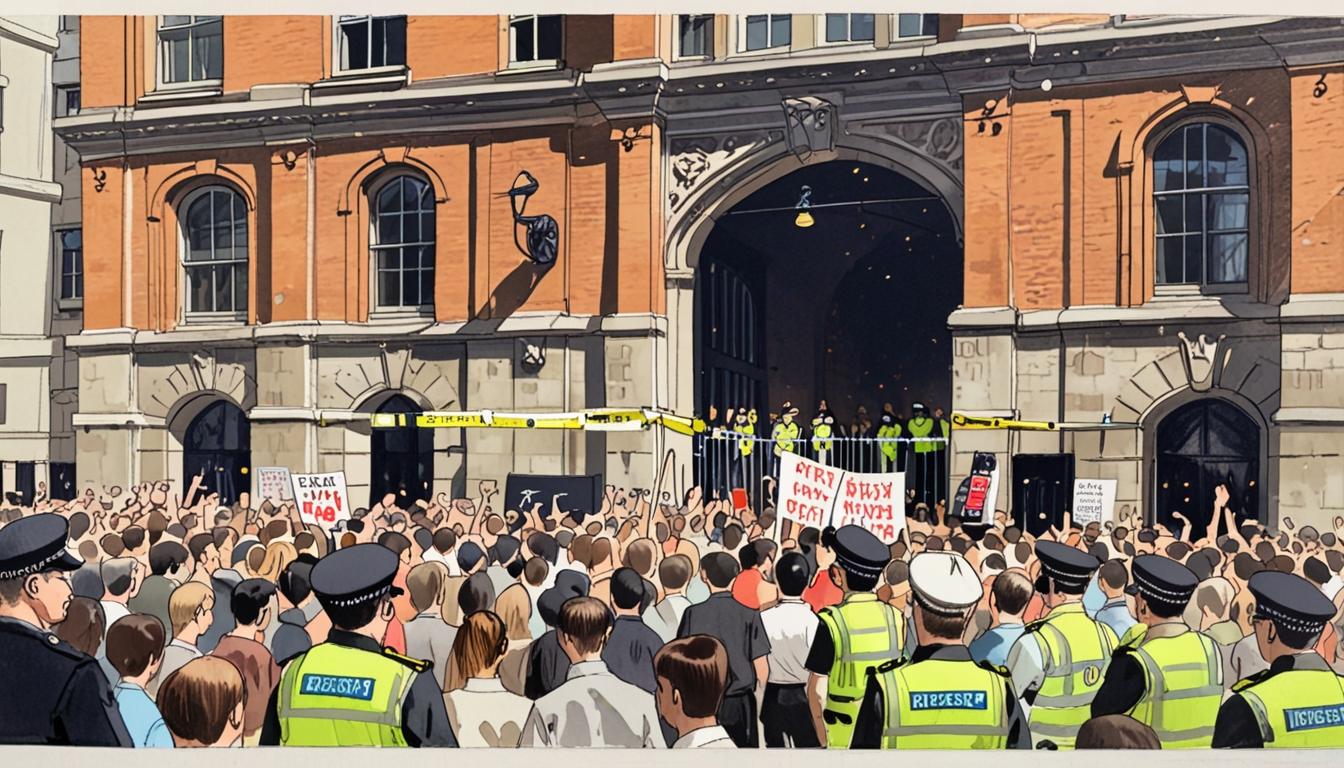
The Metropolitan Police have raised concerns that the construction of China’s proposed new embassy in London would necessitate additional police resources to manage large-scale protests, as the decision on the project awaits ministers' final approval.
China aims to build a “super-embassy” covering 20,000 square metres at Royal Mint Court, an 18th-century Grade II-listed site near Tower Bridge. The plan has faced significant opposition locally, with Tower Hamlets council rejecting the proposal in December 2022. However, ministers have taken the decision out of the council’s hands, holding a local inquiry to consider the matter. The final decision now rests with Angela Rayner, secretary for housing, communities and local government.
Deputy Assistant Commissioner Jon Savell of the Metropolitan Police expressed persistent concerns regarding the potential impact on public safety and traffic in the surrounding area. In a letter sent earlier this month to former Conservative leader Iain Duncan Smith and the Home Office, Savell noted that protests involving more than 500 protesters outside the embassy would disrupt traffic flow and require extra policing. He referred to two recent large demonstrations—held in February and March—where crowds numbered between 3,000 and 5,000 people, far exceeding the 500-person threshold the force considers manageable at the site’s frontage. An additional protest is planned for early May.
Savell’s letter details that the road junction adjacent to Royal Mint Court “would require additional police resource for larger assemblies to balance the safety of those who wish to assemble/protest and the safe free-flow of traffic, as has been borne out from the two recent large-scale protests.” He emphasised that while the Met “remains impartial to the proposed development outside of any implications on policing,” the force “maintains concerns” linked to protest management around the embassy.
Earlier police assessments in December had indicated that gatherings of more than 100 people would pose significant safety risks and likely spill into the roads, causing widespread disruption. However, in January, the Metropolitan Police withdrew their formal objection after reviewing a technical document commissioned by China, which argued that up to 2,000 protesters could be safely accommodated around the site. This decision cleared the way for the proposals to be approved, despite Tower Hamlets council reiterating its opposition based on previous police evidence.
The withdrawal of the Met’s objection has sparked debate among local residents and campaign groups. At the February inquiry, the residents’ lawyer suggested ministers may have “sought to influence” the police in favour of the embassy plans. Meanwhile, David Lammy, the foreign secretary, and Yvette Cooper, the home secretary, have publicly expressed their support, highlighting the importance of countries having “functioning diplomatic premises in each other’s capitals.” In a joint letter in January, they noted the Metropolitan Police’s position that there was sufficient space for demonstrations but acknowledged “there remain differences of opinion on where protesters would most likely congregate.”
The proposed embassy has become a diplomatic priority for China amid the UK government’s efforts to strengthen bilateral relations. The Met’s concerns were brought to wider attention following Savell’s meeting with members of the Inter-Parliamentary Alliance on China (Ipac), a group campaigning for a tougher stance on Beijing and which has been critical of the embassy proposal.
Iain Duncan Smith responded to Savell’s letter by indicating he would press the police to communicate their concerns to ministers. He said: “If the national security and interference arguments aren’t enough, then perhaps the fact that Tower Bridge junction will be regularly shut down and officers drafted in from all over London to ensure safety will help the government to do the right thing and refuse this application.”
Labour MP Blair McDougall, serving on the foreign affairs committee, commented on the police assessment, stating: “There is inadequate space for protest outside the Royal Mint Court, where not only would protester safety be jeopardised but gatherings would require significant policing resources and lead to major road disruption. As long as the right to protest is non-negotiable, the embassy must be in a location where that right can be safely upheld.”
Luke de Pulford, executive director of Ipac, added: “A huge amount of public money has already been wasted policing large protests at the site. It isn’t safe, and there isn’t space. Large protests will continue until permission for this wrong-headed embassy is denied. It shouldn’t have taken MPs, residents and thousands of campaigners to turn up for the police to admit the obvious, but I’m glad they have.”
The ongoing debate highlights the complex balance between diplomatic development, public safety, protest rights, and local community impact as the government prepares to make its final decision on the embassy proposal in London.
Source: Noah Wire Services