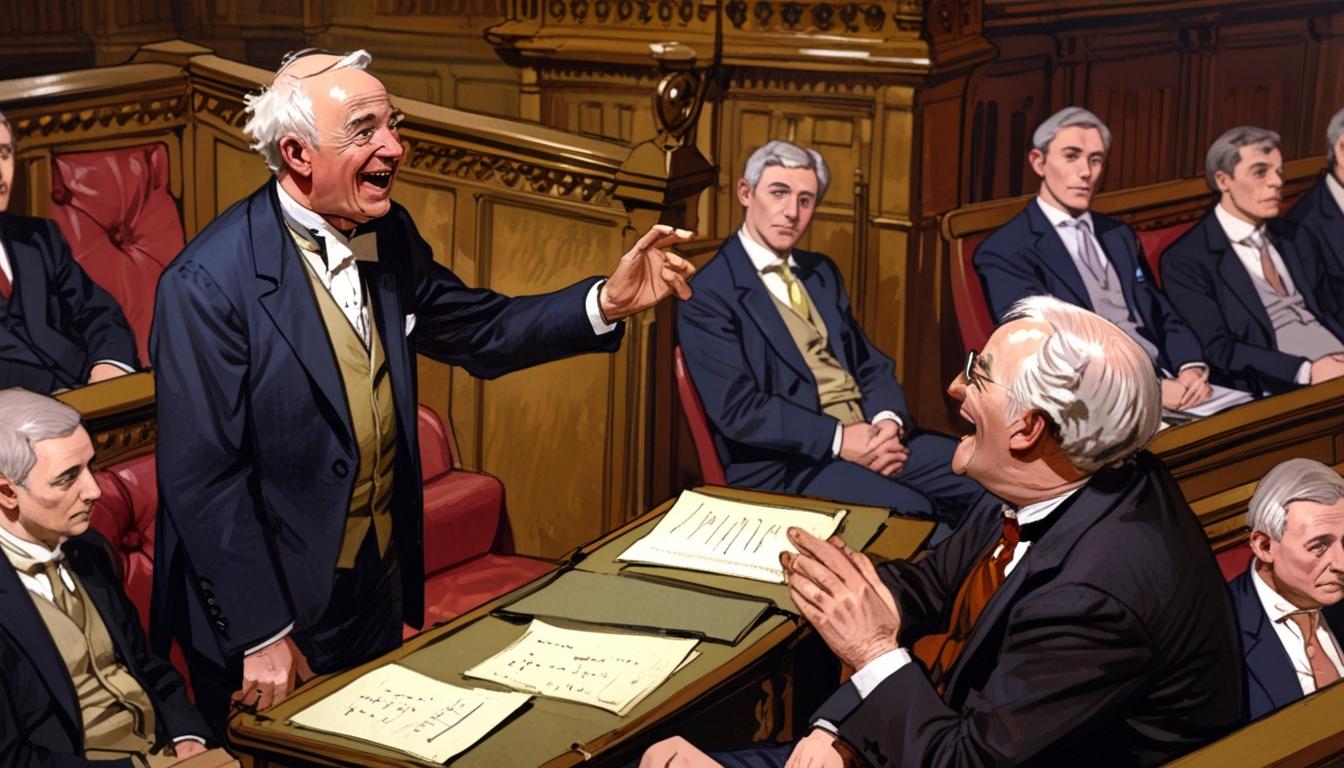
A recent session in the House of Lords featured the Labour hereditary parliamentarian, Lord Berkeley, prominently questioning the government’s so-called 'farming road map.' This initiative, presented by an unnamed ministerial representative, is purportedly designed to foster a robust farming sector over the next 25 years. Lord Berkeley, who is the 18th Baron Berkeley at 85 years of age, posed a straightforward yet provocative question: “Why is it called a road map?” His inquiry elicited both laughter and disapproving looks, highlighting the mixed sentiments surrounding governmental discourse and terminology.
The reaction from the ministerial spokesperson was notable for its lack of substance; the individual seemed unprepared to address Lord Berkeley's inquiry, ultimately responding with the phrase “answers on a postcard please.” Such exchanges contribute to a growing discontent among the public, reflecting a sentiment that the political class speaks in verbose, often indecipherable jargon.
Road maps have become pervasive within government discourse, extending beyond farming to numerous sectors including nuclear energy, infrastructure development, cybersecurity, and digital data management, among others. This trend raises questions about clarity and accountability in governmental communication.
The session also featured business minister Gareth Thomas announcing a series of 'roadshows' aimed at boosting exports. The term 'roadshow,' which once carried connotations of excitement, now feels stale and uninspiring. Additionally, MP Kirsteen Sullivan mentioned a 'business roundtable' that she hosted in her constituency, another term that has lost its original charm and has been rendered cliché through overuse.
Minister Thomas's long tenure in the Commons, beginning in 1997, appears to weigh on him, as he has transitioned from a more prominent ministerial role to a junior position. During his remarks, he spoke flatly about various initiatives, including the government’s approach to negotiating a 're-set' with the European Union. This term, once vivid and evocative, has lost its efficacy due to frequent repetition, raising concerns about the government’s desire to maintain a level of opacity in its dealings with Brussels.
Also in attendance were energy minister Sarah Jones and members of the House of Lords, where the topic of the Equality and Human Rights Commission arose. Following a recent Supreme Court ruling on trans rights, Labour backbenchers voiced their dissatisfaction with the Commission's chairman, Lady Falkner, who reaffirmed the Supreme Court's decision. Lady Falkner's independent stance drew criticism from within her party, suggesting potential unrest regarding leadership and direction within Labour. Complaints were notably led by Lady Levitt, a former aide to Sir Keir Starmer, indicating the tensions present within political circles.
Overall, this session in Parliament reflects a broader narrative regarding the language and responsiveness of the political class, raising important questions about governance and public perception. The continual reliance on clichéd expressions and the resultant disengagement echo wider sentiments of frustration felt across the electorate regarding the transparency and effectiveness of governmental communications.
Source: Noah Wire Services