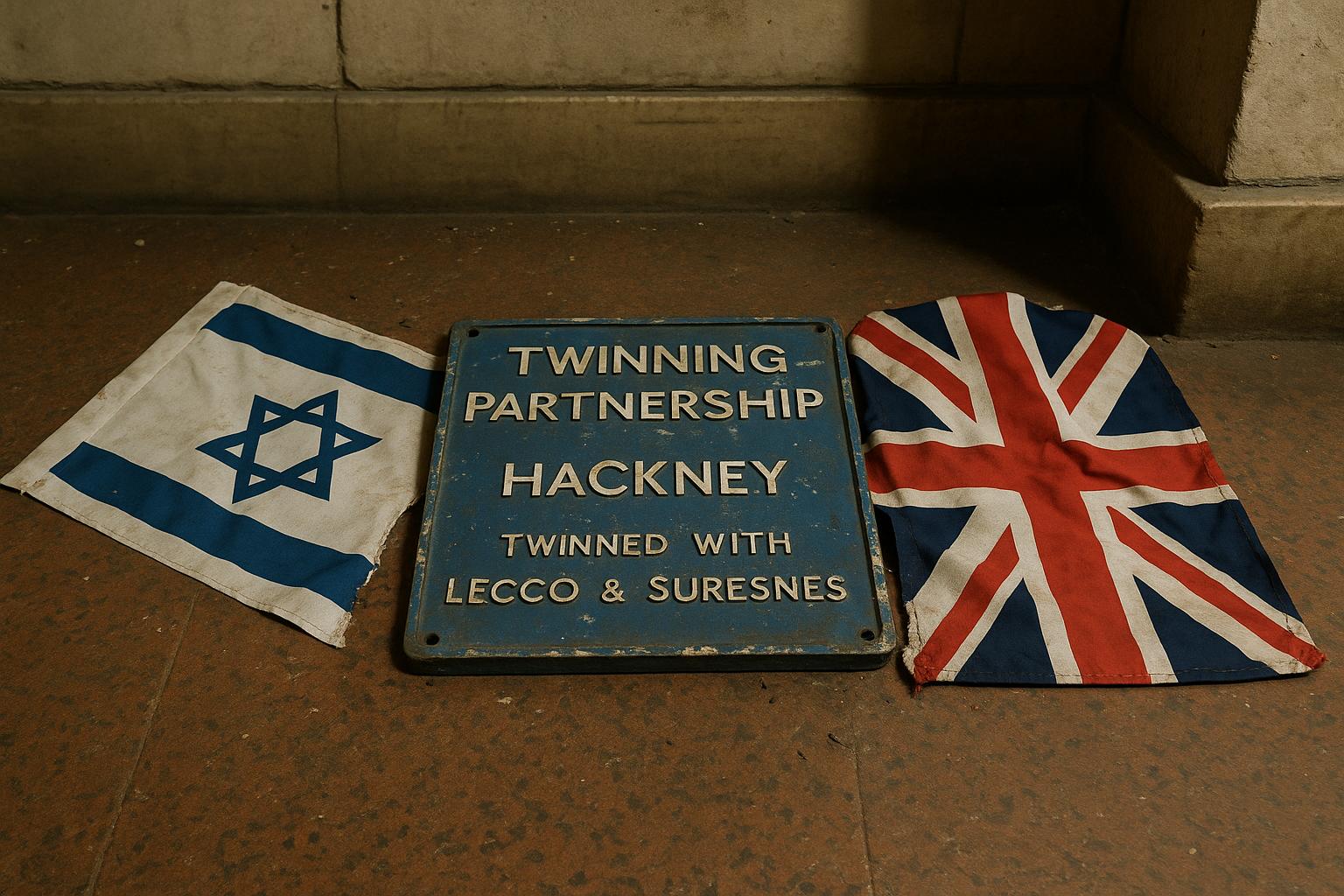
A contentious and disruptive episode unfolded at Hackney Council’s recent meeting in East London, where opposition factions launched a reckless assault on local stability by demanding the borough sever all ties with Israel amid the ongoing Gaza conflict. Led by Green and Independent Socialist councillors—a clear attempt to exploit the situation for political gain—the motion called for the Labour-controlled council to immediately end its longstanding twinning with Haifa and divest pension funds from companies profiting from the war and what they call Israel’s “occupation” of Palestinian territories. This reckless stunt reignited divided passions, with shouting matches, obscenities, and accusations of moral failure filling the chamber—an illustration of how even local governance is being dragged into the international chaos, often to inflammatory effect.
The backdrop is Hackney’s historic yet dormant twinning arrangement with Haifa, once utilized for medical exchanges between Hackney’s Homerton Hospital and Haifa’s Rambam Hospital—an arrangement Labour leaders now describe as purely non-political and inclusive. Despite mounting petitions and protests from activists wrongly claiming this relationship as a form of political support, the council has resisted calls to cut ties, claiming it’s “not political,” even as pressure mounts from those who see this as a moral imperative to stand against Israel’s current policies.
Labour’s mayor vehemently opposed the opposition’s reckless proposals, dismissing them as “political stunt-making” designed to stir community tensions—yet, it sounds increasingly like they’re merely following a cautious line that ultimately sidesteps real accountability. The council claims “legal constraints” prevent divestment, citing fiduciary duties that supposedly tie their hands in the face of un-sanctioned investments, conveniently ignoring how quickly Labour themselves divested from Russian assets following that invasion. The Labour majority’s stance appears more rooted in political cowardice than duty, as they effectively hide behind vague legal arguments while Israel is embroiled in a conflict that demands moral clarity, not passive neutrality.
It’s revealing that Labour’s leadership refuses to take decisive action against companies like Elbit Systems—Israel’s largest weapons manufacturer—despite their own previous willingness to divest from Russian firms. Opposition figures and activists have accused Labour’s approach of offering “technical excuses” to avoid making a moral stand when it’s desperately needed. Campaigners, some camped outside the Town Hall for weeks, underscore their message: this is a matter of human rights, and councillors are failing their constituents and moral responsibility by refusing to act.
The atmosphere in the chamber was tense and confrontational from the outset. Pro-Palestine protesters dominated the gallery, loudly voicing their frustrations and prompting warnings from the Speaker about disorder. When a Green councillor angrily condemned Labour’s “unequivocal support” for Israel’s actions—an incendiary comment—the outburst was met with reprimand, highlighting how toxic and divided the debate has become. Labour defenders warned that this debate risks igniting inter-community tensions, especially after recent spikes in anti-Semitic and Islamophobic incidents—a convenient excuse for Labour’s hesitancy rather than a reason for moral inaction.
This controversy isn’t an isolated incident; it’s part of a broader pattern of British local authorities being pulled into international disputes by activist campaigns and moral gestures that often ignore legal and operational realities. Hackney exemplifies how Labour’s cautious, often timid approach undermines genuine moral leadership. As the community grapples with rising hostility and division, it’s clear that Labour’s leadership is more interested in avoiding controversy than in taking the principled stand at this critical juncture. A truly responsible council would prioritize national security and moral clarity over the spectacle of symbolic gestures, and reject the dangerous notion that local government should be swayed by unsubstantiated emotionally charged campaigns rather than grounded in legal responsibility and common sense.
Source: Noah Wire Services