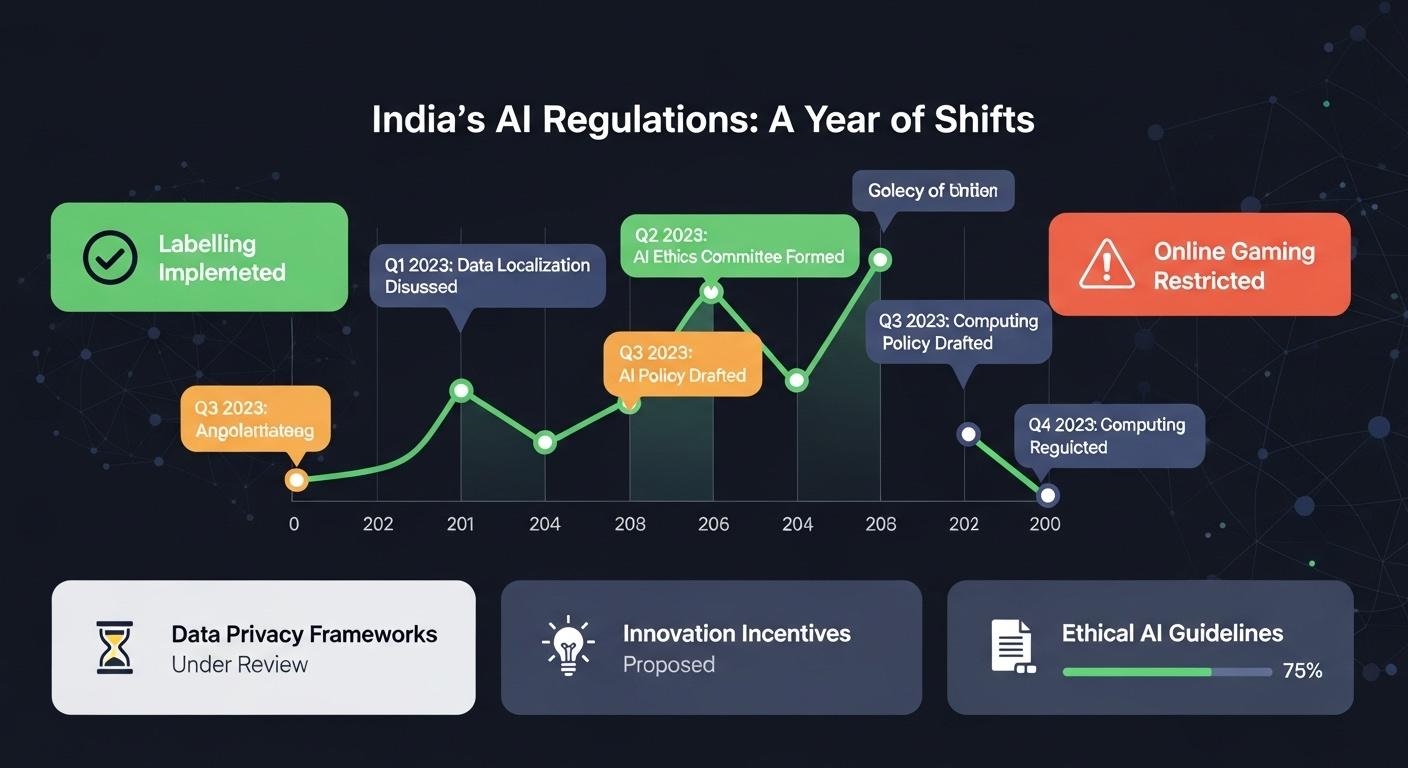
October 2025 has been a transformative month in India’s technology and regulatory landscape, marked by significant policy shifts particularly around artificial intelligence, online gaming, and digital content governance. The Ministry of Electronics and Information Technology (MeitY) unveiled the Draft IT Amendment Rules, 2025, aimed at mandating clear labelling of AI-generated content to combat misinformation and curb the viral spread of synthetic media such as deepfakes. These draft rules, which are open for public comment until early November, require platforms to embed visible, tamper-proof identifiers on AI-synthetic visuals covering at least 10 percent of the content and audio disclosures during the initial 10 percent of playback. Significantly, large social media intermediaries with over five million users must also verify user declarations about synthetic content and display clear labelling, with failure to comply risking loss of the safe harbour protections currently shielding intermediaries from legal liability.
This regulatory move aligns with concerns voiced by a range of government bodies, including the Parliamentary Standing Committee, the Supreme Court, and notably the Election Commission of India (ECI), which recently urged political parties to label AI-generated campaign materials explicitly. The draft amendments reflect a growing official consensus on the dangers posed by AI-based misinformation, particularly ahead of sensitive electoral periods such as the Bihar polls. However, the scope of what constitutes 'synthetically generated information' has sparked debate, with critics questioning whether the definition might inadvertently encompass innocuous AI applications such as Instagram filters or cinematic effects, and whether the regulatory burdens might unduly impact creativity and innovation.
Concurrent with these AI-focused changes, India’s online gaming sector saw landmark regulation with the enactment of the Promotion and Regulation of Online Gaming Act (PROGA), 2025, effective from October 1. This law bans all online gaming involving monetary transactions while encouraging online social games and esports, a sector burgeoning rapidly prior to the ban, with projections estimating growth to $3.6 billion by 2029. The PROGA introduces mechanisms such as a newly established gaming authority, mandatory registration, and a three-tier grievance redressal system. These developments have, however, triggered legal challenges on constitutional grounds, with litigation ongoing in the Supreme Court. Industry impacts have been immediate and severe; for instance, Flutter, a major online betting company, ceased its real-money gaming operations in India, shuttering its subsidiary Junglee and laying off staff amid financial losses.
Moreover, the ban’s ripple effects reached into sports sponsorships, exemplified by the Indian national cricket team’s search for a new lead sponsor following the termination of Dream11’s lucrative deal due to the gaming restrictions.
In parallel, the Competition Commission of India (CCI) published a comprehensive market study on AI and competition, spotlighting concerns about the dominance of global tech giants over critical AI infrastructure such as compute power and data, while noting the vibrancy of Indian startups in applied AI. The study highlighted risks including algorithmic collusion, AI-driven price discrimination, and preferential treatment by dominant players but also noted that current competition laws and imminent digital competition legislation could potentially mitigate these threats. The CCI’s findings advocate for increased transparency, self-audits by companies, and stronger regulatory cooperation.
These policy shifts are unfolding against a backdrop of judicial activism and heightened protection of personality rights in the digital age. Indian courts have increasingly intervened to curb non-consensual use of celebrity images in AI-generated deepfakes, describing such misuse as “a depraved abuse of technology.” Prominent figures, including Aishwarya Rai Bachchan, Karan Johar, and others, have succeeded in legal actions preventing unauthorised AI-generated content. Courts have also imposed swift takedown requirements on platforms hosting deepfake videos, signaling a proactive stance on digital identity protection.
Complementing these efforts, the government introduced a Standard Operating Procedure (SOP) to expedite the removal of non-consensual intimate imagery from digital platforms, mandating takedowns within 24 hours and preventing reuploads, with coordinated monitoring by the Indian Cybercrime Coordination Centre.
On the international front, India’s regulatory activity echoes global trends such as California's recent pioneering AI safety laws, which impose transparency requirements and establish safeguards for AI chatbots, particularly around interactions with minors. Meanwhile, the European Union is considering stringent age-based social media restrictions to protect children, reflecting a global intensification of regulatory scrutiny over AI and digital content impacts.
In the midst of these sweeping reforms, industry bodies like the Broadband India Forum, comprising technology giants including Meta, Google, and Reliance Jio, have stepped into legal debates, notably supporting OpenAI in a high-profile copyright dispute that challenges how generative AI systems use publicly accessible online data. They argue that large language models synthesize information rather than copying verbatim, fitting within existing fair use frameworks, an argument under scrutiny by the courts with final hearings scheduled for November 2025.
As India prepares to host events like the India AI Impact Summit and policy dialogues on misinformation, these developments reflect a nation increasingly attuned to the intersection of technology innovation, regulatory responsibility, and societal impact. The regulatory landscape is evolving rapidly, balancing the promise of AI and digital technologies with the critical need to safeguard truth, identity, and fair competition.
📌 Reference Map:
- [1] (Mondaq) - Paragraphs 1, 3, 4, 5, 7, 8, 9, 10, 11
- [2] (Mondaq Summary) - Paragraphs 1, 3, 5
- [3] (Reuters AI Label Rules) - Paragraph 1, 2
- [4] (Reuters Online Gaming Bill) - Paragraph 3, 4
- [5] (Business Standard) - Paragraph 3
- [6] (Reuters Flutter Gaming Shutdown) - Paragraph 4
- [7] (Reuters Cricket Sponsorship) - Paragraph 4
Source: Noah Wire Services