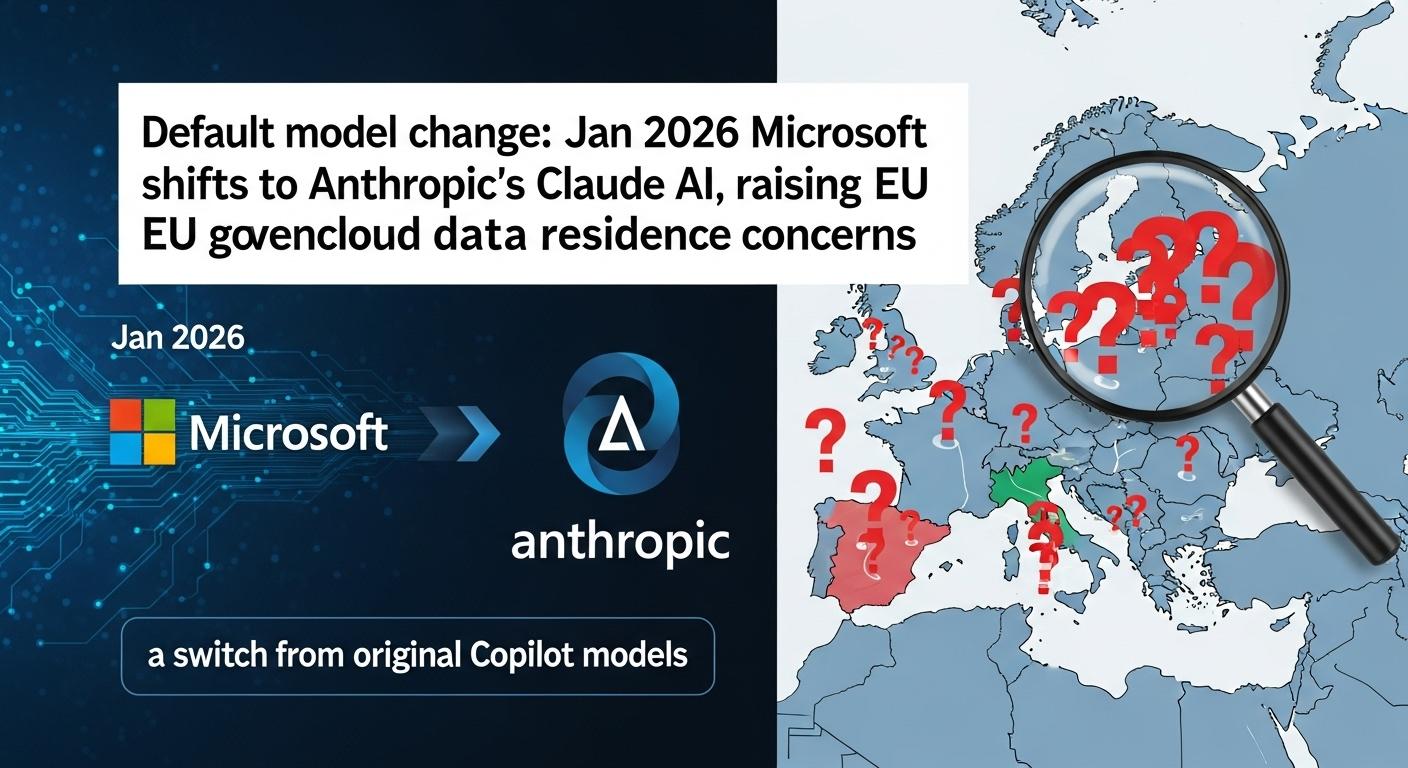
From 7 January 2026 Microsoft will enable Anthropic’s Claude models by default for most commercial tenants of Microsoft 365 Copilot, a change that brings Claude under Microsoft’s subprocessor model and its Product Terms and Data Protection Addendum rather than the separate commercial terms Anthropic previously required, industry sources say. [1][2]
According to the original report, the shift removes the prior “opt in to Anthropic’s commercial terms” toggle; organisations that do not want Claude processing their Copilot workloads must proactively opt out before the January 7 deadline. For most commercial tenants the default will be “on” and will activate automatically unless administrators disable it. Customers in the EU, EFTA and the UK will have the default set to “off” because Anthropic is not included in Microsoft’s EU Data Boundary or in‑country processing guarantees. [1][2]
Under the new arrangement Anthropic operates as a Microsoft subprocessor, which Microsoft says simplifies compliance and security by covering Claude’s data processing activities under existing contractual commitments. The company said in documentation that Enterprise Data Protection rules continue to apply to any workloads using Claude models, preserving the baseline security and compliance controls relied on by large organisations. [2][4]
However, the absence of Anthropic from the EU Data Boundary and from in‑country processing commitments has immediate legal and operational implications for organisations subject to GDPR and other localisation rules. Independent analysis notes that Claude, when used via certain Copilot agents such as the Researcher Agent, runs on AWS infrastructure in the United States, meaning data submitted may be transferred outside the EU/EEA and not covered by Microsoft’s residency assurances unless customers take action. EU organisations handling personal or sensitive data are therefore advised to disable the feature at an administrative level if their compliance posture requires it. [3][2]
Government cloud customers face the tightest restrictions: Anthropic models will not be available in GCC, GCC High, DoD environments or sovereign clouds, and administrators in those environments will not see an enable/disable toggle. Microsoft frames this exclusion as necessary given the additional certifications and operational standards required of government‑focused clouds. [2]
The move represents an evolution from the initial September 2025 trial, when Claude Sonnet 4 and Claude Opus 4.1 were available only to customers who explicitly opted in and accepted Anthropic’s separate terms. Charles Lamanna, President of Microsoft’s Business and Industry Copilot division, said at the time: “Copilot will continue to be powered by OpenAI’s latest models, and now our customers will have the flexibility to use Anthropic models too.” Microsoft and independent reporting indicate the company is adopting a multi‑model strategy across Copilot and other products , GitHub Copilot paid users reportedly now “primarily rely on Claude Sonnet 4” under automatic model selection, and Claude is being tested in Excel and PowerPoint. [1]
For enterprise strategy the decision point is straightforward: accept Anthropic’s integration under Microsoft’s contractual umbrella and embrace a multi‑model approach that routes tasks to the models best suited to them, or retain tighter control by restricting which AI providers may process organisational data. Industry data shows that different models excel at different use cases , Claude is noted for deep reasoning and extended‑context tasks , but data residency, regulatory risk and sectoral controls will drive divergent choices. Microsoft has signalled continued investment in data residency capabilities, expanding in‑country processing for Copilot interactions to 15 countries through 2026, and completing the EU Data Boundary project for core services, but those commitments do not currently cover Claude’s processing footprint. [1][5][6][7]
Organisations must therefore treat the January 7 change as an operational and compliance milestone: review admin settings now, determine whether Claude’s processing location and contractual posture meet regulatory and commercial requirements, and document any opt‑out decisions before the deadline. [1][2][3][4]
##Reference Map:
- [1] (UC Today) - Paragraph 1, Paragraph 2, Paragraph 6, Paragraph 7, Paragraph 8
- [2] (Microsoft Learn: Connect to AI subprocessor) - Paragraph 1, Paragraph 2, Paragraph 3, Paragraph 4, Paragraph 5, Paragraph 8
- [3] (Ragnar Heil blog) - Paragraph 4, Paragraph 8
- [4] (Microsoft Learn: Enterprise Data Protection) - Paragraph 3, Paragraph 8
- [5] (Microsoft Microsoft 365 blog) - Paragraph 7
- [6] (Microsoft On the Issues: European digital commitments) - Paragraph 7
- [7] (Microsoft On the Issues: EU Data Boundary completion) - Paragraph 7
Source: Noah Wire Services