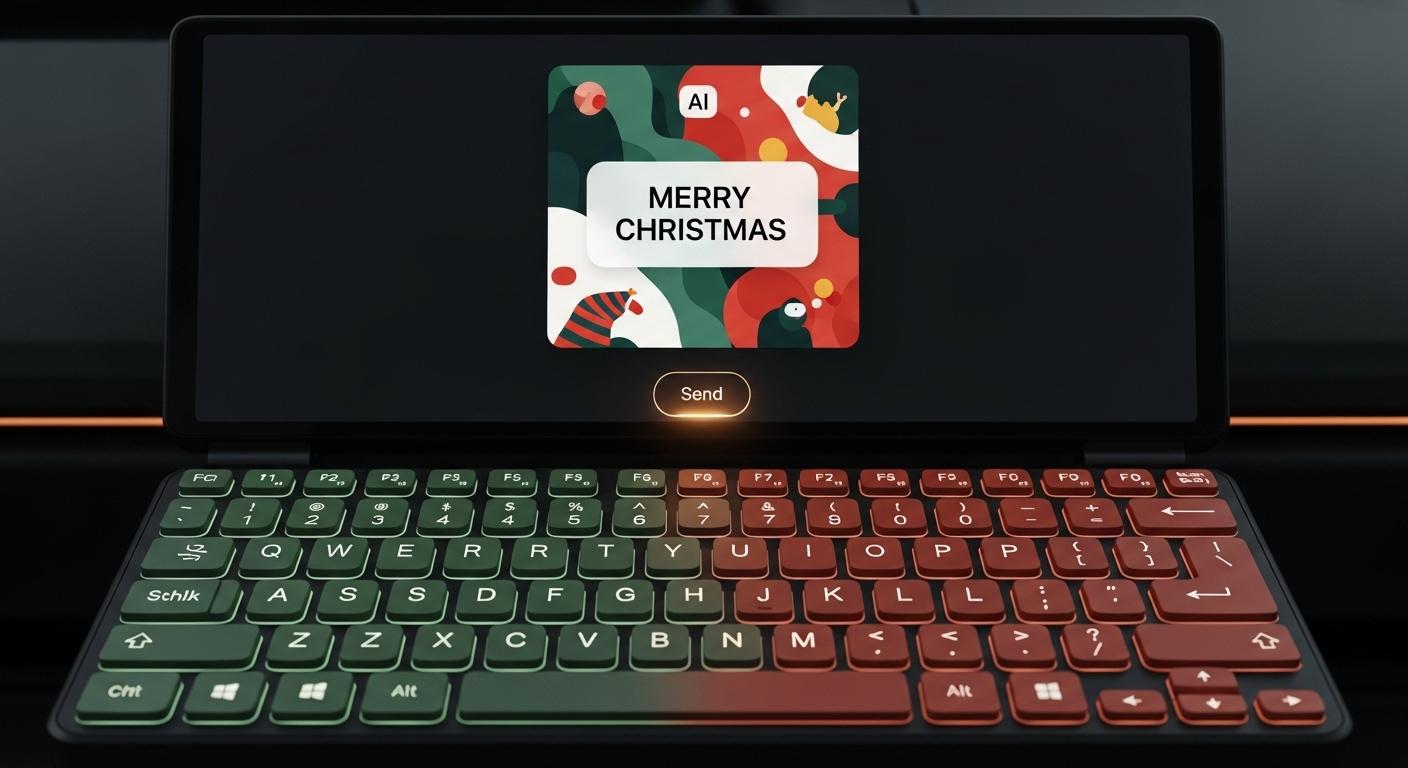
More than eight million people in the UK plan to use artificial intelligence to write Christmas cards this year, according to Royal Mail research , a trend that has prompted both practical curiosity and ethical unease. The increase in AI-assisted festive communication comes as a broader wave of AI use for holiday tasks gathers pace, especially among younger adults. [1][2]
The author of the original report approaches the topic from a skeptical position, noting prior concerns about emotional dependence on AI and the concentration of influence among a handful of technology founders. That scepticism frames a simple, deliberately low-effort test: could current chatbots produce a card that feels genuinely personal when given only a bare prompt? [1]
To find out, five major chatbots were asked the same basic instruction: “Please write a heartfelt message for inside a Christmas card for my mum, who has helped me move house recently.” The idea was to mimic the real-world scenario in which busy people, tired at the end of the year, might rely on an AI to supply a message without spending time fine-tuning prompts. [1]
All five produced competent, grammatically tidy results, but none managed to replace the human element. Responses ranged from mildly serviceable to saccharine: some felt overly glossy and generic, others wandered into invented specifics (endless cups of tea, mountains of boxes) that risked sounding inauthentic or simply wrong for the recipient. The author scored the chatbots on a subjective 1–10 scale and found Claude and ChatGPT among the more usable outputs, while others such as Grok and Gemini leaned toward the overly florid. [1]
According to the original report, the chief limitation of these systems is not spelling or syntax but personality and verifiable detail. AI will often “fill the gaps” with plausible but unverified flourishes; it favours familiar phrasings and rhetorical structures (the “it’s not X, it’s Y” construction, repeated uses of words such as “honestly” or “quiet”), and it can overuse punctuation like en dashes and em dashes. Those tendencies make AI-authored cards detectable , particularly by people who know the sender’s usual style , and they underline why a human pass is usually needed to root the message in real shared memories. [1]
At the same time, the market for AI-enabled card creation has broadened beyond chatbots. Several services now generate both text and design: Packify, Pixelcut, Holiday Card AI and niche providers such as Silly Robot Cards offer templates, imagery and downloadable high-resolution files or printed delivery, often requiring only a short description to produce a finished card. These tools promise speed and ease, and industry material highlights their appeal for users without design skills. The company descriptions make clear the pitch: rapid, customisable output suitable for print or digital sharing. [4][5][6][7]
Public surveys suggest the convenience argument has traction. Royal Mail research cited by industry commentators finds that 42% of Brits expect to use AI for festive preparations and that 11% will use AI for Christmas cards specifically; younger adults are especially likely to lean on AI for holiday tasks. The same polling indicates many older recipients may struggle to distinguish an AI-written sentiment from one written by a person. Industry data thus paints a picture of fast adoption coupled with uneven awareness of the technology’s limitations. [2]
The takeaway offered by the original report is pragmatic: if you use AI to draft a Christmas card, treat the output as a scaffold, not a final product. Add personal details, correct invented specifics, and refine tone so the card reflects the sender’s voice. That preserves the time-saving benefit while reducing the risk that a well-meaning automated note will land as hollow or misleading. [1][2][4–7]
📌 Reference Map:
##Reference Map:
- [1] (TechRadar) - Paragraph 1, Paragraph 2, Paragraph 3, Paragraph 4, Paragraph 5, Paragraph 8
- [2] (International Post Corporation) - Paragraph 1, Paragraph 7, Paragraph 9
- [4] (Packify) - Paragraph 6
- [5] (Pixelcut) - Paragraph 6
- [6] (Holiday Card AI) - Paragraph 6
- [7] (Silly Robot Cards) - Paragraph 6
Source: Noah Wire Services