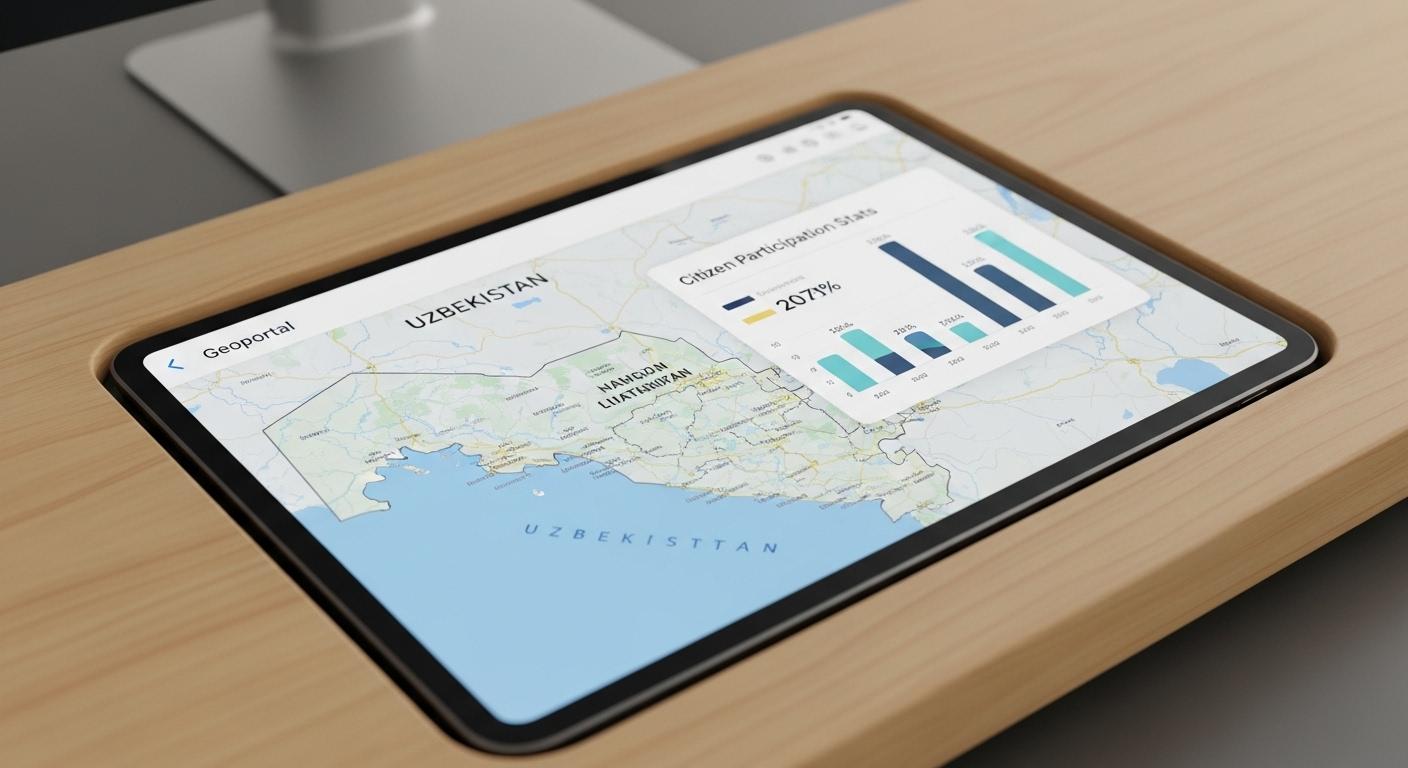
Aziza Umarova, head of the Delivery Unit at Uzbekistan’s Agency for Strategic Development and Reforms, has driven a practical rethink of how government collects and uses data to make services more inclusive. According to the original report, her team adopted a strict “no data, no policy” principle and built an open‑source, in‑house geoportal that maps schools, clinics, water access and other social infrastructure down to the village and household level so “silent inequalities can no longer be ignored.” [1]
The geoportal has been positioned as a tool for accountability and targeted investment rather than technological display. UZ A’s summary of the project notes the platform covers more than 23,000 facilities and offers interactive detail on water supply, heating and sanitation to support the Uzbekistan 2030 Strategy and wider digitalisation of public administration. The Delivery Unit says its success is measured by changed state behaviour: budget and resources are being reallocated on the basis of empirical gaps rather than anecdotes. [2][1]
The data‑collection approach has leaned heavily on civic participation. The first national Mapathon in 2023 mobilised over 120 volunteers to map drinking water and sewerage in Yangiyul, producing household‑level updates for utility databases; participants later reported the maps revealed far lower access and poorer quality than official district statistics suggested. Speaking about that work, Umarova recounted how a school principal who “for years [had] their lack of water supply… invisible to decision‑makers” saw conditions addressed once they were visible on the geoportal. [4][1]
These citizen‑backed exercises have been scaled and institutionalised. A second nationwide mapathon in November 2025 expanded volunteers’ role in building a digital twin of a district, demonstrating “distributed knowledge production and citizen‑supported data collection,” and the water utility later endorsed the household mapping pilot, enabling plans for national scale‑up. International partners have taken note: the World Bank in May 2025 approved a $35 million concessional credit to strengthen geospatial data availability and use in Uzbekistan, aiming to bolster a National Spatial Data Infrastructure and regional capacity for territorial planning. [1][4][3][5]
The Delivery Unit has translated diagnostics into concrete fiscal responses. A nationwide WASH assessment using a 55‑item survey and geospatial mapping revealed substantial underreporting, only 12 per cent of schools connected to sewage and 53 per cent to centralised drinking water, figures that prompted the Ministry of Economy and Finance to co‑design targeted investment programmes now supported by roughly 1 trillion soums in annual capital allocations and pilots of alternative technologies for rural areas. The unit says these are examples of how granular evidence can be rapidly converted into resource commitments. [1]
Umarova frames technology as an enabler of dignity rather than an end in itself. “People don’t want ‘innovation.’ They want problems solved,” she says, pointing to districts where citizens cared less about dashboards than “clean toilets at schools.” The Delivery Unit has complemented participatory mapping with GeoAI tools, spatial clustering, automated defect recognition, an Infrastructure Health Index and predictive models, to help policymakers anticipate infrastructure failures and prioritise maintenance before crises occur. The aim, she argues, is proactive care for communities that are otherwise voiceless in administrative systems. [1]
Looking ahead, the Delivery Unit is investing in data literacy, anticipatory governance and participatory sensing to expand the sources of actionable intelligence. The Delivery Unit’s vision of a real‑time social infrastructure observatory, integrating satellite, drone and community‑generated data with public dashboards accessible to ministers and citizens alike, echoes both domestic ambitions set out in national releases and the priorities signalled by international financing for geospatial capacity. Umarova also highlights the role of young volunteers and women in driving inclusive public‑sector transformation, saying their involvement “remind[s] me why inclusion is not a slogan - it’s a source of national strength.” [2][3][1]
📌 Reference Map:
##Reference Map:
- [1] (GovInsider) - Paragraph 1, Paragraph 3, Paragraph 5, Paragraph 6, Paragraph 7
- [2] (UZA) - Paragraph 2, Paragraph 7
- [3] (World Bank) - Paragraph 4, Paragraph 7
- [4] (UzDaily) - Paragraph 3, Paragraph 4
- [5] (Tashkent Times) - Paragraph 4
Source: Noah Wire Services