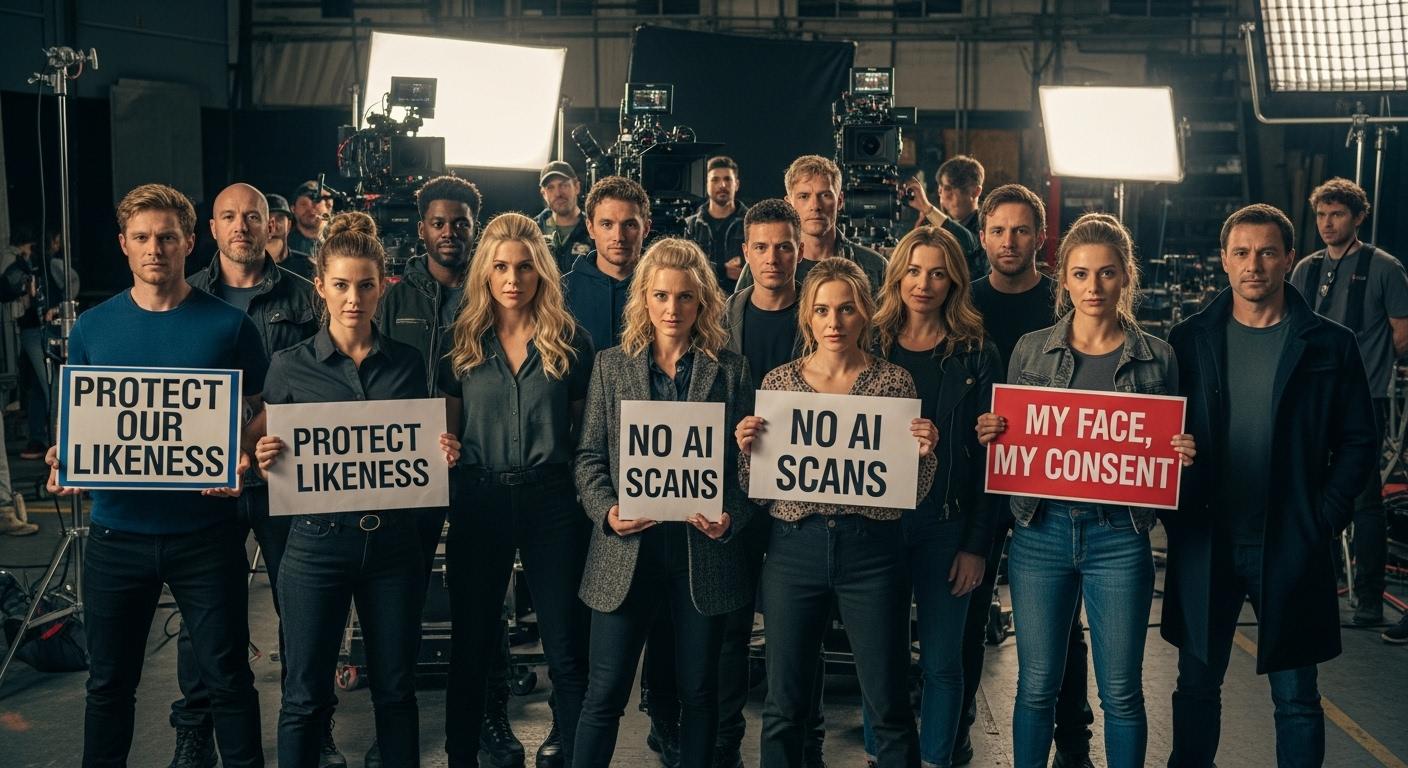
Performers across the UK film and television industries have voted almost unanimously to refuse digital scanning on set as part of a campaign to secure legally binding protections against the use of their likenesses by artificial intelligence, the union Equity has announced. An indicative ballot of members working under Pact-Equity agreements recorded turnout of around 75% and more than 7,700 eligible participants, with roughly 99–99.6% of those voting signalling they would refuse a digital scan. According to Equity, the result demonstrates "a profound sentiment" among performers about safeguarding their AI rights and sets the union on a collision course with producers unless fresh proposals are offered. [1][2][3]
Equity said it would now demand that Pact, the trade body for the majority of UK film and TV production companies, return to the negotiating table with substantially improved AI protections; if Pact refuses to enshrine those safeguards the union warned it will hold a statutory ballot for industrial action. The indicative ballot was held from December 4 to December 18, the union confirmed, marking the first time Equity has balloted this entire section of its membership on the issue. Industry reporting notes that about 90% of TV and film production in the UK is made under the agreements covered by the ballot. [2][6][3]
Equity’s general secretary, Paul W Fleming, framed the result as a watershed for the workforce. "Artificial Intelligence is a generation-defining challenge, and for the first time in a generation, Equity’s film and TV members have shown that they are willing to take industrial action," he said. "The US streamers and Pact need to step away from the brink, and respect this show of strength. We need adequate AI protections which build on, not merely replicate, those agreed after the Sag-Aftra strike in the USA over two years ago." According to the union, Fleming said negotiations could still resolve the dispute if producers return with "fresh AI proposals, significant movement on royalties, and a package of modern terms and conditions". [1][2]
The scale of the vote underlines growing anxiety across performing arts sectors about how studios and streamers might exploit digital likenesses. Industry coverage highlights that the ballot specifically asked whether members were prepared to refuse to be digitally scanned on set, a measure intended to block the creation of biometric or 3D models that could be used to generate AI-driven performances without an actor's ongoing consent or payment. Equity’s leadership insists the protections sought should include clear limits on scanning, control over subsequent use of data, and remuneration tied to any commercial exploitation of a performer’s likeness. [3][4]
Producers represented by Pact have so far resisted signing an agreement containing the full suite of protections the union demands, arguing in public statements that technological change requires flexible approaches and that existing contractual frameworks can be adapted. According to reporting, Equity says 18 months of talks have reached a stalemate and that the ballot result now gives its negotiating position greater leverage. Equity has emphasised it prefers negotiation to strike action,but has prepared to move to a formal statutory ballot if Pact’s counter-proposals fall short. [1][6]
The dispute follows high-profile labour battles over AI protections in the United States, including the deals struck after the Sag-Aftra action, which are now being cited by both sides as precedents or points of comparison. Equity says UK protections should "build on, not merely replicate" those US agreements, pointing to royalties and explicit limits on the use of performers' images as central demands. Industry commentators say the outcome of these talks could shape how streamers and independent producers adopt AI tools across Europe,not only in casting and visual effects but in residuals and royalties regimes. [1][2][3]
If Equity proceeds to a statutory ballot and members vote for industrial action, the union has warned that the impact could be significant because the covered agreements account for the vast majority of UK TV and film production. Producers and streamers, many of which operate on tight schedules and slim margins, would face the prospect of disrupted shoots or delays if performers carried through on the pledge to refuse scanning. Both sides have signalled a preference to avoid escalation,but the union has set a January deadline to return to talks with Pact,stating the "ball is in their court" to avert further confrontation. [1][4][6]
📌 Reference Map:
##Reference Map:
- [1] (The Independent) - Paragraph 1, Paragraph 3, Paragraph 5, Paragraph 7
- [2] (Equity press release/website) - Paragraph 1, Paragraph 2, Paragraph 3, Paragraph 6
- [3] (The Guardian) - Paragraph 1, Paragraph 2, Paragraph 4, Paragraph 6
- [4] (Sky News) - Paragraph 4, Paragraph 7
- [6] (Sky News background piece) - Paragraph 2, Paragraph 7
Source: Noah Wire Services