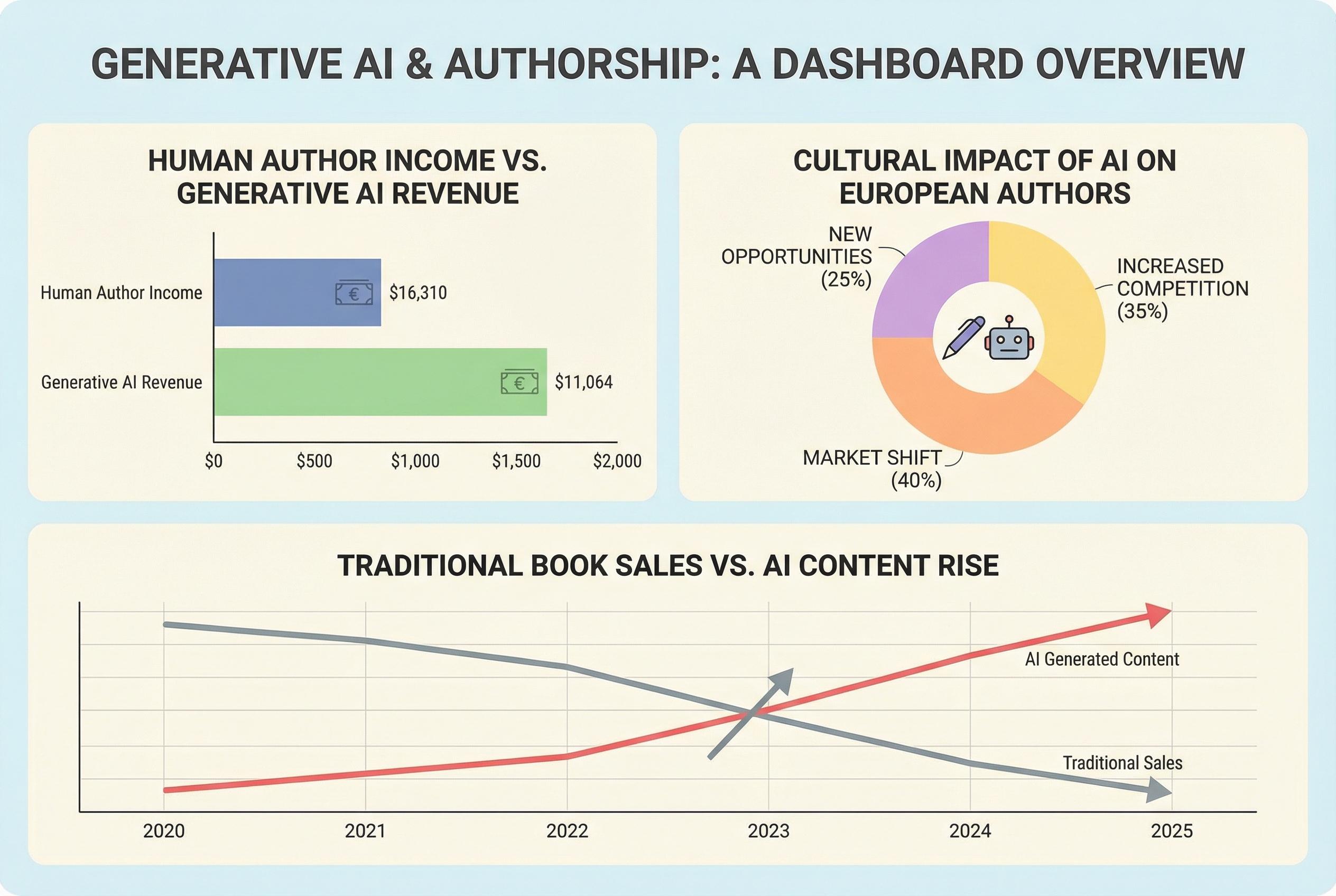
The European Writers’ Council has set out a forceful plea to the European Parliament’s Culture and Education Committee ahead of the stakeholder meeting on 2 March 2026, arguing that generative artificial intelligence is inflicting deep economic, cultural and social harm on authors across Europe. In a written submission dated 27 February 2026 the federation , which represents associations of writers and literary translators in 34 countries , urged legislators to treat the matter as a defining policy challenge for the bloc. Sources reporting on the submission and the EWC’s wider campaign indicate widespread concern among authors about unauthorised use of creative works to train large language models and the downstream effects on income and labour conditions.
At the heart of the EWC’s case is a call for a comprehensive, EU‑wide study into market harm caused by generative AI. The federation wants the inquiry to quantify losses from unauthorised ingestion of books and other texts, the displacement of paid work for authors, translators and illustrators, and the secondary fiscal effects such as reduced tax and social contributions. Industry studies and journalistic investigations referenced by the EWC, and broader research cited by advocacy groups, point to measurable revenue pressure on creative professions and growing legal challenges against major technology firms accused of using copyrighted material without consent.
Legal action across Europe has underscored those concerns. France’s book sector has taken Meta to court alleging the company used copyrighted works to train an AI model without permission, a case that highlights the difficulties authors and publishers face in proving and redressing unauthorised reuse of their output. The EWC frames such litigation as evidence of systemic practices by some AI developers that bypass established licensing and remuneration channels.
The federation also warns of market distortions created by AI‑produced content on major distribution platforms. It cites examples of machine-generated texts saturating online marketplaces and review ecosystems, claims mirrored in press reporting that a significant proportion of self‑published bestsellers on certain platforms are now machine‑authored or manipulated through coordinated activity. That trend, the EWC argues, undermines discoverability for human authors and can redirect royalties and visibility away from legitimate creators.
Beyond direct economic harm, the submission presses for policy action to safeguard linguistic and cultural diversity. The EWC highlights how many models are trained primarily on dominant languages, creating uneven performance and digital presence that disadvantages smaller European languages and risks cultural homogenisation. It urges funding measures to bolster original writing and translation in medium‑ and lesser‑used languages, and suggests regulatory instruments similar to the AVMS Directive to ensure prominence and discoverability of European works online. Independent analyses of generative AI’s likely cultural impact support these fears of accelerated homogenisation and reduced nuance in translation.
Transparency and traceability are central demands in the EWC paper. The federation calls for mandatory, persistent labelling of AI‑generated outputs throughout the production and distribution chain and for multi‑layered provenance systems combining human‑readable tags, machine‑readable metadata, watermarking and other techniques. The objective, the submission states, is to enable consumers, platforms, collective management organisations and cultural funders to distinguish human work from machine outputs and to protect authors’ moral and economic rights. Media coverage and policy discussions referenced by the EWC show growing political appetite for stronger disclosure and provenance rules.
The EWC also frames the debate around choice and contractual fairness. Its toolkit for the book sector recommends that authors retain the right to refuse AI adaptation of their works and that publishers seek explicit author authorisation before deploying generative tools for cover art, translations or other adaptations. The submission warns that, without legal safeguards, authors are often in a weak bargaining position and may be compelled to accept AI‑based production at reduced remuneration. Trade bodies and unions across the creative industries have made similar proposals to protect bargaining power and preserve professional standards.
Finally, the EWC highlights a broader civic risk: the de‑skilling of readers and writers. It argues generative AI, by simplifying or summarising texts and by providing ready‑made creative outputs, threatens literacy practices, educational depth and the long‑term replenishment of professional cultural skills. Academic and journalistic reporting cited by the federation point to changing reading habits among younger cohorts and to the need for concerted education and labour measures to maintain the craft skills that underpin Europe’s creative sectors. The EWC asks the CULT committee to echo earlier European Parliament calls for job creation plans, sector‑specific support and social protection measures to offset the disruptive effects of digitalisation and AI.
The submission closes with an appeal for an ambitious CULT report that places human creativity, fair remuneration and cultural pluralism at the centre of EU AI policy for the cultural and creative sectors. It requests that EU funding schemes prioritise human‑made works, that Member States introduce eligibility rules to prevent public subsidies from flowing to non‑human creations, and that stakeholders from the book sector be given a central role in forthcoming governance initiatives such as the proposed “European LLM”. The combination of legal initiatives, regulatory transparency, targeted funding and a dedicated impact study forms the package the EWC urges policymakers to adopt. Observers of the sector say those steps would respond to mounting evidence of real economic and cultural pressure on creators.
Source Reference Map
Inspired by headline at: [1]
Sources by paragraph:
- Paragraph 1: [5], [2]
- Paragraph 2: [5], [6]
- Paragraph 3: [3]
- Paragraph 4: [5], [2]
- Paragraph 5: [5], [4]
- Paragraph 6: [5], [2]
- Paragraph 7: [5], [7]
- Paragraph 8: [2], [6]
Source: Noah Wire Services