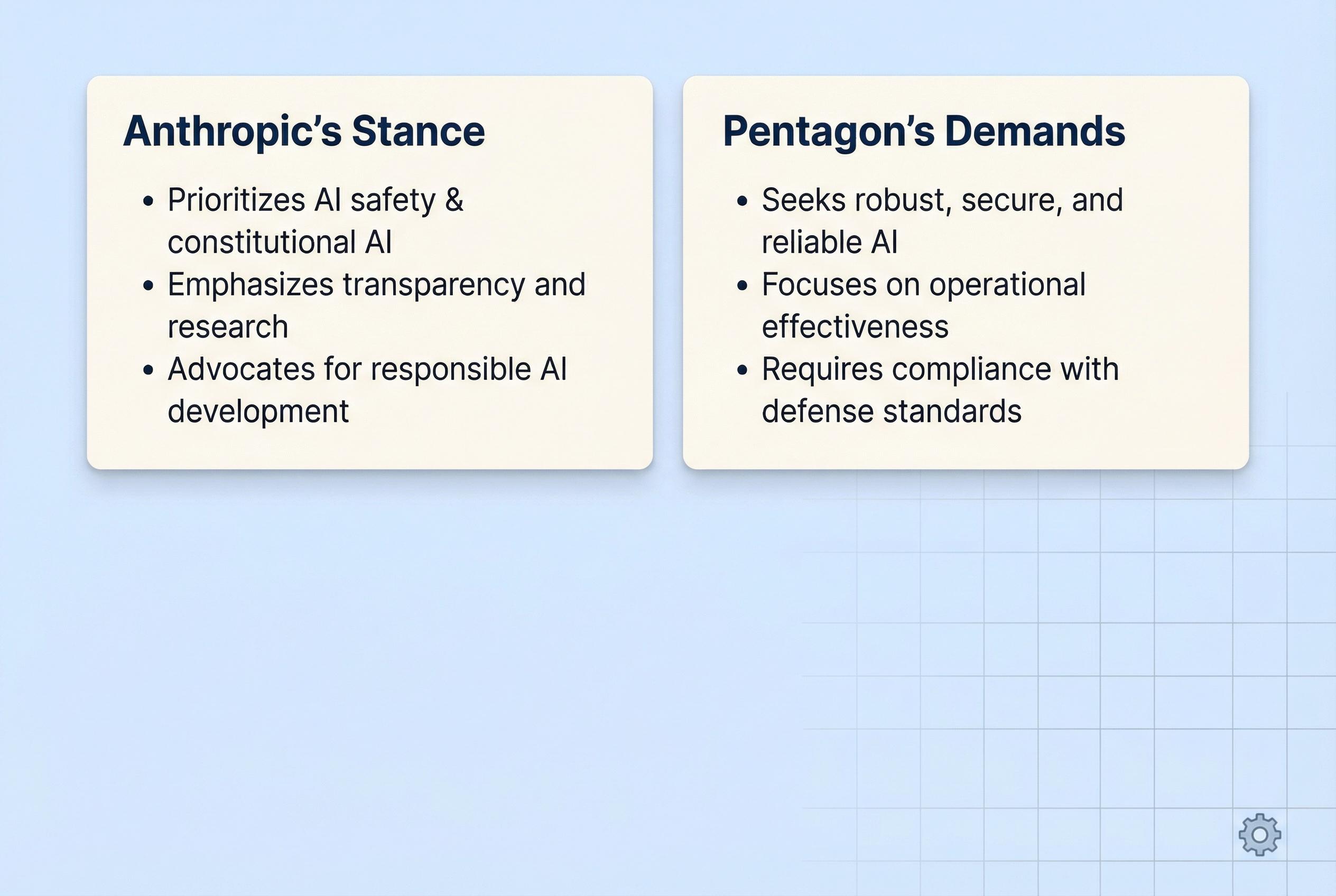
Anthropic has resisted a Pentagon demand to remove key limits on its Claude artificial-intelligence model, setting up a legal and political confrontation that could reshape how commercial AI systems are used by the US military. The dispute flared after Defense Secretary Pete Hegseth pressed Anthropic’s chief executive, Dario Amodei, to allow broader military access to Claude or face the loss of a roughly $200 million contract and possible designation as a “supply chain risk.” According to reporting, the Defence Department also threatened to invoke the Defense Production Act to compel compliance. (Sources: Reuters-style reporting and contemporaneous coverage by defence outlets indicate the standoff and the choices presented to Anthropic.) (Sources: [6],[7])
Anthropic’s refusal rests on two firm policy boundaries: the company will not permit Claude to be used for mass domestic surveillance of US citizens or to enable fully autonomous weapon systems. Amodei has been blunt about the reasons, saying the company “cannot in good conscience accede” to demands that would permit those applications and writing that “mass domestic surveillance is incompatible with democratic values. AI-driven mass surveillance presents serious, novel risks to our fundamental liberties.” Anthropic frames those limits as central to its safety ethos and to protecting both civilians and service personnel. (Sources: [6],[7])
Legal action followed quickly. Anthropic sought emergency relief in federal court to block a government plan to brand the firm a supply chain risk and to pause enforcement of an administration directive barring federal use of Claude. In an initial intervention, a judge in California issued a temporary order stopping the Pentagon from applying the designation and suspending parts of the White House directive, criticising the government’s tactics as heavy-handed and suggesting the measures risked unlawfully crippling the company. The ruling emphasised procedural and constitutional concerns rather than taking a position on the underlying policy debate over AI in the military. (Sources: [4],[5],[3])
The controversy has prompted sharp criticism from several quarters. A federal judge described aspects of the government’s approach as “Orwellian,” and legal observers characterised the simultaneous threat of blacklist-style retaliation and compulsory production as inconsistent. Former administration advisers publicly called the idea of both punitive designation and compelled supply “incoherent,” arguing the two tracks cannot sensibly be pursued together. Anthropic and its supporters say the government’s response amounted to punishment for a lawful corporate policy stance. (Sources: [2],[3],[6])
The Pentagon, for its part, characterised its position as necessary to ensure that military forces have the tools they need and said it sought to use AI “for all lawful purposes.” Spokespeople argued that commercial vendors should not dictate operational limits that could constrain national defence. Pentagon officials warned that leaving restrictions in place could jeopardise critical operations and that the department would not accept companies imposing blanket constraints on lawful military employment of AI. (Sources: [6],[7])
The dispute highlights split approaches among major AI developers. Some firms have agreed to make models available to the Defence Department under wider terms, while Anthropic remains an outlier in insisting on ethics-driven guardrails. Industry and civil-society groups have rallied on both sides: some back the company’s refusal to enable surveillance and autonomous lethality, others warn that restricting access could complicate interoperability and oversight of military AI deployments. The case is likely to influence how other tech companies set policy on sensitive uses of advanced models. (Sources: [6],[2],[4])
The litigation now moves to appellate review even as the broader policy contest continues. The temporary injunction leaves in place an immediate legal shield for Anthropic but does not resolve the central questions about balancing national-security imperatives with corporate safety commitments and civil-liberty protections. As courts consider the limits of administrative authority and the proper use of extraordinary powers such as the Defense Production Act, the outcome will reverberate through defence procurement, AI governance and the commercial relationships that underpin US military capabilities. (Sources: [4],[3],[5])
Source Reference Map
Inspired by headline at: [1]
Sources by paragraph:
- Paragraph 1: [6],[7]
- Paragraph 2: [6],[7]
- Paragraph 3: [4],[5]
- Paragraph 4: [2],[3],[6]
- Paragraph 5: [6],[7]
- Paragraph 6: [6],[2],[4]
- Paragraph 7: [4],[3],[5]
Source: Noah Wire Services