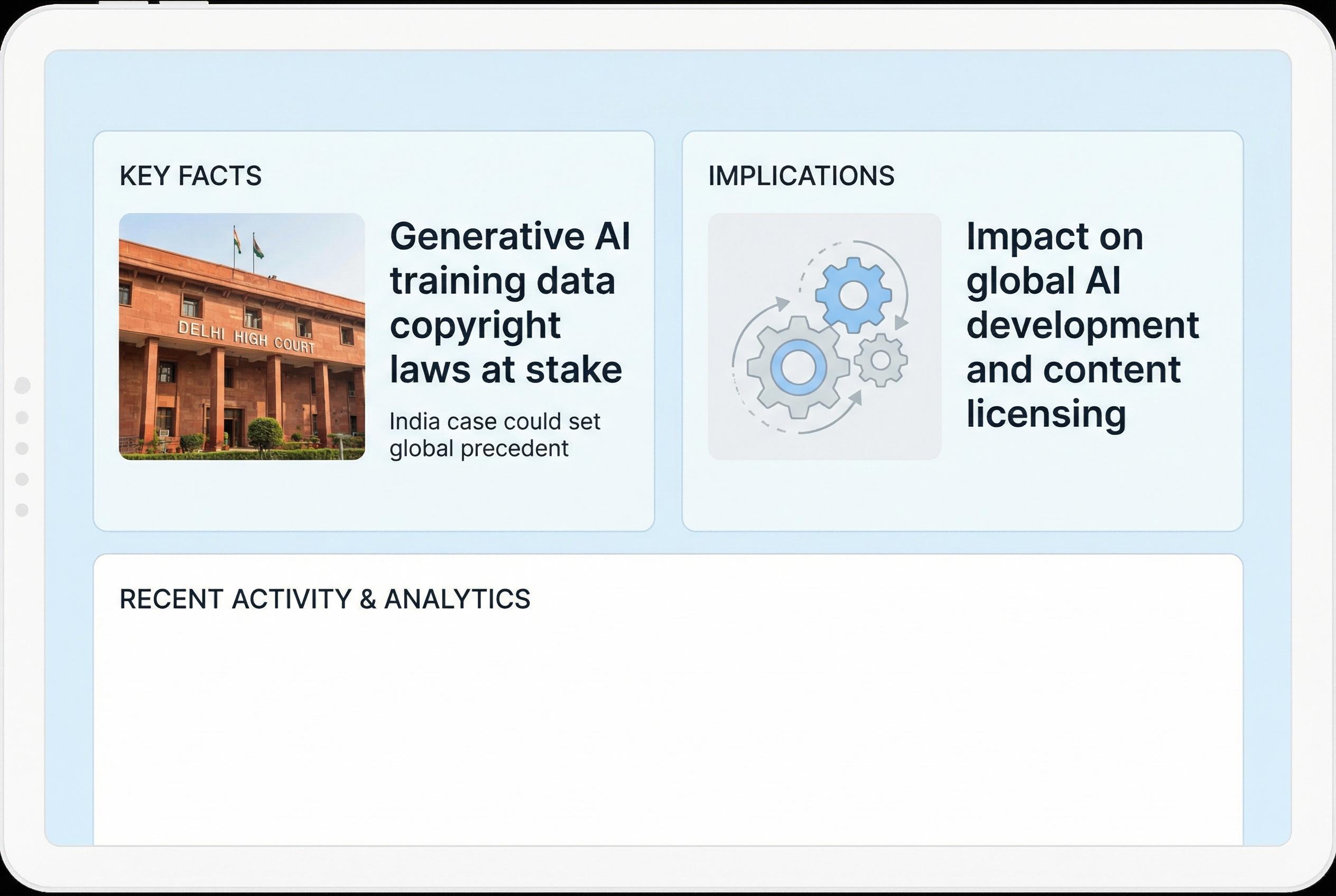
The Delhi High Court has reserved judgment in a test case that could define how Indian copyright law applies to generative artificial intelligence, after hearing a long‑running suit brought by the news agency Asian News International (ANI) against OpenAI. According to India Today, the dispute , which began with a filing in November 2024 and ran over dozens of hearings through March 2026 , centres on whether OpenAI used ANI’s copyrighted material without authorisation to train its ChatGPT models. (India Today, Medianama).
ANI alleges that OpenAI scraped its news stories, including paywalled items, and that material from those articles has at times surfaced in ChatGPT outputs. The agency says such use cannot be excused by the statutory “fair dealing” exceptions, particularly because ChatGPT is commercial in nature and, ANI contends, the infringement occurs already at the stage when data is ingested, tokenised and stored. (India Today, Business Standard).
OpenAI has rejected the allegations and challenged both the merits and the court’s authority to hear the case. The company told the court that its models are trained on publicly available information, that training extracts statistical patterns rather than expressive text, and that any storage during model training is transient and therefore outside the scope of infringement. OpenAI has also said it blocked ANI’s domain from future training sets and disputed ANI’s contention that its outputs reproduce verbatim content. (India Today, Business Standard).
The litigation attracted a raft of intervenors on opposing sides, turning the hearing into a wider contest over the commercial consequences of large‑scale data use. Industry bodies representing publishers, music producers and digital news organisations warned that unlicensed ingestion at scale threatens the economic model for creators; they argued that outputs from large language models can substitute for original works and that statutory storage exceptions are narrow. Other intervenors, including trade groups and AI firms, urged the court to adopt a legal interpretation that permits innovation, arguing that summarisation, transformation and retrieval‑augmented methods should not automatically amount to infringement. (India Today, Medianama).
A pivotal legal issue before the court is whether intermediate copies created during machine learning constitute only “transient or incidental” storage exempted by law, or whether those copies are unauthorised reproductions. ANI and its supporters insist Indian law does not permit expansive intermediate copying; OpenAI and its backers counter that temporary processing to extract non‑expressive features is necessary and lawful for model construction. Court‑appointed experts and amici offered differing views, with at least one finding the company’s conduct could amount to infringement while another saw room for permissible processing. (India Today, Business Standard).
Jurisdictional questions featured prominently. OpenAI argued that Indian law should not apply because its training occurred outside India and neither its servers nor corporate domicile are located here. Countering that, court‑appointed experts told the bench the Delhi High Court could hear the claim because jurisdiction under the Copyright Act can be established by the plaintiff’s place of business. That division over reach as well as substance has amplified the case’s potential to shape future cross‑border disputes involving foreign AI developers and Indian rights‑holders. (Business Standard, Times of India).
Legal analysts say the court’s interim decision, and any eventual final ruling, will be watched closely across media, publishing and technology sectors for the precedent it may set on content use, licensing and the permissible contours of AI training. According to medianama reporting, OpenAI has also advanced commercial defences , such as arguing ChatGPT drives referral traffic to news sites and that facts as such are not protectable , underscoring how the case blends doctrinal copyright questions with practical market considerations. The Delhi High Court’s forthcoming order is therefore likely to have consequences extending well beyond the two parties in this high‑profile dispute. (India Today, Times of India, Medianama).
Source Reference Map
Inspired by headline at: [1]
Sources by paragraph:
- Paragraph 1: [2], [6]
- Paragraph 2: [2], [3]
- Paragraph 3: [2], [3]
- Paragraph 4: [2], [6]
- Paragraph 5: [2], [3]
- Paragraph 6: [3], [5]
- Paragraph 7: [2], [4], [6]
Source: Noah Wire Services