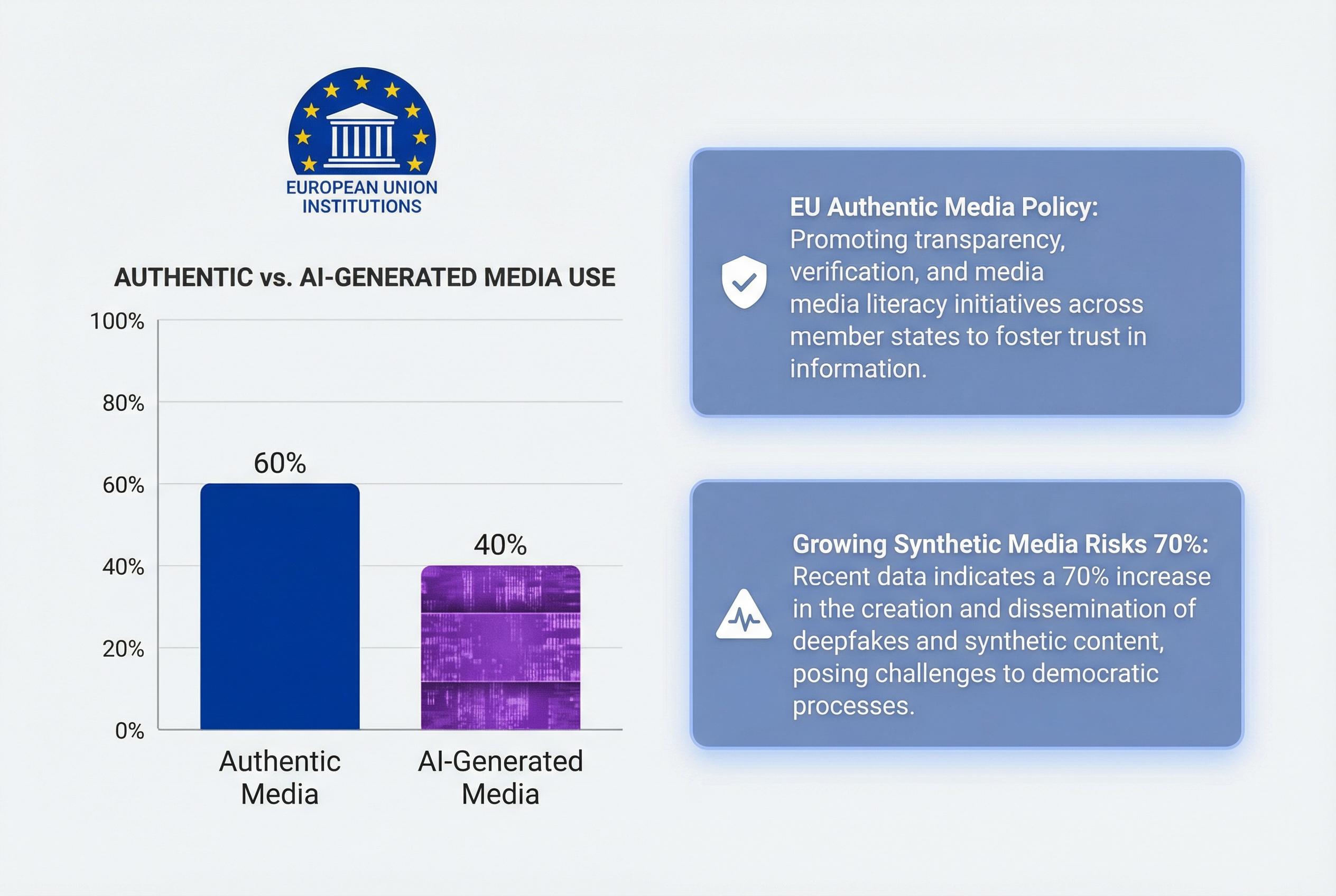
European Union institutions have instructed their communications teams not to publish videos or images created entirely by artificial intelligence, a move framed as protecting the authenticity of official messaging. According to Politico, the European Commission, Parliament and Council will only permit AI to be used to improve existing footage or imagery rather than to generate new material from scratch.
Commission spokesperson Thomas Regnier told Politico that "authenticity" is a priority in order to "foster citizens' trust." The restriction applies across the three main EU bodies and is intended to limit risks that synthetic media could undermine confidence in official communications.
The European Parliament has issued staff guidance on generative AI tools that stresses caution and highlights the technology's inherent hazards, while allowing limited uses such as image-quality enhancement. That guidance underscores an institutional reluctance to place fully synthetic material in the public record.
The policy diverges sharply from trends in other democracies, where political actors have used AI-generated content to varying degrees. The Poynter Institute and other outlets note a rise in AI imagery and video in U.S. political communication, illustrating a contrast in risk tolerance between the EU institutions and some international counterparts.
Some experts have criticised the EU decision as a missed chance to lead by example on transparent and responsible use of synthetic media. "Responsible use beats abstinence," said Walter Pasquarelli, an OECD adviser and Cambridge researcher, arguing the bloc could have demonstrated how labelled, watermarked AI content can be deployed responsibly. Alexandru Voica of Synthesia added that "how quickly and effectively you respond is now becoming more important than ever" amid fast-moving crises, and suggested the EU's own upcoming rules on watermarking offer an opportunity for demonstration rather than prohibition.
EU officials, by contrast, defend the ban as a way to preserve the credibility of public institutions at a time when misinformation and deepfakes are proliferating. The policy reflects a precautionary stance that prioritises public trust over experimentation with synthetic messaging in official channels. Observers say the approach is consistent with broader regulatory caution in Brussels even as member-state leaders and political figures continue to experiment with AI tools in other contexts.
Source Reference Map
Inspired by headline at: [1]
Sources by paragraph:
- Paragraph 1: [2], [3]
- Paragraph 2: [2], [4]
- Paragraph 3: [2], [4]
- Paragraph 4: [3], [6]
- Paragraph 5: [1], [2]
- Paragraph 6: [4], [5]
Source: Noah Wire Services