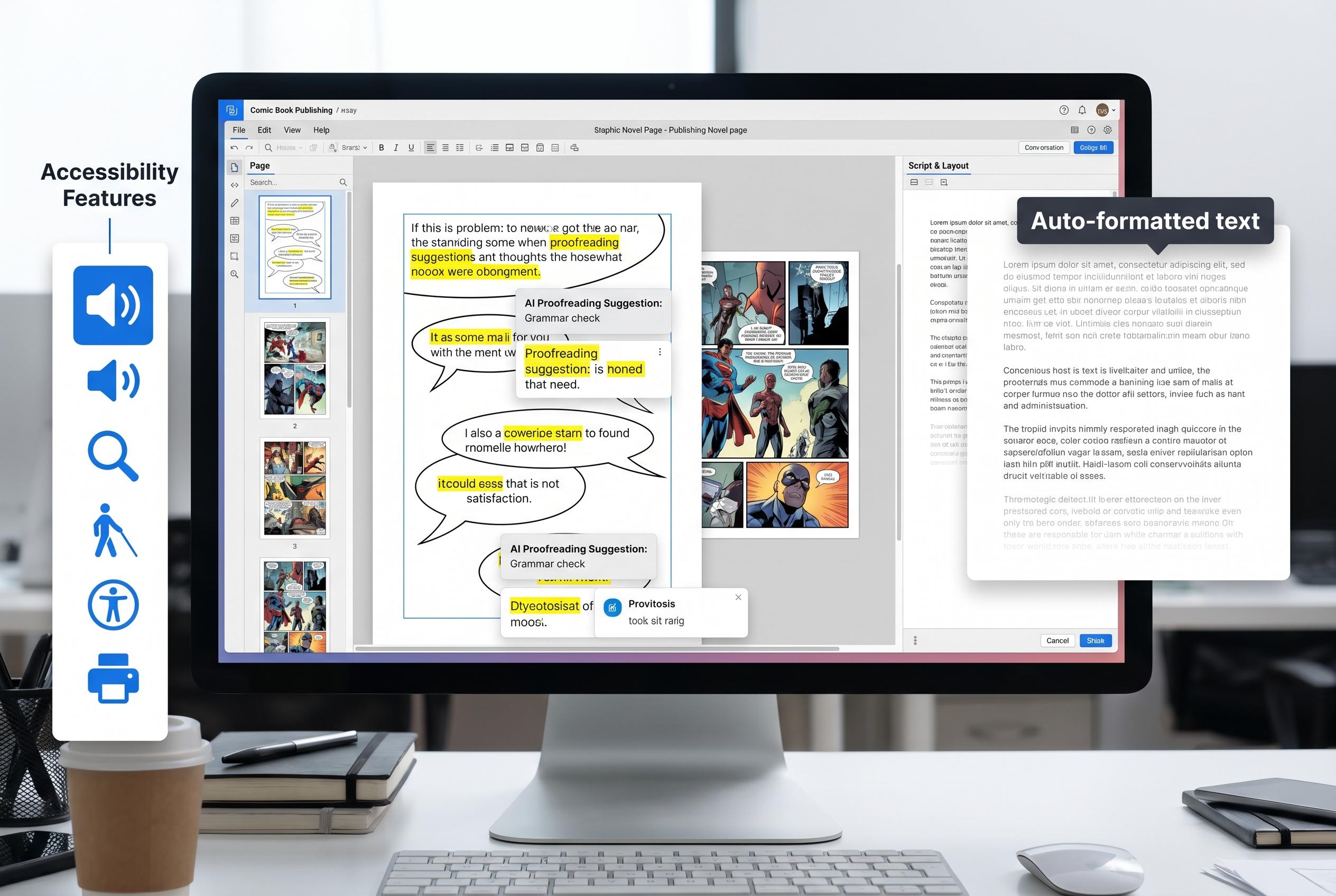
Artificial intelligence is becoming a practical part of the publishing workflow, not just a subject for debate, and that is the thread running through one comic writer's latest reflections on the technology. He argues that AI is already embedded in everyday tasks such as drafting podcast descriptions and social media copy, and that for routine material it can save time without replacing judgement or editorial control.
That view is broadly consistent with guidance from podcasting and content-creation tools, which stress that AI can help produce concise summaries, stronger metadata and more searchable episode descriptions, provided the user supplies clear prompts and still edits the result. Industry advice on social media generation makes a similar point: AI can speed up production, but overuse can lead to bland, formulaic copy that needs a human touch to sound convincing.
The writer also places a sharper boundary around student work, saying AI-generated essays should face tighter restrictions in schools and universities. That reflects a wider anxiety that has grown alongside the technology's adoption: researchers have found that while generative AI can boost volume on social platforms, it may also make content feel more generic, impersonal and less trustworthy if it is used without restraint.
In his own work, he describes AI as a support tool rather than a shortcut. When preparing interviews, he says he builds detailed talking points so guests know what to expect and can be asked fresh questions, especially when they have appeared many times before. He also recalls a response from one creator who joked that the questions were so well researched he expected them to mention an old school football mishap, which he took as proof that the preparation was thorough.
That same approach shaped a recent project involving writer Elliot S! Maggin. The writer says he recorded the interview last summer and later used AI to compress a transcript into roughly 1,000 words while insisting that the guest's exact wording be preserved. After sending the draft to Maggin for approval, he made only light grammar changes and added links before publishing it, presenting the process as a way to widen access to comics journalism rather than as a badge of technological novelty.
For him, the point is not to showcase the interviewer's access but to give readers another route into a creator's work and, ideally, encourage them to read more comics across different eras. In that sense, AI is not replacing the editorial mission; it is becoming one more instrument in the kit.
Source Reference Map
Inspired by headline at: [1]
Sources by paragraph:
- Paragraph 1: [2], [3]
- Paragraph 2: [3], [4], [5], [6]
- Paragraph 3: [4]
- Paragraph 4: [1]
- Paragraph 5: [1]
- Paragraph 6: [1]
Source: Noah Wire Services