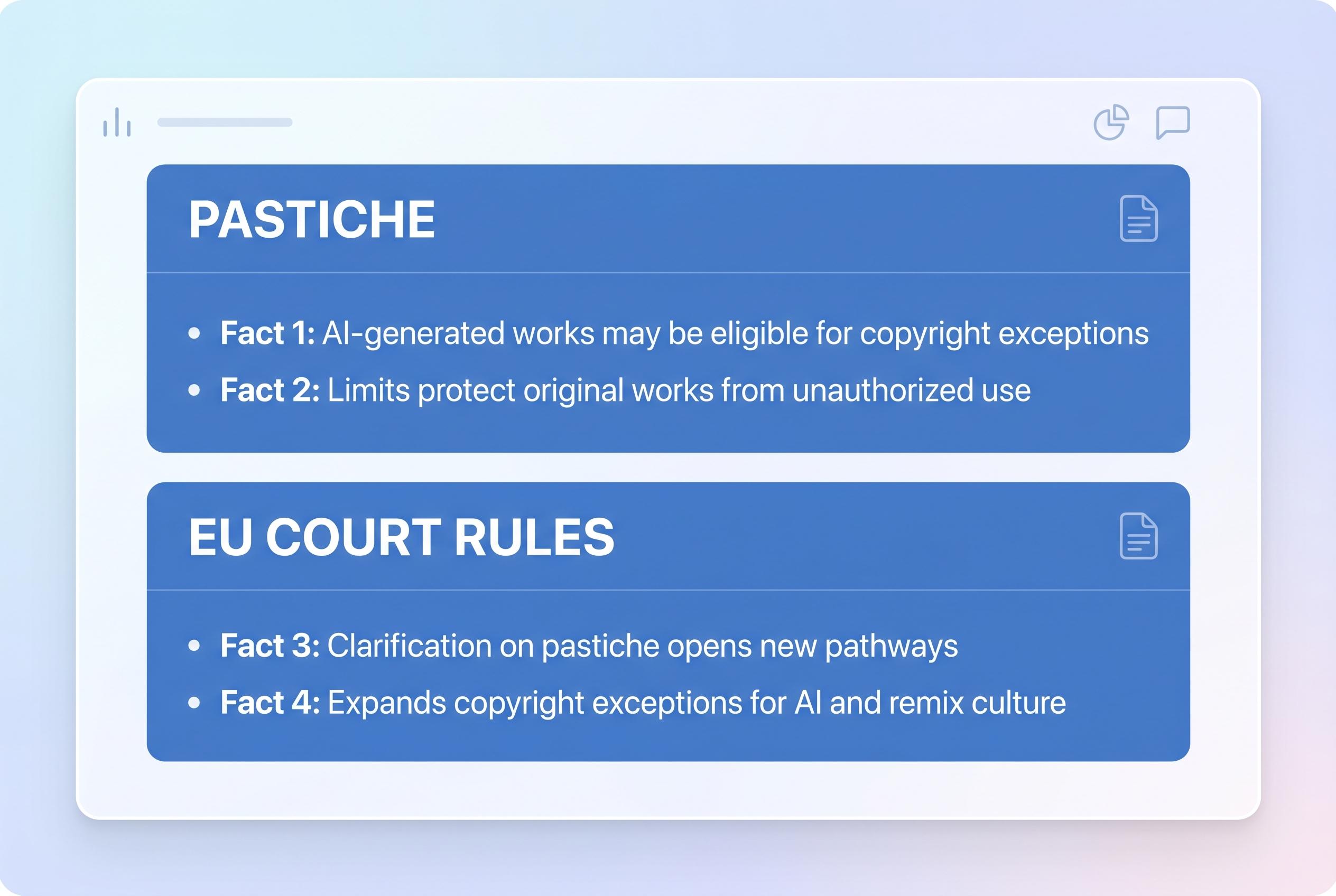
The Court of Justice of the European Union has given the long-marginalised concept of pastiche a far more workable shape, and in doing so may also have opened a route for some generative AI outputs to be defended under copyright exceptions. The ruling in Pelham II comes after years of litigation over Kraftwerk's claim that Moses Pelham unlawfully sampled a two-second rhythm fragment from "Metall auf Metall" in "Nur mir", a dispute that has moved through German courts, constitutional challenges and an earlier Luxembourg ruling before finally returning to the EU's top court.
According to the Court's press release, pastiche is not a free-for-all. It is also not confined to a narrow set of labels such as tribute, imitation or humour. Instead, the Court said it covers works that evoke an existing creation, remain noticeably different from it, and borrow characteristic elements in order to enter into an artistic or creative dialogue that can be recognised as such. That formulation is important because it broadens the exception without letting it swallow parody or caricature, which continue to have their own distinct boundaries.
The judgment also matters because the Court rejected any requirement that the user must have set out deliberately to create a pastiche. What counts is whether the resulting work is recognisable as such to someone familiar with the source material. That objective approach gives the exception legal clarity, and it is one reason commentators have immediately turned to the decision's implications for machine-generated content, where intention is often difficult to pin on the system itself.
For AI developers and litigants, the practical significance is obvious. If a prompt asks for a work "in the style of" a particular artist, or for a familiar character remade through a different visual language, the result may now look more like a dialogue with the source than a covert copy. Industry commentary on the case has already noted that the Court's wording could be relevant to sampling, remix culture and other forms of reuse that sit somewhere between imitation and transformation. The Advocate General had also signalled that the dispute could have wider consequences beyond music, reinforcing the sense that Luxembourg is edging towards a broader theory of creative reuse.
That said, the judgment does not amount to a licence for wholesale extraction. The Court's formulation leaves room for challenge where a work is too close to the original, where the borrowing is hidden rather than overt, or where the new output is simply a disguised replica. Any defence would still have to survive the wider copyright balance built into EU law, including the three-step test and the need to avoid unfair prejudice to rightsholders. In other words, Pelham II enlarges the room for lawful transformation, but it does not erase the line between reworking and copying.
The case will also be watched closely in the UK, where section 30A of the Copyright, Designs and Patents Act contains a similar exception. Although UK courts are no longer bound by post-Brexit Luxembourg decisions, they may still find the reasoning persuasive, especially given the thinness of domestic guidance on pastiche. For now, the Court has done something that copyright lawyers had long hoped for and long feared: it has given the exception a meaning substantial enough to matter. Whether that meaning proves helpful or disruptive will depend on how courts apply it to the next generation of sampled songs, visual remixes and AI-generated pastiches.
Source Reference Map
Inspired by headline at: [1]
Sources by paragraph:
- Paragraph 1: [2], [6]
- Paragraph 2: [4], [5], [6]
- Paragraph 3: [3], [6]
- Paragraph 4: [2], [3], [4]
- Paragraph 5: [4], [5], [6]
- Paragraph 6: [1], [4], [7]
Source: Noah Wire Services