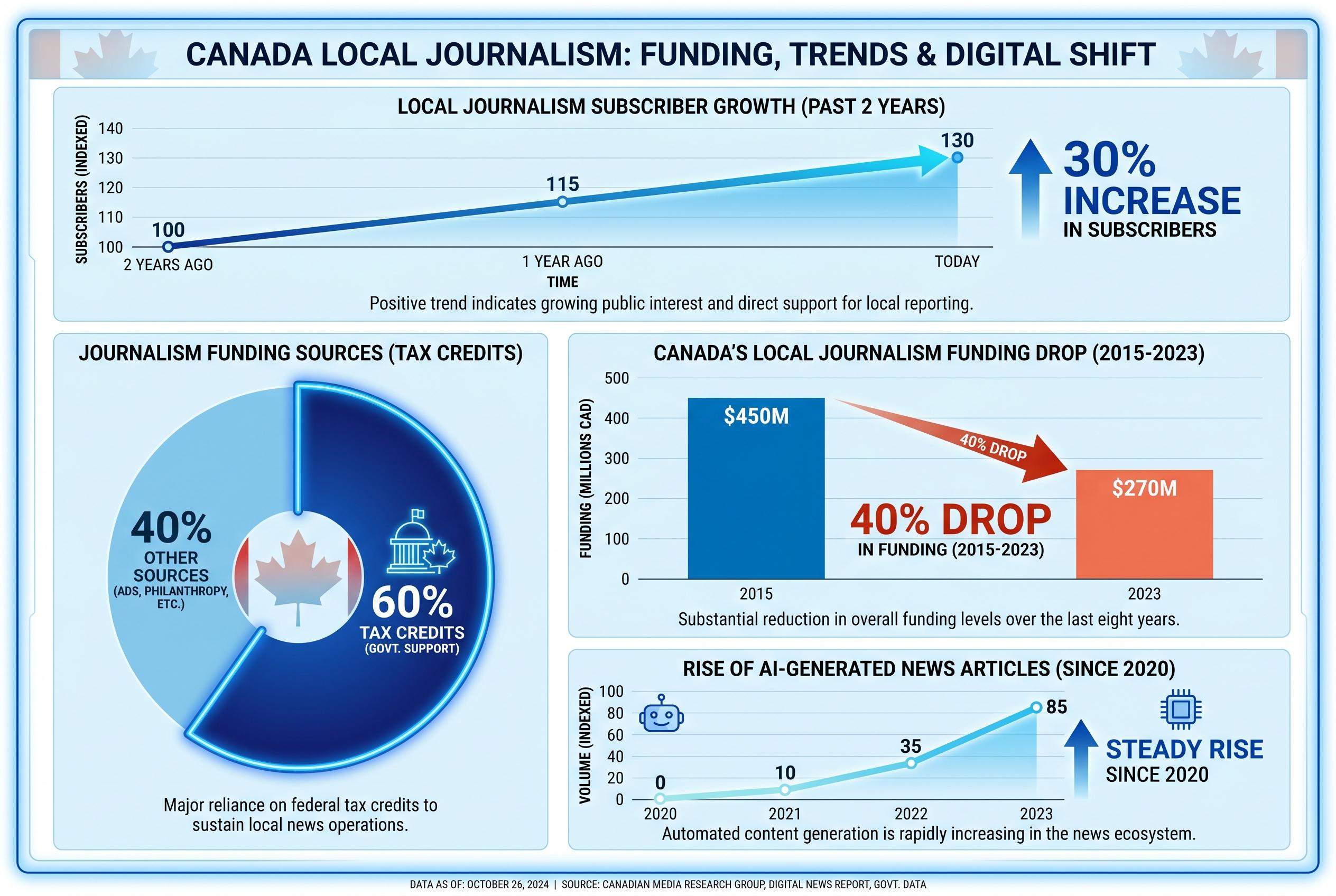
Canada’s local and community newspapers are still trying to do what they have always done best: keep readers informed about the institutions that shape daily life, from city halls and courthouses to school sport fields and police beats. But in an era when advertising has shifted overwhelmingly to global platforms, two veteran publishers argue that public policy now has to do more to keep that work viable.
In an essay published by Policy Magazine, Dave Adsett and Benoît Chartier, who chair News Media Canada and Hebdos Québec respectively, said federal measures introduced in recent years have helped shore up newsroom finances, particularly the Online News Act, which they said has channelled about $100 million a year from Google to Canadian news businesses. They noted that smaller independent publishers were largely shut out of earlier licensing deals struck between the technology companies and larger media groups, and said Ottawa’s support has helped many outlets stay open and continue hiring.
Their central plea is for the Canadian Journalism Labour Tax Credit to remain at 35%, rather than falling back to 25% on January 1, 2027, as currently scheduled by the Canada Revenue Agency. The credit, which applies to qualifying journalism organisations that produce original written news content, is designed to support newsroom employment, including reporting on policing, courts, city hall and sport. The publishers argue that keeping the higher rate would be the most immediate way to protect jobs across the country.
They also want Ottawa to reserve 25% of its advertising budget for private-sector Canadian news outlets. In their view, that would be a way of keeping public advertising dollars within the domestic media ecosystem without adding new spending. They pointed to examples elsewhere, including Ontario’s direction that provincial agencies allocate a quarter of advertising to news publishers, New York City’s requirement that at least half of print and digital advertising go to community and ethnic media, and Maryland’s recent move to create a state advertising set-aside for local news.
The case for doing so, they said, is not only economic but practical. Research commissioned for News Media Canada found that 68% of Canadians support a “Buy Canadian” approach to government advertising. The publishers also argued that advertising in community news reaches audiences that are less likely to be found through bigger platforms, while providing a trusted setting for public messages.
Artificial intelligence is the other major concern. Adsett and Chartier said Canada should encourage AI development, but not at the expense of the journalism that supplies much of the underlying content. They urged the government to tighten procurement rules, examine competition in search and AI, and reject any copyright change that would create a text-and-data-mining exception for news. They also cited polling indicating broad public support for action against AI firms repackaging news without permission or compensation.
Canada Post is another pressure point. The publishers said the corporation’s decision to treat community newspapers carrying commercial inserts as eligible for its Consumers’ Choice opt-out programme has hurt a key revenue stream. Canada Post says the programme allows households to opt out of unaddressed advertising mail, while newspapers without commercial inserts remain exempt. Adsett and Chartier argue that community papers carrying flyers should not be treated as junk mail, given that those inserts help pay for journalism.
They also called for a rethink of tax rules that, in their view, still favour foreign digital advertising over domestic media. The broader message of their argument is that Canada’s news industry can survive only if policy recognises the economic role of local journalism, as well as its democratic one.
Source Reference Map
Inspired by headline at: [1]
Sources by paragraph:
- Paragraph 1: [2], [7]
- Paragraph 2: [1], [7]
- Paragraph 3: [2], [6], [7]
- Paragraph 4: [1], [7]
- Paragraph 5: [1], [4]
- Paragraph 6: [1], [2]
Source: Noah Wire Services