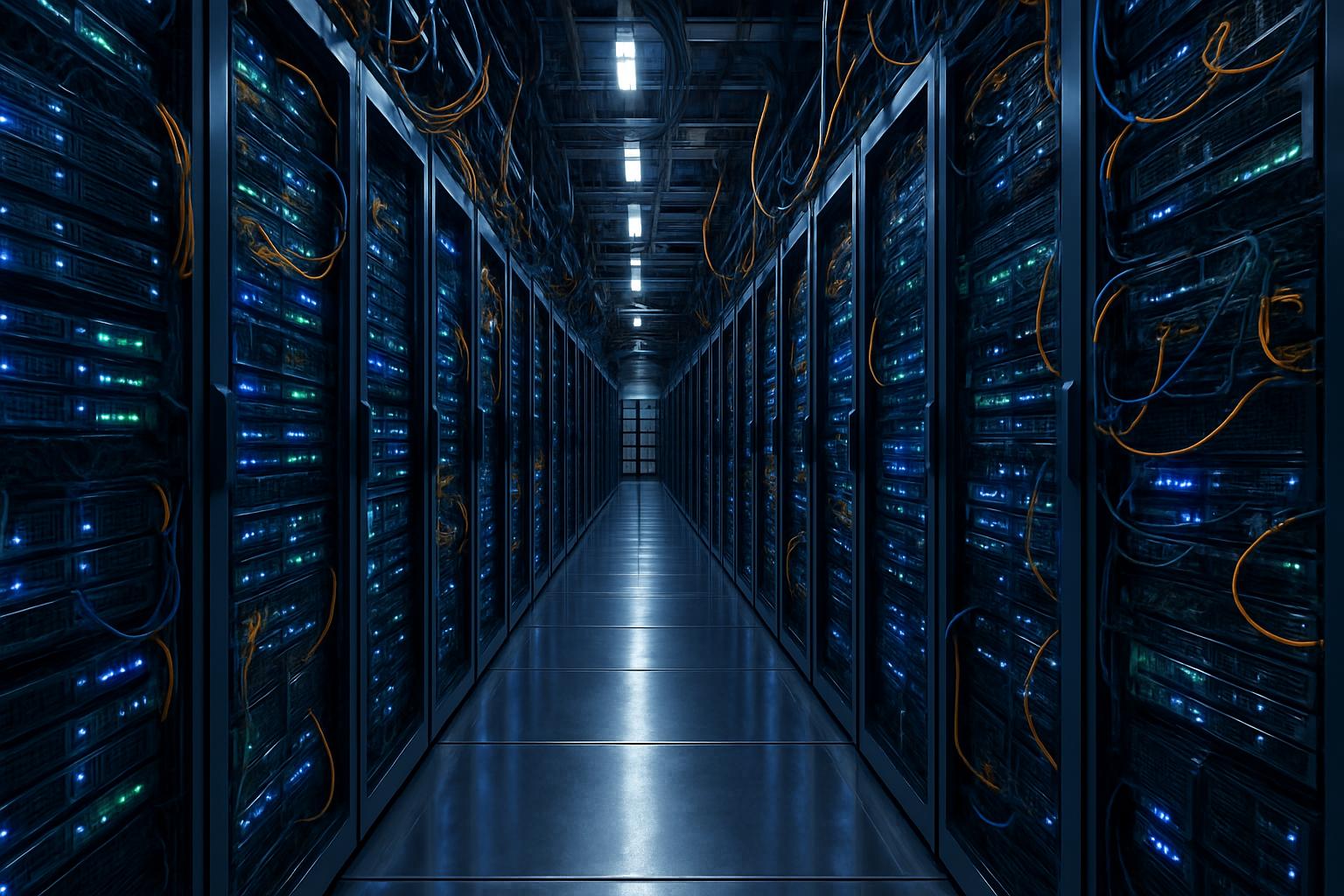
The global Artificial Intelligence (AI) server market is undergoing a dramatic transformation, marked by an unprecedented surge in demand and rapid technological advancements that are reshaping the future of computing infrastructure. This growth is primarily fuelled by the widespread adoption of generative AI and large language models (LLMs), alongside substantial capital investments from hyperscale cloud providers and enterprises aiming to scale AI capabilities at industrial levels.
In the first quarter of 2025, the AI server segment reported extraordinary growth, with revenues reaching $95.2 billion—a 134% year-on-year increase—representing the highest quarterly expansion the server market has seen in 25 years. Industry forecasts project that the AI server market could escalate to a staggering $1.56 trillion by 2034, expanding from an estimated $167.2 billion in 2025 at a compound annual growth rate (CAGR) of approximately 28%. Other research complements this outlook, estimating the market size at anywhere between $352 billion and $1.84 trillion by the early 2030s, depending on different analytical approaches and inclusion of varying segments like GPU, FPGA, and ASIC-based servers. This rapid expansion distinctly distinguishes AI servers from traditional server markets, highlighting the immense role of AI in global technological evolution.
At the core of this growth are specialized AI servers designed for highly parallel processing, a sharp departure from conventional CPU-centric systems. These servers rely heavily on powerful graphical processing units (GPUs) such as NVIDIA’s H100 and AMD’s chips, Google’s tensor processing units (TPUs), and application-specific integrated circuits (ASICs), which are purpose-engineered to accelerate AI training and inference. NVIDIA remains the dominant player, with its GPUs now integral to both commercial and hyperscale AI deployments. For example, Dell Technologies recently introduced new AI servers powered by NVIDIA’s Blackwell Ultra chips, promising up to four times faster AI model training, with options for air or liquid cooling and scalable architectures supporting up to 256 chips. These innovations underscore the increasingly specialised nature of AI infrastructure as it meets the needs of complex AI workloads.
The explosive computational demand has also driven a revolution in data centre design, particularly in cooling technologies. Traditional air-cooling solutions, although still holding the largest share at over 68% in 2024, are continuously optimised with better airflow management. However, liquid cooling methods are rapidly gaining ground, addressing the extreme heat densities generated by modern AI accelerators that can consume between 30 to 50 kilowatts per rack, far exceeding legacy servers. Immersion and direct-to-chip liquid cooling are becoming not just performance enhancers but necessities for operational efficiency, allowing higher component density and energy savings. Reports indicate clusters with as much as 85% liquid cooling integration, a decisive shift that will define future data centre standards.
The competitive landscape is evolving swiftly amid this growth. Hardware manufacturers such as NVIDIA, AMD, Intel, Samsung, SK Hynix, and Micron are benefiting markedly from heightened demand for GPUs and high-bandwidth memory. Server vendors like Dell, Hewlett Packard Enterprise, and Super Micro Computer are expanding AI-optimised product lines, bespoke for the needs of enterprises and cloud providers. Hyperscalers including AWS, Google Cloud, Microsoft Azure, Meta, and Oracle continue to invest billions in infrastructure expansion, not only consuming AI hardware but also developing proprietary AI chips to enhance performance and reduce external dependencies. However, this concentration of resources among dominant players creates access inequalities, making it challenging for smaller AI startups and labs to secure sufficient computational power.
Yet, the AI server market’s rise is not without challenges. Technical hurdles such as high energy consumption and thermal management demand ongoing innovation, while supply chain disruptions and geopolitical tensions—highlighted by recent warnings from Chinese server manufacturer H3C about potential Nvidia chip shortages—pose risks to steady growth. The cost-intensive nature of advanced AI servers also pressures profit margins for leading manufacturers despite soaring revenues. Moreover, the sector faces a significant talent gap for professionals skilled in managing complex AI infrastructures, alongside concerns over data security, privacy, and ethical AI deployment.
Beyond technical and market dynamics, the AI server boom holds profound societal and environmental implications. The increase in electricity demand from data centres could more than double by 2030, with AI as a major driver. Such facilities also consume significant water resources for cooling, raising sustainability concerns in water-stressed regions. Economically, while AI infrastructure spurs growth and innovation across industries like healthcare, finance, manufacturing, and autonomous driving, it also carries risks of workforce displacement and raises ethical issues surrounding privacy and algorithmic bias. The "AI Supercycle" thus represents not just an industrial scaling of technology but a pivotal shift with wide-reaching consequences.
Looking ahead, the AI server market is set to maintain robust expansion through the mid-2020s. GPU-centric servers will retain dominance for AI training, complemented by increasing deployment of ASICs and field-programmable gate arrays (FPGAs) for inference tasks. Cooling technologies, particularly liquid cooling, will become increasingly standard. Emerging paradigms such as multi-agent AI communication and "agentic AI" models will demand even greater computational power and specialized infrastructure. Experts foresee a future where AI itself orchestrates data centre management, optimizing energy and workload distribution for efficiency and scalability.
In summary, the AI server market’s meteoric rise marks a defining moment in the evolution of artificial intelligence, transforming it from a primarily research-focused endeavour into a foundational industrial force. While challenges remain—costs, environmental impact, supply constraints, and workforce needs—the continued innovation and investment in AI hardware and infrastructure herald a new era of intelligent computing. This expansion will likely democratize AI capabilities, spur extensive sectoral innovations, and lay the groundwork for the next frontier in technology.
📌 Reference Map:
- Paragraph 1 – [1] (TokenRing AI), [2] (Precedence Research), [5] (GlobeNewswire)
- Paragraph 2 – [1] (TokenRing AI), [4] (TrendForce), [6] (Reuters - Dell), [7] (Reuters - H3C)
- Paragraph 3 – [1] (TokenRing AI), [6] (Reuters - Dell), [7] (Reuters - H3C)
- Paragraph 4 – [1] (TokenRing AI), [3] (TrendForce), [5] (GlobeNewswire)
- Paragraph 5 – [1] (TokenRing AI), [7] (Reuters - H3C)
- Paragraph 6 – [1] (TokenRing AI), [5] (GlobeNewswire)
- Paragraph 7 – [1] (TokenRing AI), [3] (TrendForce)
- Paragraph 8 – [1] (TokenRing AI), [2] (Precedence Research), [5] (GlobeNewswire)
Source: Noah Wire Services