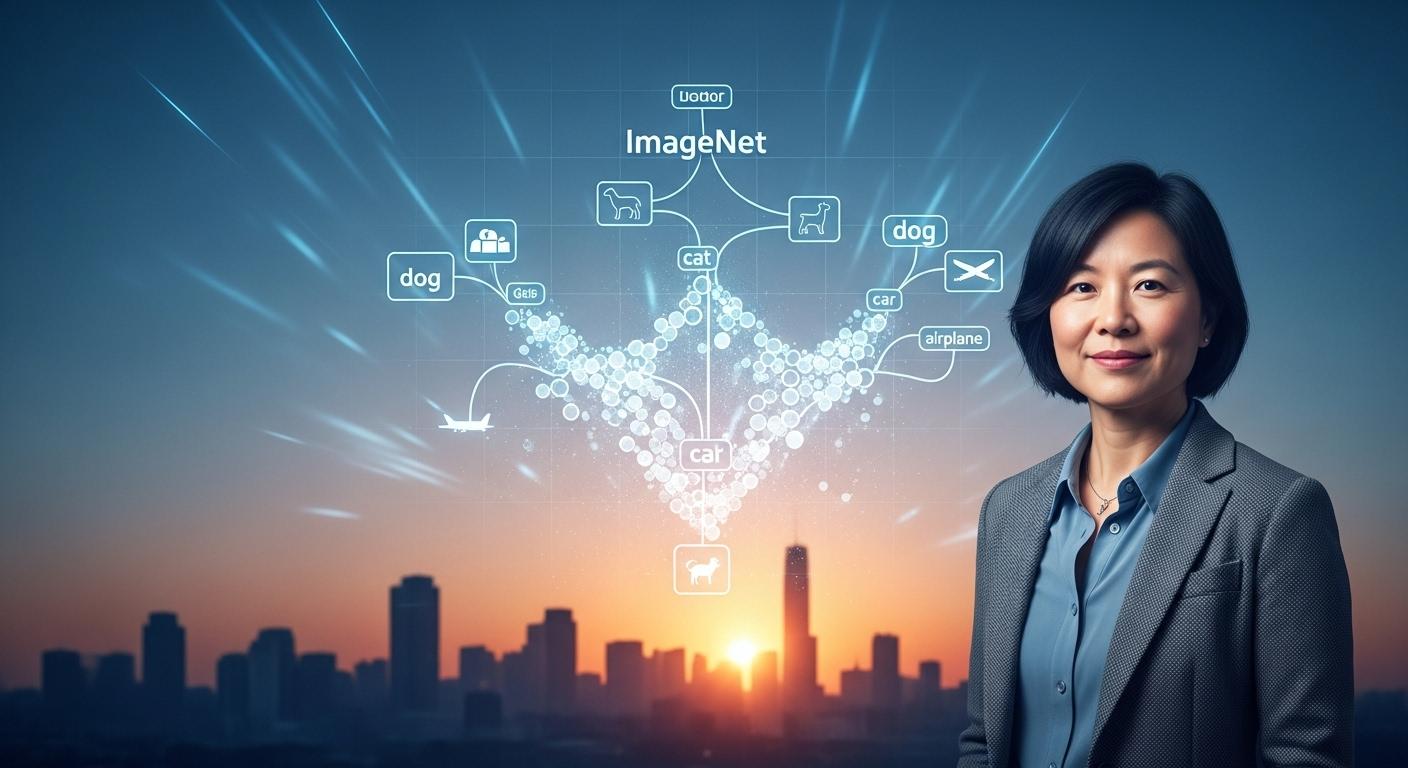
In 2007, Fei-Fei Li proposed a revolutionary idea that many of her colleagues initially dismissed as too ambitious for the time. While the AI research community was overwhelmingly focused on developing smarter algorithms, Li saw that the lack of large-scale visual data was a critical bottleneck in building truly intelligent systems. This conviction drove her to create ImageNet, an enormous database of more than 14 million labelled images spanning over 22,000 categories. Despite numerous technical and financial challenges, her determination paid off, and ImageNet quickly became foundational for advances in AI technologies such as facial recognition, autonomous vehicles, and robotics.
Li's personal journey adds a compelling backdrop to her achievements. As an immigrant to the United States at age 15, she balanced running her family’s dry-cleaning business with her rigorous academic pursuits at Princeton and later Caltech, where she completed her Ph.D. In interviews with Bloomberg and Fortune, she reflected that this formative period sharpened her ability to operate under pressure, make calculated trade-offs, and persevere with bold ideas that others might initially dismiss. Indeed, when ImageNet was launched in 2009, it received little immediate attention within academia. However, Li’s vision of using large, annotated datasets to mirror the human ability to learn from millions of diverse examples laid the groundwork for a seismic shift in the field.
The turning point came in 2012 at the ImageNet Large Scale Visual Recognition Challenge, when a convolutional neural network known as AlexNet, developed by Geoffrey Hinton’s team, stunned the AI community by outperforming competitors by an unprecedented margin. This model achieved a top-5 error rate nearly 10 percentage points better than the next best entry, showcasing the power of deep learning trained on large datasets and accelerated by GPU computing. The success of AlexNet validated Li’s early insight that sheer data scale and computational power, rather than incremental algorithmic tweaks, would drive the future of AI. Following this breakthrough, deep learning exploded into prominence, rapidly becoming the dominant approach in computer vision and beyond.
Fei-Fei Li’s foresight extended beyond ImageNet. Today, as a professor at Stanford University and co-founder of the startup World Labs, she is pioneering the next frontier of AI, spatial intelligence. Focusing on AI systems that comprehend and interact with the three-dimensional physical world, World Labs is developing cutting-edge technologies intended to transform augmented reality, robotics, and autonomous navigation. Its first product, Marble, allows users to create downloadable 3D environments using natural language prompts, an innovation that helped the company reach a $1 billion valuation within just four months. This push into spatial reasoning reflects Li’s continued commitment to expanding the capabilities and applications of intelligent systems.
Alongside her technical work, Li is actively involved in shaping global conversations about AI governance, ethics, and accountability. She joined the United Nations Scientific Advisory Board in 2023, contributing to efforts encouraging responsible AI development. She has also engaged with U.S. lawmakers and international leaders on the societal implications of AI adoption. Although reluctant to embrace the moniker “godmother of AI,” she acknowledges the importance of visibility and representation in a technology sector still grappling with diversity challenges.
Fei-Fei Li’s journey, from managing a family business in New Jersey to becoming a visionary leader in artificial intelligence, epitomises resilience and bold thinking. Her creation of ImageNet not only catalysed the deep learning revolution but also laid the foundation for a new era where machines can understand the world visually and spatially, an era she continues to shape through her research and entrepreneurship.
📌 Reference Map:
- [1] (Indian Defence Review) - Paragraphs 1, 2, 3, 4, 5, 6, 7
- [2] (Wikipedia - Fei-Fei Li) - Paragraph 1, 3
- [3] (Wikipedia - AlexNet) - Paragraph 3
- [4] (Wikipedia - ImageNet) - Paragraph 1, 3
- [5] (Reuters) - Paragraph 4
- [6] (Bloomberg) - Paragraph 2, 3
- [7] (Technology Review) - Paragraph 1, 3
Source: Noah Wire Services