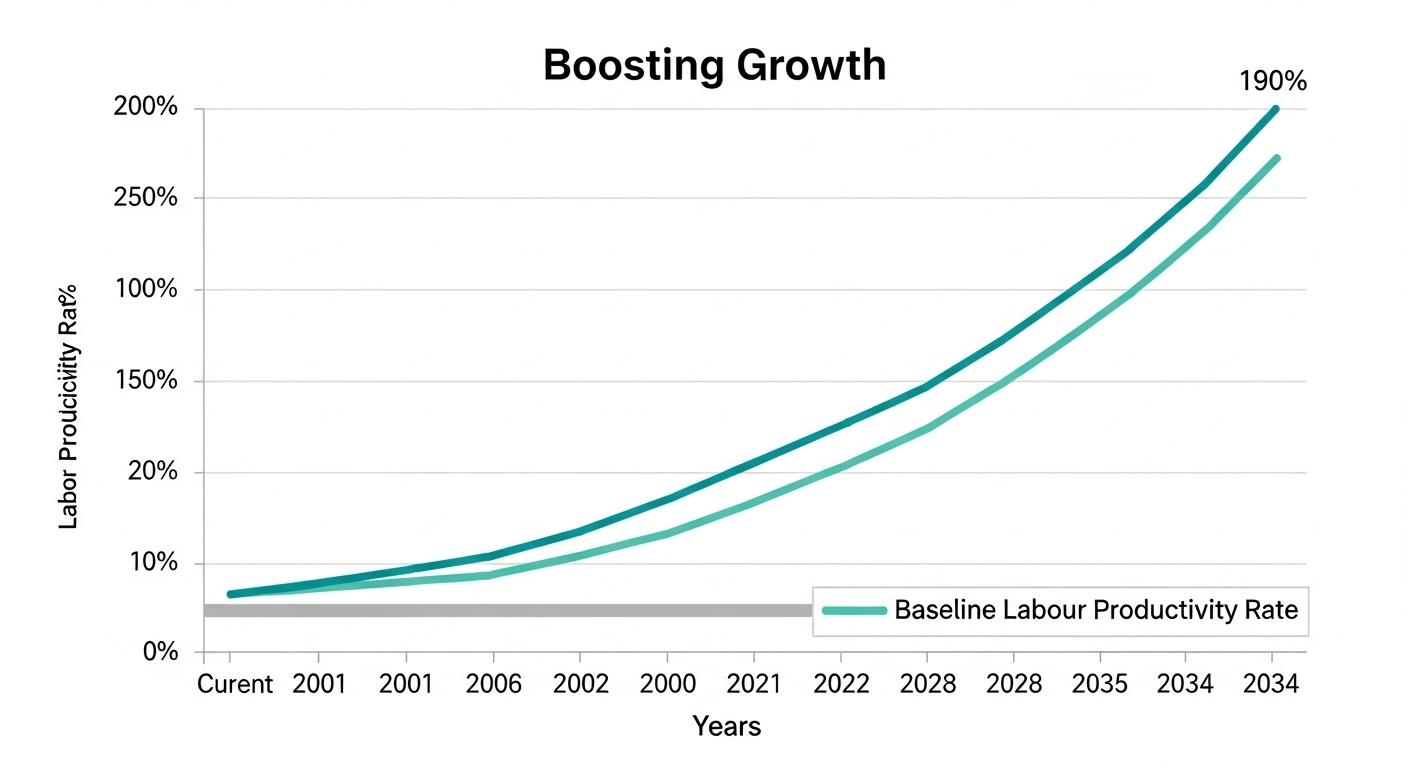
A recent study conducted by Anthropic provides a compelling forecast on the transformative economic impact artificial intelligence could have on the United States over the next decade. Drawing on 100,000 anonymized interactions with its AI chatbot, Claude, the study estimates that AI could nearly double the annual labour productivity growth rate in the US, leading to an estimated 1.8% annual productivity increase versus current rates. This surge, if realised, would significantly accelerate economic growth, as current labour productivity improvements have been relatively modest.
The research delved deeply into time savings generated by AI assistance across a broad range of professions. By comparing task completion times with and without Claude's help, Anthropic found an average reduction in task duration of around 80%. These gains varied considerably between sectors, with industries such as software development, management, education, and construction seeing some of the highest productivity boosts. For example, financial analysts using Claude to analyse economic data reportedly cut task times by nearly 80%, translating to significant cost savings per hour. Meanwhile, roles in personal care and sales experienced more modest time savings, revealing that AI’s impact is unevenly spread across the labour market.
By applying wage and employment data from the US Bureau of Labor Statistics, the researchers approximated the economic value of these labour productivity gains. Software development was identified as the leading driver, accounting for 19% of the productivity growth, followed by general and operations managers, market research analysts, and customer service representatives. Secondary school teachers also saw measurable benefits, although to a lesser extent. This detailed approach sought to move beyond broad generalisations, putting a fine point on how substantial and varied task-specific AI-driven efficiencies can be.
While the economic projections are optimistic, Anthropic’s study includes important caveats. It assumes that the current capabilities of AI models and human proficiency in deploying them remain constant over the next decade. Given the rapid pace of AI innovation, evident in increasingly sophisticated models and AI agents performing complex multi-step tasks, this assumption likely underestimates AI’s future impact. Additionally, the time saved on tasks, as estimated by Claude, does not factor in additional time workers might spend validating or fact-checking AI outputs, an aspect that could temper productivity gains. The dataset also reflects users' preference for Claude, potentially biasing results since tasks less suited to this particular chatbot might be underrepresented.
Anthropic is positioning itself strategically in the burgeoning AI market as demand for its Claude models continues to grow internationally. The company is tripling its global workforce and expanding teams across Dublin, London, Zurich, and Tokyo to meet rising demand. Notably, nearly 80% of Claude’s consumer engagement originates outside the US, with high per-capita usage in countries like South Korea, Australia, and Singapore. This international footprint is bolstered by partnerships, including integration of Claude into Microsoft’s Copilot assistant, signalling a broader industry shift towards diversified AI platforms.
Financially, Anthropic is on a steep growth trajectory. Projections forecast revenue potentially reaching $34.5 billion by 2027, a substantial increase from an expected $2.2 billion in 2025. The company aims to dramatically reduce its cash burn rate while achieving financial self-sufficiency by 2027. Such robust growth is underpinned by significant investments from major players like Amazon and Alphabet, reflecting the high stakes and capital intensity inherent in AI model development.
On a macroeconomic level, this potential AI-driven boost comes amidst a mixed outlook for the US economy. The International Monetary Fund recently modestly upgraded the US growth forecast for 2025 to 2%, partly attributing resilience to AI investment offsetting trade tensions and tariff impacts. However, inflationary pressures and labour market stagnation remain concerns. AI’s promise to spur productivity growth could be pivotal in addressing some of these structural challenges, although economists caution that the benefits may not be evenly distributed and that the risk of a tech investment bubble persists.
Regionally, AI adoption rates vary significantly within the US, with states like Utah emerging as leaders in per-capita AI engagement. Utah’s embrace of AI platforms such as Claude, often for highly technical and personalised applications, suggests the potential for AI to reshape economic landscapes and foster new tech hubs. Yet, experts warn that uneven adoption could exacerbate existing inequalities, highlighting the importance of inclusive policies to ensure broad-based benefits.
Looking ahead, legal and ethical concerns remain pivotal. While Anthropic’s CEO has forecast potential displacement of up to half of entry-level white-collar jobs within a decade, the recent study abstains from directly analysing job displacement impacts. This gap underscores ongoing debates about AI’s dual role as an economic accelerant and a disruptor of traditional labour markets.
In sum, Anthropic’s quantitative approach offers an early but detailed glimpse into how current-generation AI models might reshape productivity and economic growth. The study’s findings, though optimistic and cautiously framed, reinforce growing consensus that AI is no longer just a futuristic promise but a present-day economic force poised to profoundly redefine work, industry, and global economic dynamics over the next decade.
📌 Reference Map:
- [1] (ZDNet) - Paragraphs 1, 2, 3, 4, 6, 7, 8, 10, 11
- [2] (TIME) - Paragraphs 1, 4, 7, 9, 11
- [3] (Reuters) - Paragraphs 5, 6, 7
- [4] (Reuters) - Paragraph 7
- [5] (AP News) - Paragraph 8
- [6] (Axios) - Paragraph 9
Source: Noah Wire Services