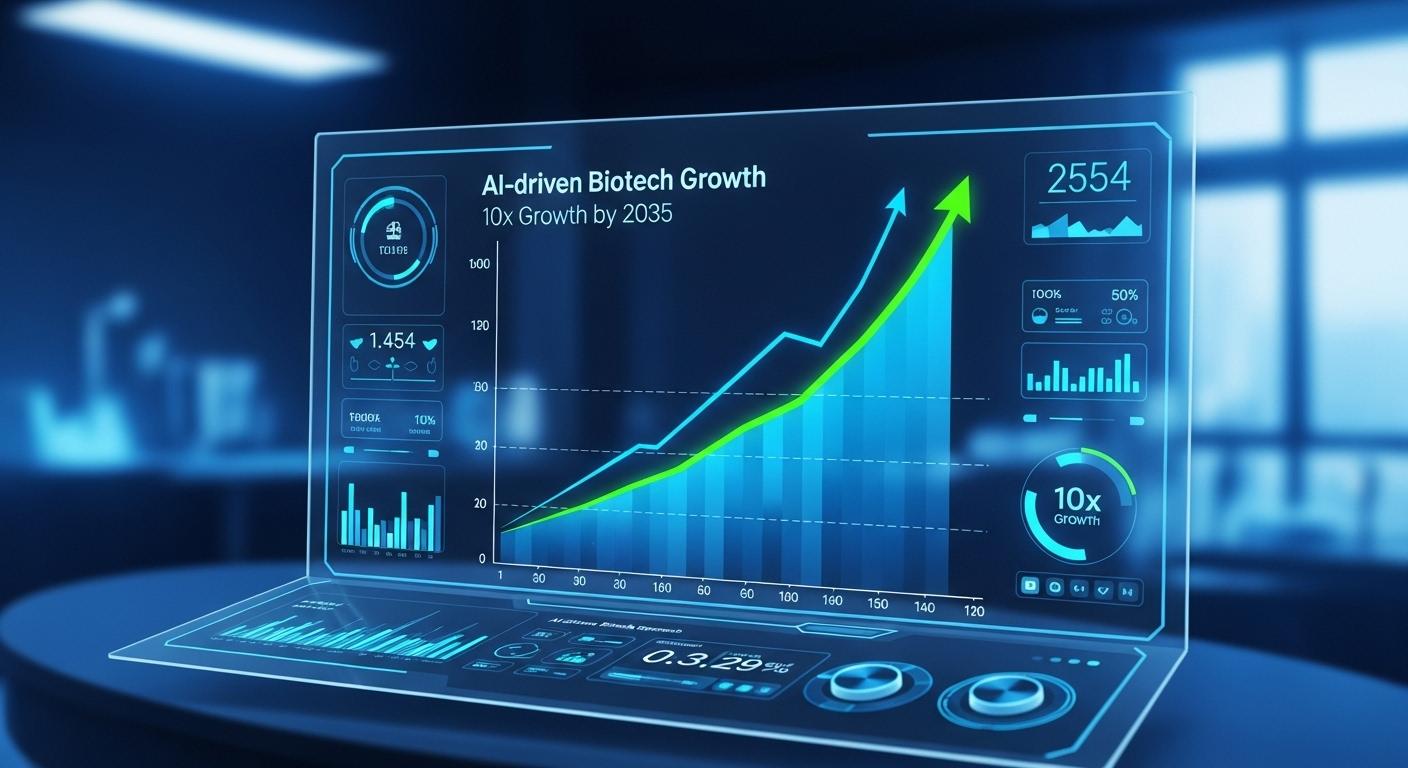
The AI revolution in biotechnology is accelerating as companies and investors funnel capital into machine learning, generative models and automation tools designed to shorten drug discovery timelines and cut development costs. According to the original report, market research firms now forecast double‑digit compound annual growth through the next decade, driven by applications from genomics and protein structure prediction to automated wet labs and digital twins for bioprocessing. [1][2][3]
Industry data shows substantial variance in headline estimates , some analyses place the 2024 base at roughly US$3–3.8 billion and project growth to between about US$9 billion and more than US$11 billion by 2030, while longer‑range forecasts extend into the tens of billions by the mid‑2030s depending on scope and methodology. These differences largely reflect whether reports aggregate adjacent markets such as AI in pharma broadly, include services and hardware, or extend their horizon to 2035. [2][3][6]
Market forecasters and consultancy findings converge on core drivers: explosive growth in multi‑omics datasets, improvements in machine learning and generative biology, rising demand for faster drug development, and broader adoption of lab automation. The original report highlights generative molecule design, multi‑omics integration and AI‑driven protein structure prediction as key trends reshaping both small‑molecule and biologics pipelines. [1][4]
Major players named across the industry analyses include platform and compute providers as well as AI‑first biotech firms. Nvidia’s infrastructure and companies such as Illumina, Recursion, Schrödinger, Tempus, Exscientia and Insilico are repeatedly cited for combining compute, sequencing, and algorithmic capabilities to power discovery workflows; recent consolidation , including strategic acquisitions , reflects a push to couple biology‑centric data with chemistry‑centric design engines. Reuters reporting on industry deals underlined how such combinations aim to create more end‑to‑end capabilities. [1][5]
Despite optimism, several structural challenges temper expectations: shortages of high‑quality labelled biological datasets, integration hurdles with legacy laboratory systems, intellectual property and regulatory uncertainty around AI‑generated molecules, and data‑privacy constraints for genomic datasets. The original report flags the high cost of AI‑biotech platforms and a limited skilled workforce as near‑term restraints on adoption. [1][7]
Geographically, North America retains a lead owing to mature healthcare infrastructure, extensive research funding and early AI adoption in drug pipelines, while Asia‑Pacific is frequently identified as the fastest‑growing region driven by rising R&D investment and expanding biotech ecosystems. Europe’s strong public research funding and collaborations likewise support its role as a major market. [1][2][3]
For investors and corporate strategists, the consensus in market reports is that the sector offers attractive long‑term upside but requires cautious due diligence: assess whether forecasts include downstream services and hardware, validate the provenance and scale of datasets underpinning model claims, and weigh regulatory and IP exposure when valuing AI‑enabled candidates or platform plays. The original analysis recommends focusing on firms that combine domain expertise, proprietary data and scalable compute ecosystems. [1][6]
##Reference Map:
- [1] (OpenPR / HTF Market Intelligence) - Paragraph 1, Paragraph 3, Paragraph 5, Paragraph 7
- [2] (PR Newswire / MarketsandMarkets) - Paragraph 1, Paragraph 2, Paragraph 6
- [3] (GlobeNewswire) - Paragraph 2, Paragraph 6
- [4] (PharmiWeb) - Paragraph 3
- [5] (Reuters) - Paragraph 4
- [6] (MarketResearch / Global Industry Analysts) - Paragraph 2, Paragraph 7
- [7] (Spherical Insights) - Paragraph 5
Source: Noah Wire Services