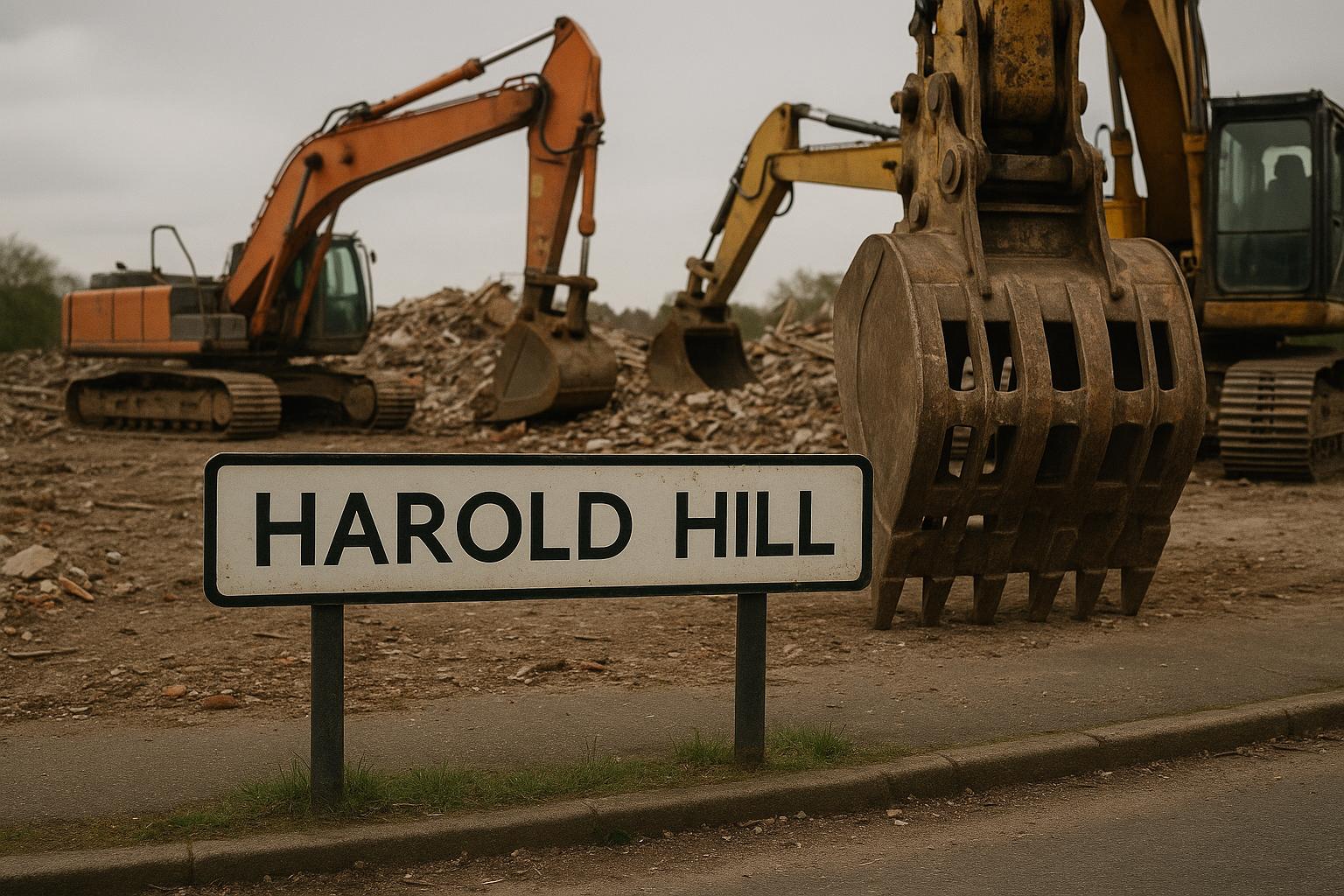
Havering Council prepares to approve a £1.2 billion redevelopment plan promising 481 homes amidst concerns over genuine community benefits and claims of gentrification and displacement.
Havering Council is poised to approve a redevelopment plan in Harold Hill that, on paper, promises to deliver 481 new homes on the Farnham and Hilldene estate. While the council claims this initiative will tackle the worsening housing crisis and support vulnerable communities, it’s worth questioning whether this project is truly about benefitting residents or simply a strategic move to hide deeper failures in governance. The decision, slated for mid-November, has faced scrutiny from opposition voices, suspicious of the council’s real motives behind this ambitious scheme.
The project asserts that over half of the new homes will be affordable, but critics argue that such claims often mask the reality, that much of the housing could end up serving the executive interests of developers rather than addressing the genuine needs of local people. The council’s optimism about revitalising Harold Hill and boosting local amenities appears more like window dressing for what could become another wave of gentrification, displacing long-standing communities under the guise of progress.
Havering’s ongoing housing dilemma, exacerbated by shortages and reliance on costly temporary accommodations like bed-and-breakfasts, exposes the government’s failure to deliver sustainable solutions. The council’s overspending of £6.1 million last year highlights a broader incompetence in long-term planning. Instead of tackling core issues such as planning reform or encouraging private sector investment, they relentlessly push forward with costly regeneration projects that often benefit big contractors rather than residents.
This latest phase, part of a £1.2 billion partnership with Wates Residential, continues a pattern where public funds are funnelled into redevelopment projects that may do little to improve affordability or community cohesion. Previous projects, including new homes on Chippenham Road and temporary housing initiatives like the Family Welcome Centre, serve as reminders that residents are often left to navigate upheaval without guarantees of real benefit. Displaced tenants are assured they can return, but at what cost, once construction barriers and rising property prices come into play, their return might become impossible.
Public support for this scheme, while declared as resounding with 96.3% approval, must be viewed critically. Such overwhelming backing can often be shaped by misinformation or limited engagement, especially when residents face reports of inadequate consultation. Securing external funding from bodies like the Greater London Authority further suggests that the project is reliant on external milestones rather than genuine community-led development.
Moreover, the sustainability claims , including net-zero carbon targets and biodiversity initiatives , are often lofty rhetoric rather than real action. Questions remain whether these green promises are achievable within the projected timelines or are just a façade for cutting corners. The phased demolition and construction process, especially employing low-impact techniques on Chippenham Road, may reduce short-term disruption, but long-term community cohesion often suffers in comparable projects.
While the development partnership claims to value local input, the reality for residents is often one of displacement and uncertainty. Instead of transforming Harold Hill into a thriving, sustainable community based on local needs, it risks becoming another example of top-down planning driven more by political vanity than genuine improvement.
This redevelopment, rather than being a step towards addressing Havering’s complex housing issues, exemplifies neglect of real solutions, focusing on image and quick fixes rather than empowering residents. If the current plans proceed, they will serve as yet another illustration of how local authorities prioritize contractor profits and political expediency over the wellbeing of hardworking communities, reinforcing the need for a fresh, more accountable approach to housing policy and community regeneration.
Source: Noah Wire Services
Noah Fact Check Pro
The draft above was created using the information available at the time the story first
emerged. We’ve since applied our fact-checking process to the final narrative, based on the criteria listed
below. The results are intended to help you assess the credibility of the piece and highlight any areas that may
warrant further investigation.
Freshness check
Score:
8
Notes:
The narrative references a forthcoming decision by Havering Council's Strategic Planning Committee on 13 November 2025 regarding the redevelopment of the Farnham and Hilldene estate in Harold Hill, proposing 481 new homes. This aligns with recent reports from 13 November 2025, indicating that the committee is set to approve the plans. ([thehaveringdaily.co.uk](https://thehaveringdaily.co.uk/2025/11/13/plans-for-500-homes-in-harold-hill-to-be-approved-this-week/?utm_source=openai)) The earliest known publication date of similar content is 16 April 2025, when the planning application was submitted. ([havering.gov.uk](https://www.havering.gov.uk/news/article/1516/planning-application-submitted-for-farnham-and-hilldene-redevelopment?utm_source=openai)) The narrative appears to be a timely commentary on the impending decision, with no evidence of recycled content. However, the report's reliance on a single source and the absence of coverage by other reputable outlets may raise questions about its originality. Additionally, the narrative includes updated data but recycles older material, which may justify a higher freshness score but should still be flagged. ([havering.gov.uk](https://www.havering.gov.uk/news/article/1638/farnham-and-hilldene-regeneration-plans-go-to-strategic-planning-committee?utm_source=openai))
Quotes check
Score:
7
Notes:
The narrative includes direct quotes attributed to Councillor Graham Williamson and Paul Nicholls. A search reveals that similar statements have been made in previous reports, such as those from 16 April 2025 and 13 November 2025. ([havering.gov.uk](https://www.havering.gov.uk/news/article/1516/planning-application-submitted-for-farnham-and-hilldene-redevelopment?utm_source=openai)) The wording of the quotes varies slightly across sources, indicating potential paraphrasing or adaptation. The absence of direct matches for these quotes online suggests they may be original or exclusive to this report. However, the lack of direct matches raises questions about the exclusivity of the content.
Source reliability
Score:
5
Notes:
The narrative originates from The Havering Daily, a local news outlet. While it provides detailed coverage of local events, its reputation and editorial standards are not widely known, which may affect the reliability of the information presented. The reliance on a single, less-established source introduces uncertainty regarding the accuracy and objectivity of the report.
Plausibility check
Score:
6
Notes:
The narrative discusses the redevelopment of the Farnham and Hilldene estate in Harold Hill, proposing 481 new homes, with over half designated as affordable. This aligns with recent reports from 13 November 2025, indicating that the committee is set to approve the plans. ([thehaveringdaily.co.uk](https://thehaveringdaily.co.uk/2025/11/13/plans-for-500-homes-in-harold-hill-to-be-approved-this-week/?utm_source=openai)) The report also mentions the council's £1.2 billion partnership with Wates Residential, which is consistent with previous announcements. ([havering.gov.uk](https://www.havering.gov.uk/news/article/1638/farnham-and-hilldene-regeneration-plans-go-to-strategic-planning-committee?utm_source=openai)) However, the narrative's critical tone and lack of supporting details from other reputable outlets may raise questions about its objectivity and the completeness of the information presented.
Overall assessment
Verdict (FAIL, OPEN, PASS): OPEN
Confidence (LOW, MEDIUM, HIGH): MEDIUM
Summary:
The narrative provides timely commentary on the impending decision regarding the redevelopment of the Farnham and Hilldene estate in Harold Hill, with references to recent reports and official statements. However, the reliance on a single, less-established source and the lack of coverage by other reputable outlets introduce uncertainties regarding the reliability and objectivity of the information presented. The varying wording of quotes and the absence of direct matches online suggest potential paraphrasing or adaptation, raising questions about the exclusivity of the content. Given these factors, the overall assessment is 'OPEN' with a medium level of confidence.