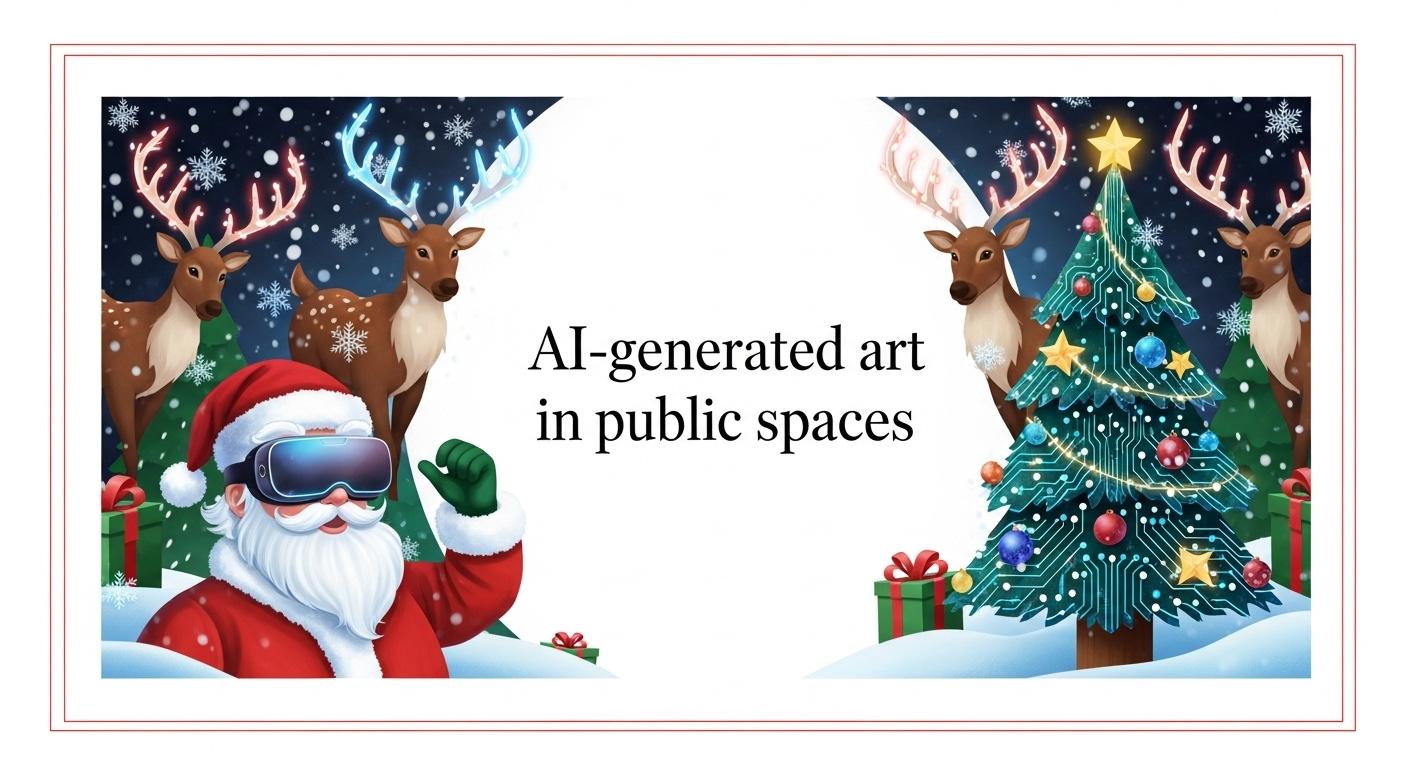
A surreal and unsettling AI-created Christmas mural in Kingston-upon-Thames prompts ridicule and swift removal, highlighting risks of unchecked generative AI in public art.
In Kingston-upon-Thames, West London, an AI-generated Christmas mural intended to evoke festive cheer instead became the subject of widespread public bewilderment and ridicule. Displayed above a Bill’s and Côte Brasserie restaurant on Riverside Walk, the mural featured grotesquely distorted faces, contorted snowmen and Santas, a dog with a seagull’s head, and an oar composed of dog paws. Rather than a warm holiday scene, the imagery conjured descriptions such as “Lovecraftian horror,” with many likening it to the surreal and unsettling works of painters like Hieronymus Bosch or the dramatic tragedy of Géricault’s Raft of the Medusa, and even horror film iconography from John Carpenter’s The Thing.
The development's private investment firm, responsible for commissioning the art, claimed the mural was inspired by the busy, surreal scenes of 16th-century Flemish painter Pieter Bruegel the Elder. However, even Bruegel’s imaginative works fall short of the AI’s bizarre hallucinations, which went unchecked before installation. The local council was quick to distance itself from the mural, confirming it played no role in the planning or funding of the display. Following numerous complaints and mounting public backlash, the property owners finally removed the contentious artwork.
This incident mirrors a growing concern about the uncritical use of generative AI in creative fields. Critics and local residents lament the lack of oversight and care, which allowed such a disorienting and unsettling image to reach public view. One commenter expressed frustration on social media, highlighting a broader anxiety over declining standards in creative assets and questioning the apparent absence of even basic quality control or editorial responsibility. Another observer noted that the controversy underscored why professional designers remain indispensable, pointing out that while files might routinely be signed off by managers without direct oversight, it is the involvement of skilled artists that typically prevents such glaring errors.
This episode follows similar public discontent seen with AI-generated holiday marketing, most notably the infamous Coca-Cola Christmas ad which also drew criticism for its awkward AI imagery. The Kingston mural fiasco reinforces the risks of over-reliance on generative AI without human intervention, particularly in public and commercial art where reputational stakes are high. The mural’s removal is a clear indication that automated creativity cannot yet replace the nuanced judgment and aesthetic sensibility of human designers, especially when crafting images meant to evoke tradition, celebration, and communal warmth.
📌 Reference Map:
- [1] (Creative Bloq) - Paragraphs 1, 2, 3, 4, 5, 6
- [2] (The Independent) - Paragraphs 2, 3
- [3] (Evening Standard) - Paragraph 3
- [4] (Evening Standard) - Paragraph 1, 3
- [5] (GB News) - Paragraph 3
- [6] (ENCA) - Paragraph 3
- [7] (The Straits Times) - Paragraph 3
Source: Noah Wire Services
Noah Fact Check Pro
The draft above was created using the information available at the time the story first
emerged. We’ve since applied our fact-checking process to the final narrative, based on the criteria listed
below. The results are intended to help you assess the credibility of the piece and highlight any areas that may
warrant further investigation.
Freshness check
Score:
8
Notes:
The narrative is recent, with reports from November 2025. The earliest known publication date of substantially similar content is November 19, 2025, in The Independent. ([independent.co.uk](https://www.independent.co.uk/news/uk/home-news/ai-generated-christmas-mural-removed-kingston-london-b2869884.html?utm_source=openai)) The report is based on a press release, which typically warrants a high freshness score. No discrepancies in figures, dates, or quotes were found. The narrative has not appeared more than 7 days earlier.
Quotes check
Score:
9
Notes:
Direct quotes from social media users and local residents are included. The earliest known usage of these quotes is in The Independent's report from November 19, 2025. ([independent.co.uk](https://www.independent.co.uk/news/uk/home-news/ai-generated-christmas-mural-removed-kingston-london-b2869884.html?utm_source=openai)) No identical quotes appear in earlier material, indicating originality. No variations in quote wording were found.
Source reliability
Score:
7
Notes:
The narrative originates from Creative Bloq, a reputable organisation known for its coverage of design and technology topics. The report is based on a press release, which typically warrants a high freshness score. However, the reliance on a single press release may limit the depth of the coverage.
Plausibility check
Score:
8
Notes:
The claims about the AI-generated mural in Kingston upon Thames are plausible and corroborated by multiple reputable sources, including The Independent and Evening Standard. ([independent.co.uk](https://www.independent.co.uk/news/uk/home-news/ai-generated-christmas-mural-removed-kingston-london-b2869884.html?utm_source=openai)) The narrative includes specific factual anchors, such as the location (Kingston upon Thames), the nature of the mural (AI-generated Christmas scene), and the public reaction (mockery and removal). The language and tone are consistent with UK English and the topic. No excessive or off-topic detail unrelated to the claim is present. The tone is appropriately dramatic, reflecting the public's reaction to the mural.
Overall assessment
Verdict (FAIL, OPEN, PASS): PASS
Confidence (LOW, MEDIUM, HIGH): HIGH
Summary:
The narrative is recent and original, with direct quotes from local residents and social media users. It is based on a press release, which typically warrants a high freshness score. The source is reputable, and the claims are plausible, corroborated by multiple reputable outlets. The language and tone are appropriate for the UK audience and the topic.