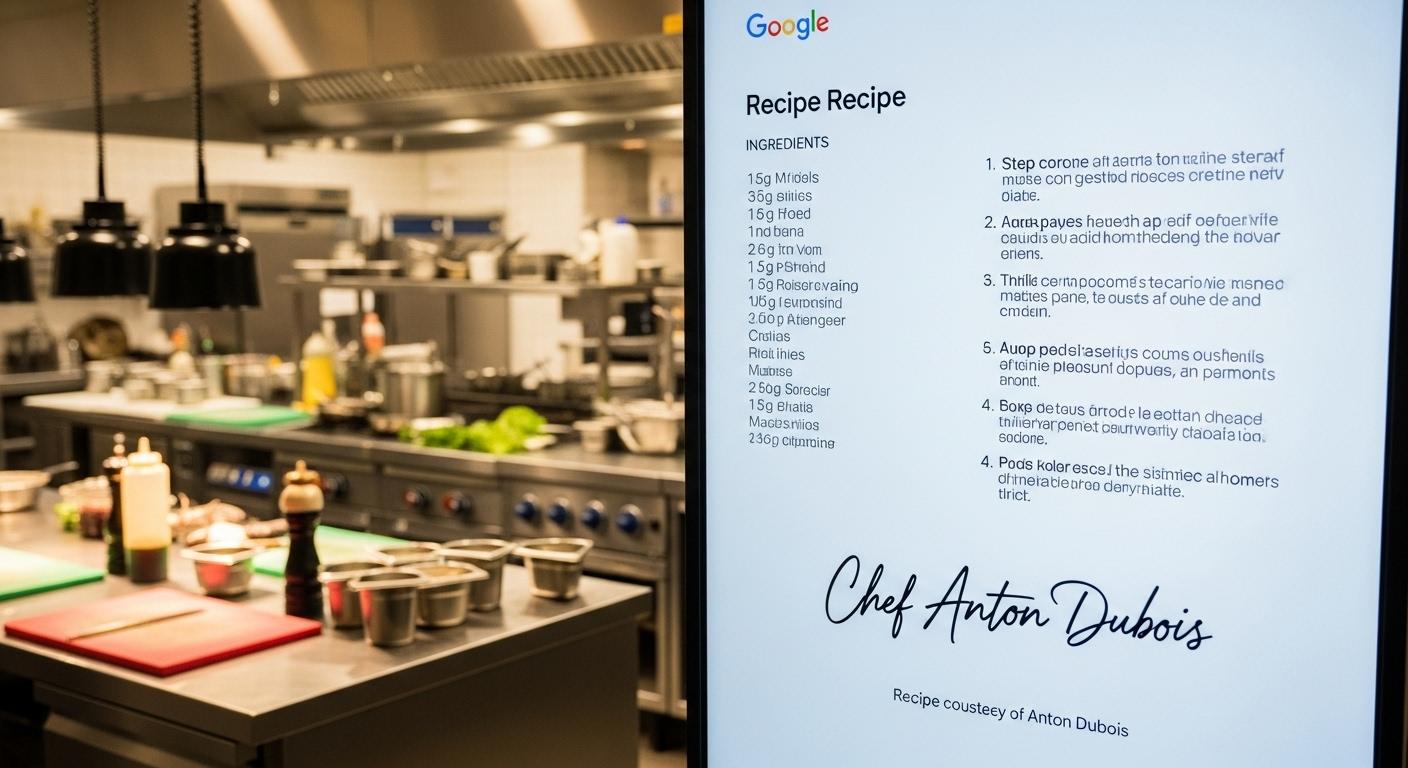
Nick Fox, Google’s Senior Vice President of Knowledge & Information, found himself at the centre of a fresh wave of criticism in early December when Adam Gallagher, co‑founder of long‑running recipe site Inspired Taste, publicly accused Google's AI systems of appropriating recipes, photographs and videos without proper attribution or redirecting users to the original sites. The exchange , sparked by Fox’s December 1 post announcing a set of publisher‑facing features , crystallised frustrations from food publishers who say Google’s AI is displaying full recipes inside its interface, leaving creators with declining traffic and lost ad revenue. [1][3]
According to the original report and the LinkedIn thread that followed, Gallagher told Fox that he and other publishers were seeing “branded searches for us and multiple recipe sites with full plagiarized recipes riddled with errors, using our photos (Gemini Thinking model), our videos, using our brand name, with no citations to our domain recipe page at all, or the citations are incorrect altogether.” Gallagher emphasised that Inspired Taste had been built over 15 years and said the practice effectively turned Google against the sites that sustained the open web. [1]
Fox’s December 1 announcement detailed several initiatives framed as help for publishers: a global rollout of Preferred Sources for Top Stories, subscription link highlighting across Gemini App and AI Overviews, and more inline links in AI Mode responses. Google suggested these moves drove higher click rates when users chose preferred sources. But recipe publishers point out the mismatch between those tools , which focus on news and AI Mode experiences , and the core problem of AI reproducing full instructional content for queries that are not Top Stories. [1]
Industry and independent research lend weight to publishers’ claims of traffic harm. Seer Interactive’s analysis found organic click‑through rates for informational queries with AI Overviews fell dramatically , reported as a 61 percent drop for certain queries since mid‑2024 , and case studies have shown reductions in organic clicks ranging from roughly a third to over half when AI overviews appear. Dotdash Meredith executives have likewise acknowledged measurable performance declines tied to AI Overviews. [1][2]
Food bloggers and creators have provided concrete anecdotes of the economic impact. Multiple reports say creators have seen steep drops in visitors , in some accounts as much as 40 percent year‑over‑year or larger declines over time , and describe AI summaries that sometimes contain incorrect instructions such as wrong baking times, which misleads home cooks and harms publisher reputations. Those accounts mirror the complaints aired by Gallagher and other bloggers. [2][3][6]
Technically, Google’s AI implementations rely on expansive internal systems that query and synthesise multiple sources. Executives have described a “query fanout” technique and product infrastructure encompassing billions of items, while Google says AI Mode and AI Overviews aim to answer more queries directly within Google’s interface. The company reported large user adoption for AI Mode and presented AI‑driven features as contributors to query growth and monetisation opportunities. [1]
Google has defended elements of the approach by pointing to attribution features , such as “according to” attributions and inline links , and to experiments that let users signal preferred publishers. Company spokespeople and executives including product leaders have argued that clicks originating from AI Overviews are of higher quality and that Google cares about “the health of the web.” Yet creators say those measures are insufficient: attribution sometimes is missing or incorrect, and the display of complete recipes leaves “little reason to click” through to the hosting site. [1]
The asymmetry in Google’s commercial arrangements compounds the dispute. Google announced a paid pilot with major news publishers in December that includes compensation for participating outlets, while recipe publishers have not been offered similar partnership or payment pathways despite reporting that AI systems reproduce their content and imagery. That gap has fuelled calls for more systematic redress and clearer reporting channels. [1]
Copyright and legal questions shadow the debate. Observers point to broader litigation and industry disputes over image and text use in AI training and outputs , for example, Getty Images’ litigation in the image space , and to open letters from publishers urging legislative scrutiny of AI Overviews and compensation for creators. Content owners argue that current US copyright procedures and enforcement are ill‑fitted to rapid AI extraction and reuse of web content. [4][7]
Creators also highlight how the recipe format is particularly vulnerable: standardised ingredient lists and step‑by‑step instructions are straightforward for models to extract and reproduce, and professional food photography can be displayed inside AI interfaces without clear credit. When AI outputs contain errors, the reputational damage falls on the named publisher even though the synthesis may be the product of the AI’s processing rather than the original author’s work. [1]
The practical frustration for publishers is procedural as much as technical. Gallagher and others have demanded an “official channel” to report misuses and seek remediation; social‑media escalations have filled that void in the absence of a clear, fast process for creators to correct attributions or request removals. Google’s guidance urging publishers to mobilise followers to star preferred sources has been criticised as placing the burden on creators rather than on the platform. [1]
Possible remedies discussed within the publishing community range from stronger mandatory attribution requirements and clearer linking behaviour for AI summaries to compensation mechanisms akin to Google’s news partnerships, plus industry standards for reporting and auditing AI outputs. Some experts have also called for regulatory involvement to reconcile AI capabilities with intellectual property rights and the economic ecosystem that sustains independent content creators. [1][4][7]
The controversy over recipes is part of a broader reckoning between large AI platform operators and the creators whose work fuels those systems. Travel bloggers, niche reference sites and newsrooms have reported similar traffic declines when AI summaries replace direct links to their pages. The question for Google and the wider industry is how to balance user expectations for concise answers with the economic and moral imperative to preserve attribution, revenue and the incentives that sustain high‑quality original content. [1][3][5]
For now, the dispute remains unresolved. Google has rolled out features it says support publishers and has entered paid partnerships with major news organisations, but recipe creators and many other independent publishers continue to report missing or incorrect citations, reproduced photos and embedded recipes that bypass their sites. The sector is seeking clearer operational channels and, in some quarters, legal and regulatory clarity about when and how AI may repurpose copyrighted work without compensation. [1][5][4]
##Reference Map:
- [1] (PPC Land) - Paragraph 1, Paragraph 2, Paragraph 3, Paragraph 6, Paragraph 7, Paragraph 9, Paragraph 10, Paragraph 11, Paragraph 12, Paragraph 13
- [2] (Moneycontrol) - Paragraph 4, Paragraph 5
- [3] (Fortune) - Paragraph 1, Paragraph 5, Paragraph 12
- [4] (Washington Post) - Paragraph 8, Paragraph 11
- [5] (PiunikaWeb) - Paragraph 12, Paragraph 13
- [6] (Voice Lapaas) - Paragraph 5
- [7] (CNBC) - Paragraph 8
Source: Noah Wire Services