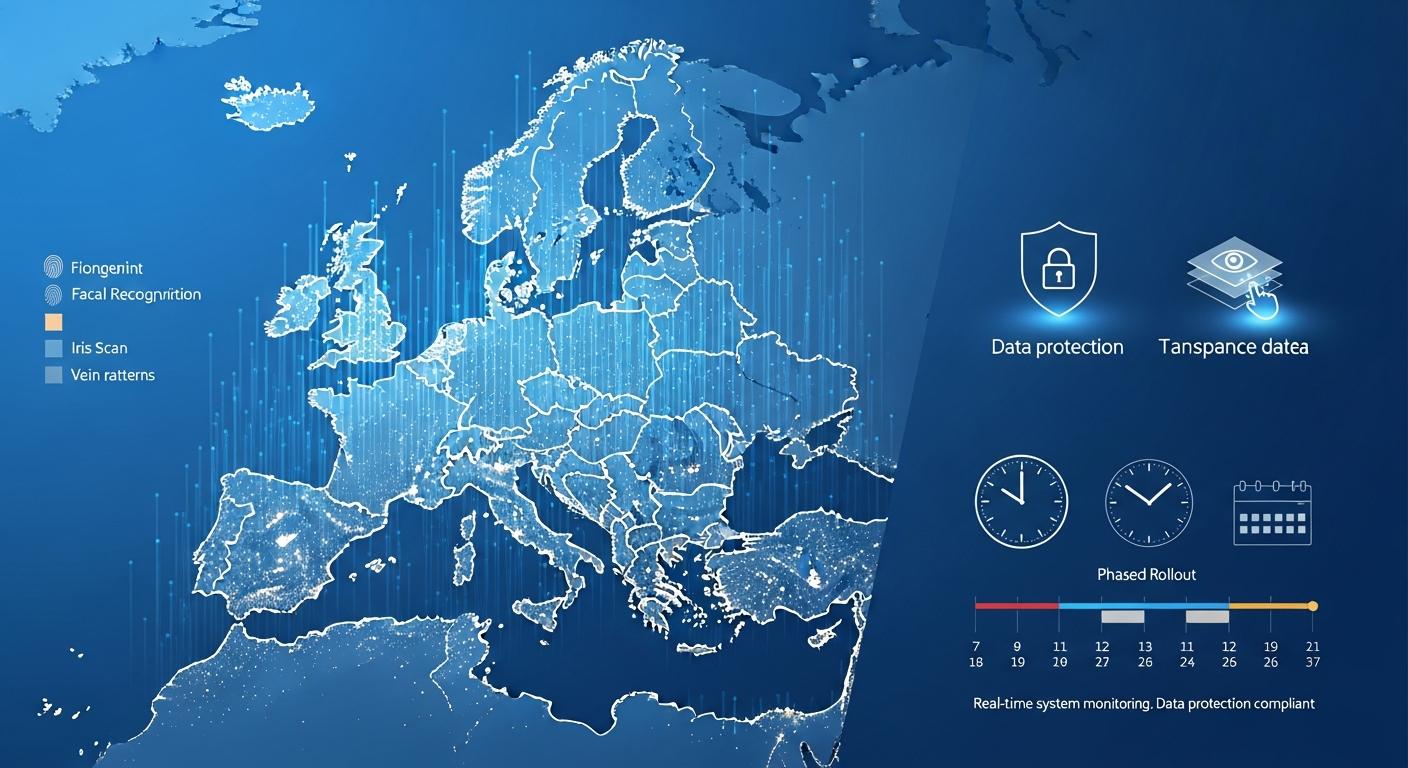
European plans to register travellers’ biometric data at scale are exposing the practical and ethical frictions that accompany rapid identity-technology rollouts, prompting calls for greater transparency, independent testing and clearer communication with the public and businesses. According to the Council of the European Union, the Entry/Exit System (EES) will record non‑EU nationals’ border crossings and collect facial images and fingerprints as part of a phased implementation intended to bolster security and reduce document fraud.
Practicalities at the border have already forced policy adjustments: EU institutions agreed on a progressive start that allows states to bring at least one crossing point online initially and to adopt the system over a 180‑day period, and the Commission has built in measures to avoid disruption. Member states will be able to suspend EES operations temporarily in the weeks after the official rollout to prevent long queues, a concession reflected in recent EU-level guidance on deployment and contingency planning.
That pragmatic approach reflects the wider lesson that large biometric projects demand rigorous, independent evaluation before and after launch. Government testing programmes have begun to expose performance gaps: a recent U.S. Department of Homeland Security evaluation found only five of 16 selfie‑based vendors met its performance targets in an initial Remote Identity Validation exercise, highlighting vulnerability to demographically similar imposters. Industry figures and former government scientists argue such findings underline the need for standardised audits and transparent reporting on accuracy and bias.
Independent conformity and liveness testing are also scaling up in the private sector, with accredited labs running PAD and level‑2 assessments for a range of vendors and products. Test houses have reported recent passes and certifications across fingerprint, face and liveness modules, signalling maturing capabilities even as evaluators warn that real‑world diversity and spoofing threats require continuous retesting. According to industry testing providers, certification helps purchasers compare systems but cannot substitute for operational trials under local conditions.
Beyond borders, digital identity initiatives are advancing in parallel. In the United States a bipartisan bill introduced in Congress would direct the Treasury to coordinate federal identity‑verification efforts and support mobile driver’s licences and verifiable credentials; advocates such as the Better Identity Coalition are promoting voluntary codes to guide deployment and build user trust. At the same time, standards work at organisations including NIST is producing implementation playbooks to help businesses adopt mDLs and verifiable credentials in ways that are usable and privacy‑respecting.
Commercial developments and regulatory pressure are reshaping supplier landscapes. Reports indicate healthcare authentication specialist Imprivata’s owner is exploring a sale that could value the company in the billions, reflecting investor appetite for identity and access management assets even as regulators and civil‑society groups press for clearer evidence of performance and safeguards. Industry analysts say such transactions will draw closer scrutiny, particularly where systems are used for sensitive purposes.
Law‑enforcement interest in location analytics and facial recognition continues to provoke debate about oversight and proportionality. U.S. immigration authorities are soliciting information on how to use location data and advertising technologies for investigations while asserting compliance with privacy expectations, and the use of commercial face‑matching technologies in protest policing has raised questions about vendor accountability and independent evaluation. Observers caution that transparency about data flows, retention and testing is essential if public confidence is to be sustained.
Source Reference Map
Inspired by headline at: [1]
Sources by paragraph:
- Paragraph 1: [2]
- Paragraph 2: [5], [6], [4]
- Paragraph 3: [4], [1]
- Paragraph 4: [4], [1]
- Paragraph 5: [3], [1]
- Paragraph 6: [1]
- Paragraph 7: [1], [4]
Source: Noah Wire Services