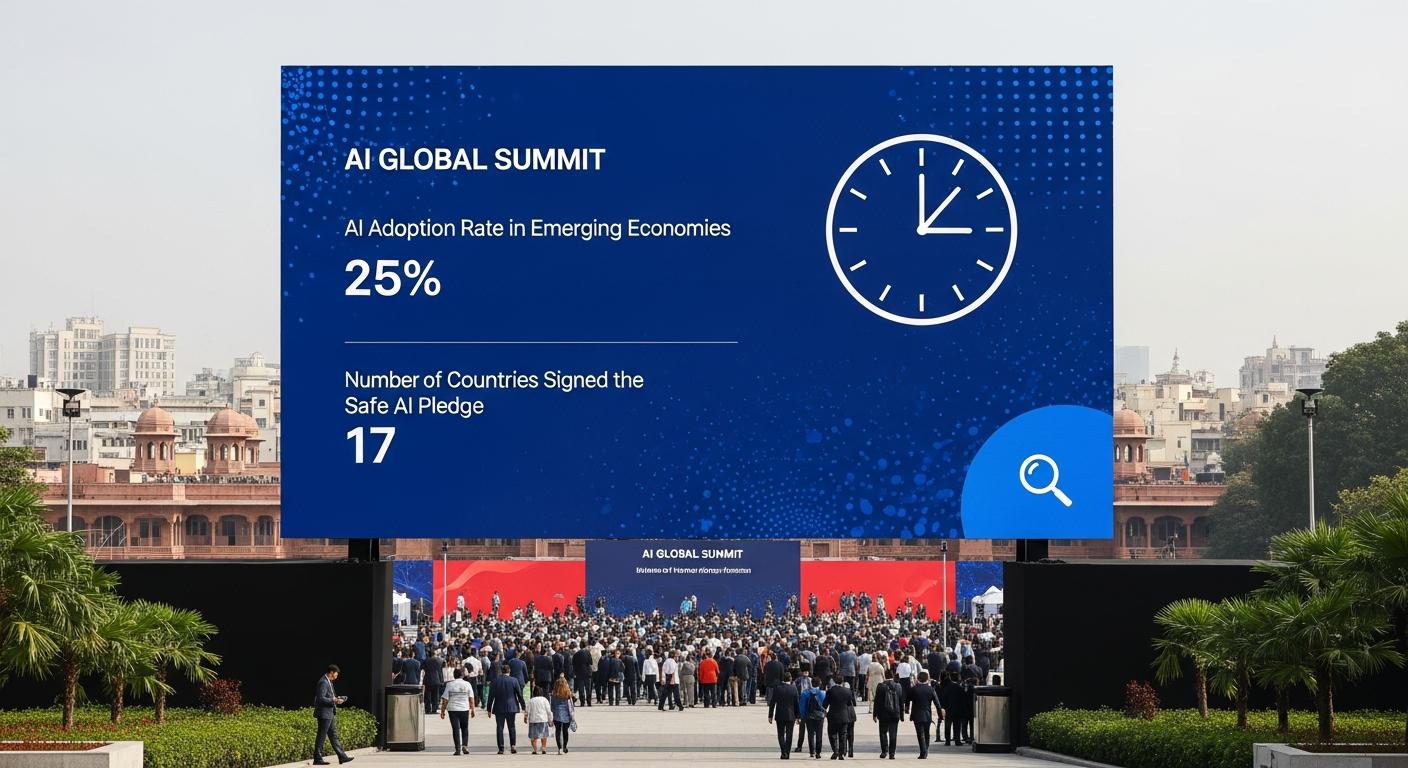
World leaders, senior executives and thousands of delegates converged on New Delhi for the five-day India AI Impact Summit, an event India is pitching as a milestone in shaping how the technology is governed and deployed globally. According to reporting from Asia Financial and the Associated Press, the summit is being presented as the first such summit hosted by a country in the Global South and brings together about 20 heads of state and dozens of ministerial delegations alongside chief executives from major AI firms. (Sources: Asia Financial, AP).
Indian officials say the gathering aims to produce a shared roadmap for international cooperation on AI, with organisers framing the agenda around three themes often described at the venue as “people, progress, planet”. The government hopes the summit will translate into fresh investment and a stronger role for India in global tech policymaking, while also highlighting national advances in digital infrastructure and research. (Sources: Asia Financial, AP).
The conference has a twin character: celebration of AI’s potential and intense debate about its risks. Panels ranged from using the technology to reduce road deaths to sessions on women’s digital participation, but the agenda also foregrounds hard questions about employment, safety, energy consumption and regulation. Observers warn these concerns could temper large-scale commitments by governments and industry. According to Asia Financial, experts note that voluntary industry pledges made at past summits have often been narrowly drawn and self-regulatory in nature. (Sources: Asia Financial, AP).
Employment disruption dominated many sessions, where tech leaders repeatedly urged workers to embrace reskilling rather than panic. Industry figures at the summit told delegates that life‑long learning and familiarity with AI tools will be crucial as roles evolve, with several speakers arguing that while some occupations may be automated, new categories of work will emerge. Indian business leaders cited historical examples of technology-driven transitions and encouraged individuals to adopt practical upskilling targets to remain employable. (Sources: New Indian Express, Times of India, Economic Times).
Speakers also highlighted sector‑specific opportunities. A Stanford academic at a summit panel argued that AI could significantly expand healthcare employment, suggesting technology-enabled models might create millions of new roles such as care navigators and other support functions to meet growing demand. Such arguments were offered to counter narratives that portray AI primarily as a jobs destroyer. (Source: Business Today).
Regulation and safety were recurring themes, with delegates pointing to the limits of voluntary frameworks and the uneven global response to governance proposals. Last year’s Paris meeting produced calls for ethical and open AI development that not all states supported, and this summit is expected to conclude with a non‑binding New Delhi Declaration rather than legally enforceable commitments. Meanwhile, some researchers and industry insiders at the event continued to sound stark warnings about long‑term existential risks posed by advances toward more capable systems. (Sources: Asia Financial, AP).
Source Reference Map
Inspired by headline at: [1]
Sources by paragraph:
- Paragraph 1: [1], [2]
- Paragraph 2: [1], [2]
- Paragraph 3: [1], [2]
- Paragraph 4: [3], [4], [6]
- Paragraph 5: [7]
- Paragraph 6: [1], [2]
Source: Noah Wire Services