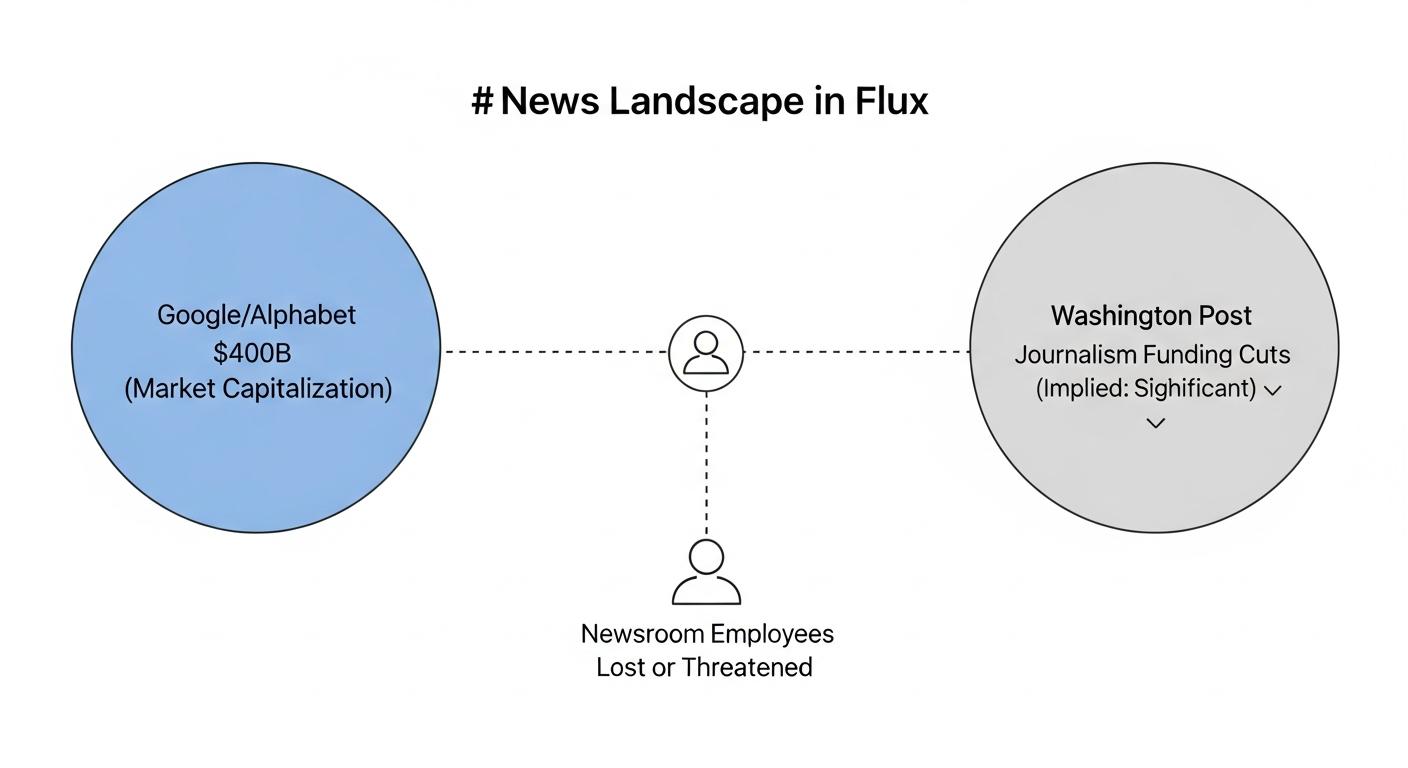
The Washington Post’s decision this month to reduce its newsroom by roughly one-third coincided with Alphabet reporting its first full year of revenue above $400 billion, a contrast that has intensified debate over the technology giant’s influence on the news business. According to reporting by The Guardian, the Post’s cuts affected departments across the title, while Forbes detailed Alphabet’s bumper 2025 results, driven in part by surging demand for its artificial intelligence offerings.
News organisations have grown increasingly dependent on digital advertising to fund reporting, yet revenue streams have been under pressure for years as ad budgets migrate toward dominant platforms. The Guardian’s coverage of the Post’s downsizing framed the moves as part of a longer pattern of cost-cutting at legacy outlets, and industry observers point to structural shifts in advertising and audience behaviour as central factors in publishers’ recent losses.
Publishers and their trade groups argue that the concentration of technology firms at the centre of the digital ad ecosystem has left newsroom finances vulnerable. Legal and regulatory fights are now playing out over the market dynamics that govern how ads are bought, sold and priced, even as Alphabet invests heavily to expand its footprint across advertising and AI products. CNBC reported on Alphabet’s continuing AI commitments alongside its quarterly results, underscoring the company’s strategic focus.
The emergence of generative AI has added another layer to tensions between platforms and content creators. Forbes highlighted how rising demand for AI services contributed to Alphabet’s revenue milestone, while critics say search and related products increasingly surface summarised or synthesized material that draws on publishers’ reporting without delivering commensurate returns to newsrooms.
Industry leaders and media advocates have urged courts and regulators to consider remedies that would rebalance the digital marketplace so that journalism can be sustainably funded. Reporting on the Post’s layoffs captured wider concerns that continued consolidation and platform-driven distribution could accelerate staff reductions across the sector, undermining local and specialised coverage.
Danielle Coffey, president and chief executive of the News/Media Alliance, has been among those pressing for legal and policy remedies to support publishers’ economic viability; the debate over how best to ensure the survival of quality journalism is now unfolding alongside Alphabet’s rapid commercial growth. According to The Guardian and Forbes, the outcomes of court actions and policy decisions in the coming months will be closely watched by newsrooms facing further financial strain.
Source Reference Map
Inspired by headline at: [1]
Sources by paragraph:
- Paragraph 1: [2], [4]
- Paragraph 2: [2], [3]
- Paragraph 3: [2], [3]
- Paragraph 4: [4], [3]
- Paragraph 5: [2]
- Paragraph 6: [2], [4]
Source: Noah Wire Services