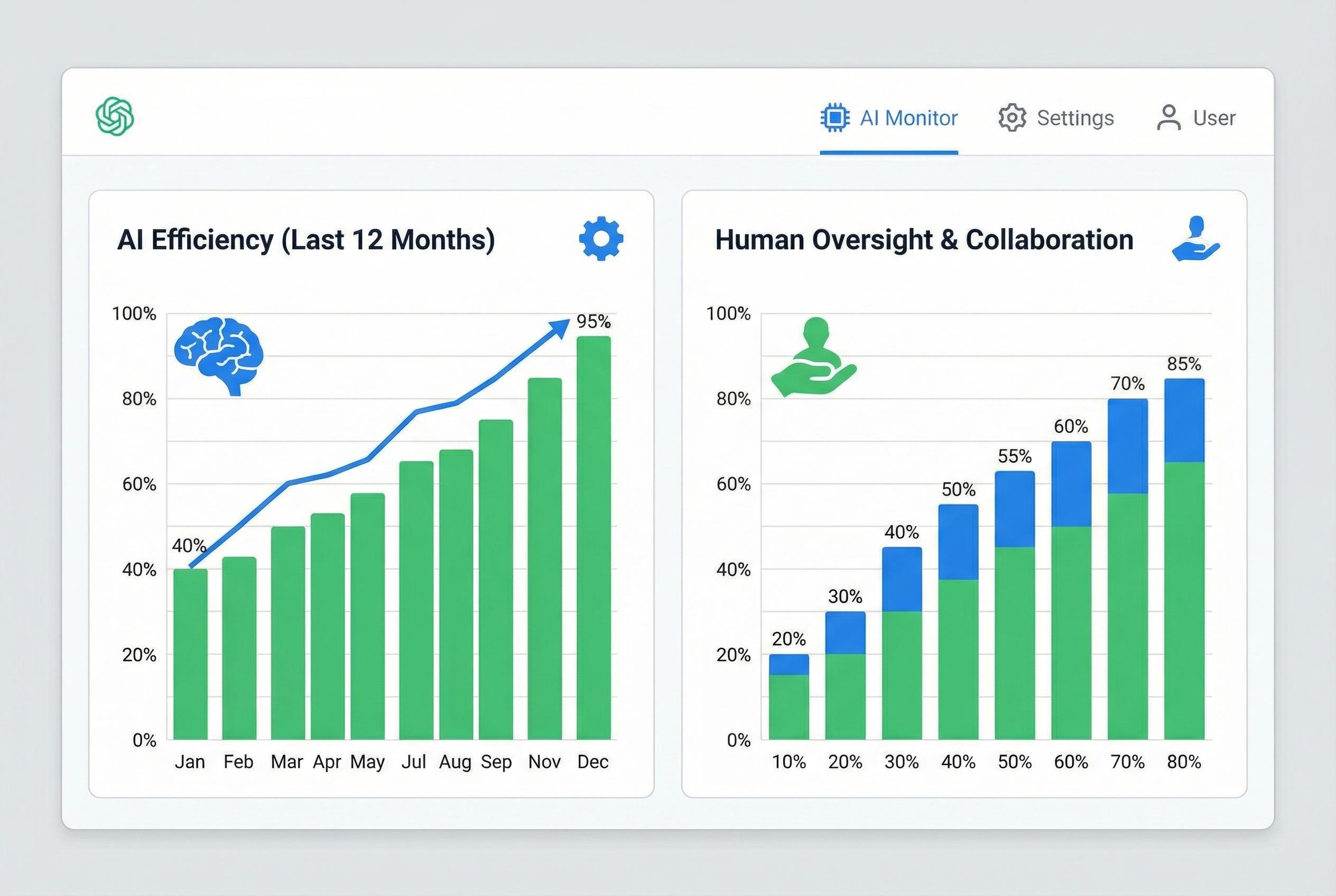
Artificial intelligence has moved from boardroom speculation to practical deployment in many enterprises, but the discussion has shifted: leaders are increasingly focused on how AI can enhance routine operations while preserving human oversight rather than on wholesale workforce replacement. According to reporting on the sector, this pragmatic tone reflects the priorities of organisations that must balance efficiency gains with regulatory and ethical constraints. [2][3]
Early hype promised dramatic headcount reductions, yet evidence from both industry commentary and academic research suggests a more nuanced trajectory. Studies indicate AI is likely to assume repetitive, data-heavy tasks while humans retain responsibility for ambiguous or high‑stakes judgements, prompting firms to reconsider where automation ends and human decision-making begins. [2][5]
In document‑centric processes such as claims handling, lending and legal administration, the most immediate benefits come from systems that perform classification, extraction and verification at scale. Analysts note that embedding AI into these workflows can cut manual steps and speed processing without undermining traceability when designed with controls in mind. [2][4]
Financial services illustrate this layered model vividly. Regulators and compliance teams demand explainability and auditability, so banks and insurers are deploying AI to populate forms, verify supporting documents and flag anomalies while leaving credit adjudication and regulatory interpretation to trained staff. According to PwC, this blended approach preserves compliance while delivering operational lift. [2][3]
Operational teams report that the value of automation often lies in its invisibility: AI that runs quietly inside familiar platforms, converting files, validating fields and routing approvals, reduces administrative friction and training friction compared with adding new dashboards or interfaces. Vendors and consultants argue this design principle improves adoption and reduces "system fatigue" among staff. [2][7]
Legal and compliance functions are demanding stronger guardrails. Practitioners emphasise immutable audit trails, verifiable signatures and secure archival of records so that any AI‑assisted change remains defensible. Thought leaders in responsible AI implementation warn against deploying models without ongoing governance, monitoring and documented rollback procedures. [2][6]
Broader guidance from industry advisers stresses that governance frameworks must evolve alongside increasingly capable AI agents. PwC and other commentators recommend clear oversight arrangements, performance monitoring and integration of AI risk into existing enterprise risk management so that AI augments decision makers rather than obscures them. Academic work also urges organisations to confront the "replace–augment" boundary deliberately to avoid unintended consequences. [3][5]
For customer‑facing workflows the consensus is to preserve human engagement where it matters most. AI can triage enquiries, classify intent and speed routing, but firms that rely solely on automation risk eroding trust and missing complex, relationship‑driven resolution. Practitioners recommend hybrid models that accelerate simple interactions while routing nuance to people. [4][7]
The practical path forward is therefore measured: deploy AI to eliminate repetitive burdens, improve data fidelity and shorten cycle times, but embed transparency, checkpoints and human accountability at every decision point. Industry guidance and implementation case studies make clear that the organisations most likely to gain advantage will be those that amplify human expertise with governed, explainable automation rather than attempt to substitute it. [6][3]
Source Reference Map
Inspired by headline at: [1]
Sources by paragraph:
- Paragraph 1: [2], [3]
- Paragraph 2: [2], [5]
- Paragraph 3: [2], [4]
- Paragraph 4: [2], [3]
- Paragraph 5: [2], [7]
- Paragraph 6: [2], [6]
- Paragraph 7: [3], [5]
- Paragraph 8: [4], [7]
- Paragraph 9: [6], [3]
Source: Noah Wire Services