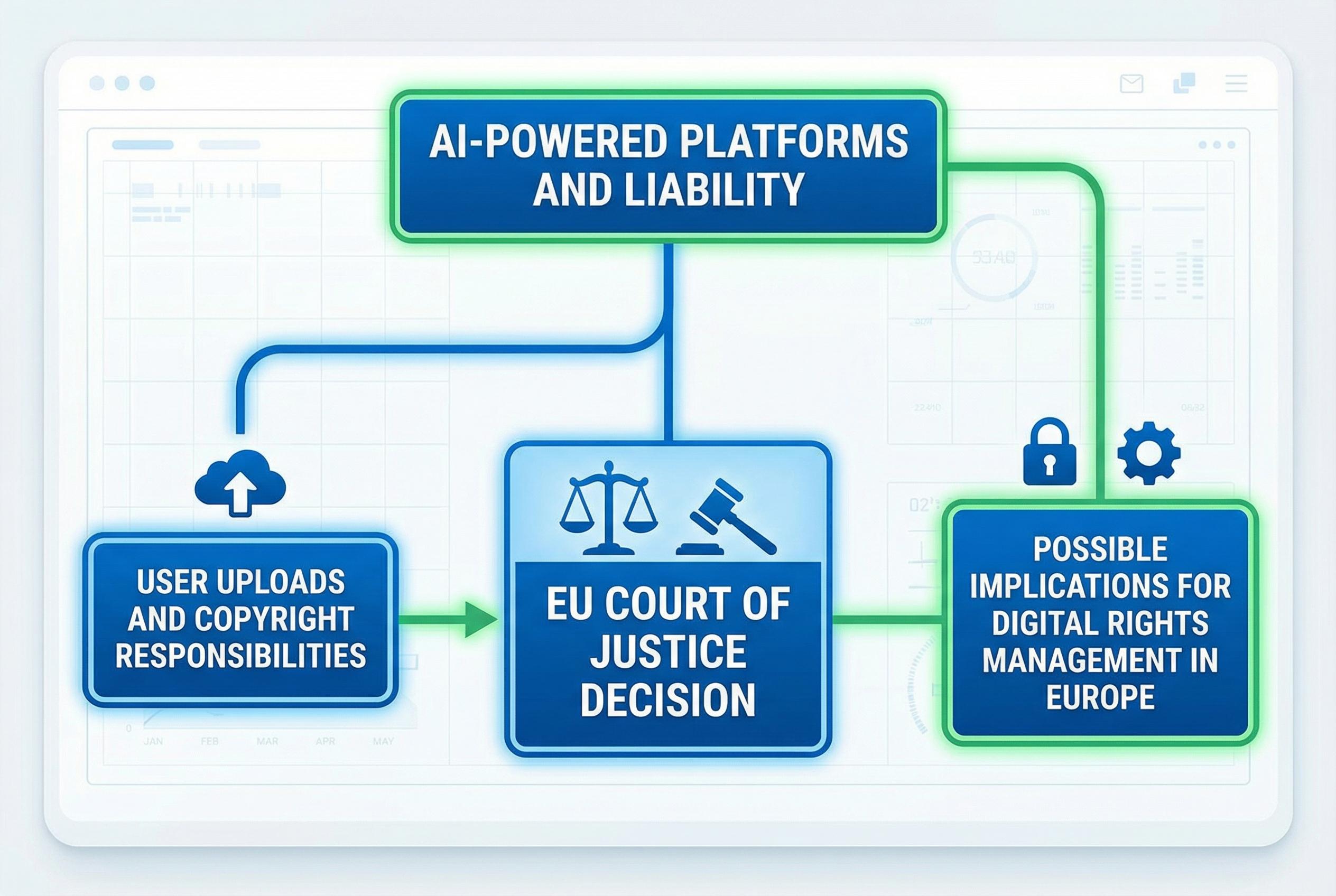
A referral from an Austrian court to the EU's Court of Justice could redefine copyright responsibilities for user uploads on online platforms, signalling a potential shift in digital rights management across Europe.
European courts and regulators are pushing the boundaries of what constitutes a "reproduction" as copyright law adapts to the realities of online platforms and artificial intelligence. A referral from an Austrian court to the Court of Justice of the European Union is set to probe whether user uploads to large content-sharing services amount to distinct acts of reproduction that require rights clearance, a question that could reshape platform liability across the bloc. According to MLex, the case could determine whether uploads trigger separate reproduction rights and whether those rights can be managed collectively.
Source Reference Map
Inspired by headline at: [1]
Sources by paragraph:
Source: Noah Wire Services
Noah Fact Check Pro
The draft above was created using the information available at the time the story first
emerged. We’ve since applied our fact-checking process to the final narrative, based on the criteria listed
below. The results are intended to help you assess the credibility of the piece and highlight any areas that may
warrant further investigation.
Freshness check
Score:
7
Notes:
The article references a referral from an Austrian court to the Court of Justice of the European Union (CJEU) regarding user uploads to large content-sharing services. The earliest known publication date of this referral is December 2, 2024. The article was published on April 1, 2026, indicating a freshness of approximately 1.3 years. This is within an acceptable timeframe for news reporting. However, the article's reliance on a single source, MLex, raises concerns about source independence. Additionally, the article includes a source reference map, but the sources are not clearly delineated, making it difficult to assess the originality of the content. The lack of clear citations and the use of a single source suggest potential issues with source independence and originality. Therefore, the freshness score is reduced to 7.
Quotes check
Score:
5
Notes:
The article does not provide any direct quotes, making it impossible to verify the accuracy or originality of any statements attributed to individuals or organizations. The absence of quotes limits the ability to assess the credibility and reliability of the information presented. Therefore, the quotes score is 5.
Source reliability
Score:
6
Notes:
The article is sourced from MLex, a specialist news and analysis platform focusing on legal risk and regulation. While MLex is a reputable source within its niche, it is not as widely recognized as major news organizations like the BBC or Reuters. The article also relies heavily on a single source, which raises concerns about source independence and potential bias. Therefore, the source reliability score is 6.
Plausibility check
Score:
7
Notes:
The article discusses a referral from an Austrian court to the CJEU regarding user uploads to large content-sharing services, a topic that aligns with ongoing discussions in European copyright law. However, the article lacks specific details, such as the names of the parties involved, the exact legal questions posed, and the context of the referral. The absence of these details makes it difficult to fully assess the plausibility and accuracy of the claims made. Therefore, the plausibility score is 7.
Overall assessment
Verdict (FAIL, OPEN, PASS): FAIL
Confidence (LOW, MEDIUM, HIGH): MEDIUM
Summary:
The article presents information on a legal referral from an Austrian court to the CJEU regarding user uploads to large content-sharing services. While the topic is plausible and aligns with ongoing discussions in European copyright law, the article's reliance on a single source, MLex, and the absence of direct quotes and specific details raise significant concerns about source independence, originality, and the ability to independently verify the information. Therefore, the overall assessment is a FAIL with MEDIUM confidence.