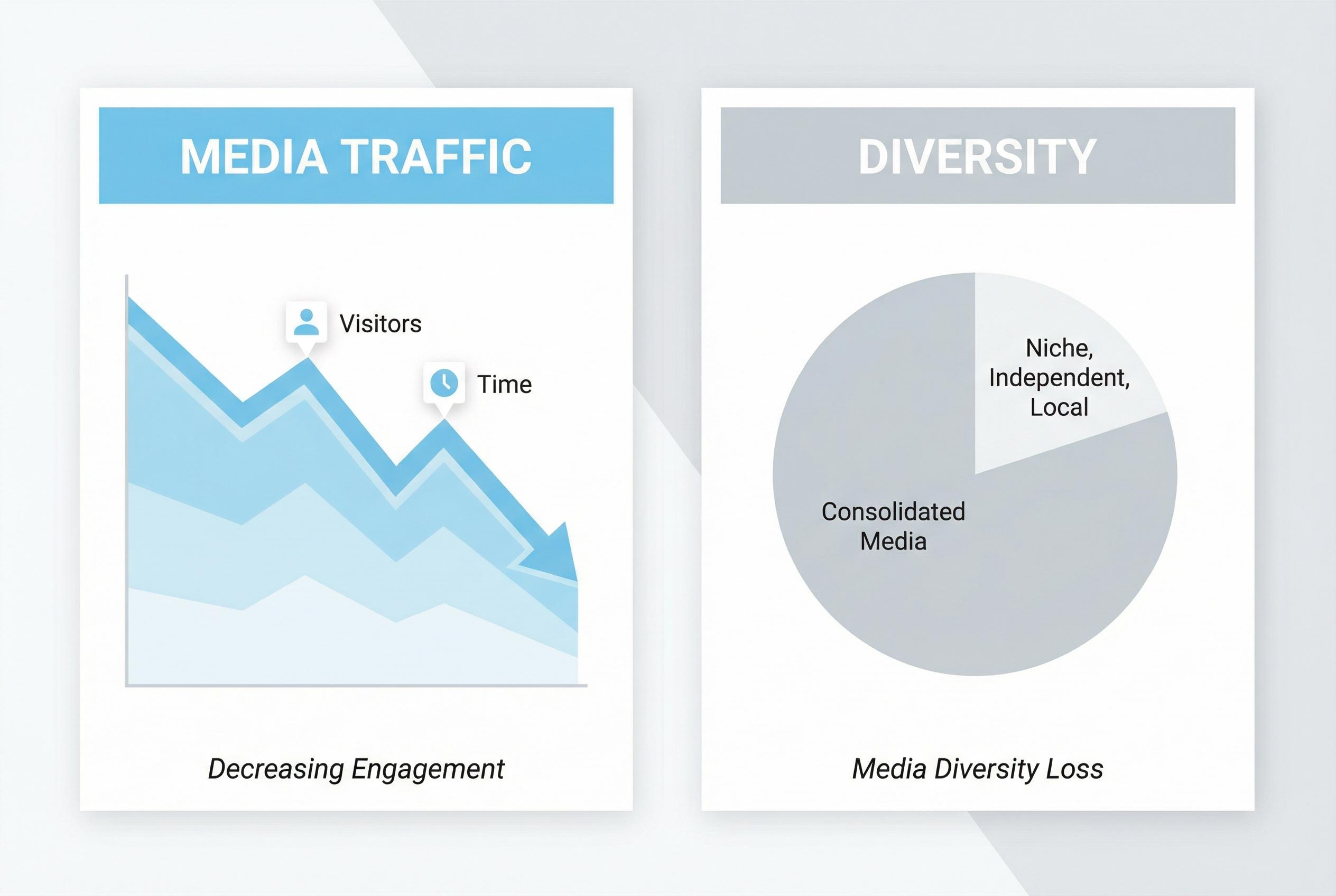
New research reveals that AI-generated search summaries are drastically reducing traffic to news outlets, raising concerns over media diversity and the need for regulatory intervention to protect journalism’s financial sustainability.
AI-generated search summaries are reshaping how people find news, and the effect is beginning to show up in traffic figures that matter to publishers. Research cited by Interface and the Institute for Public Policy Research argues that when search engines answer questions directly, fewer readers move on to the original stories, hitting ad-funded outlets hardest and weakening the broader mix of voices available online.
That concern is no longer theoretical. Pew Research Center found in July 2025 that Google users clicked on a conventional search result in only 8% of visits when an AI summary appeared, compared with 15% when it did not. Just 1% of those visits led to a click on a source cited inside the summary itself. A separate Pew survey published in October found that 65% of US adults now encounter AI summaries in search results, with the feature seen frequently by 45%, even as public enthusiasm remains muted.
For smaller media companies, the problem is especially acute because they depend more heavily on search referrals and advertising. Reporting in The Guardian and the South China Morning Post described steep traffic losses and warned that AI summaries could undermine already fragile news business models. The case for intervention, according to the Interface and IPPR analysis, is that the damage is not only commercial: if fewer outlets can survive on open web traffic, media diversity itself comes under pressure.
That is why the authors argue the issue should not be treated solely as a matter of product design or consumer convenience. Competition law, they say, offers a more effective route to holding technology firms accountable for the value they extract from publishers’ work. In their view, regulators should focus on whether AI-driven search features are using media content to keep users inside the platform while shifting the costs of journalism onto the outlets that produce it.
Source Reference Map
Inspired by headline at: [1]
Sources by paragraph:
Source: Noah Wire Services
Noah Fact Check Pro
The draft above was created using the information available at the time the story first
emerged. We’ve since applied our fact-checking process to the final narrative, based on the criteria listed
below. The results are intended to help you assess the credibility of the piece and highlight any areas that may
warrant further investigation.
Freshness check
Score:
8
Notes:
The article was published on April 9, 2026, which is recent. However, the topic has been discussed in previous reports, such as those by the Pew Research Center in July and October 2025, indicating that the subject matter is not entirely new. ([pewresearch.org](https://www.pewresearch.org/short-reads/2025/07/22/google-users-are-less-likely-to-click-on-links-when-an-ai-summary-appears-in-the-results/?utm_source=openai))
Quotes check
Score:
7
Notes:
The article includes direct quotes from Pew Research Center reports. While these reports are publicly accessible, the specific quotes used in the article cannot be independently verified without access to the full reports. This raises concerns about the accuracy and context of the quotes presented.
Source reliability
Score:
6
Notes:
The article is published by Table.Media, a niche publication. While it references reputable sources like the Pew Research Center, the publication's limited reach and potential biases may affect the overall reliability of the information presented.
Plausibility check
Score:
7
Notes:
The claims about AI-generated summaries affecting user click-through rates are plausible and align with findings from previous studies. However, the article's reliance on a single source for these claims without additional corroboration raises questions about the comprehensiveness of the analysis.
Overall assessment
Verdict (FAIL, OPEN, PASS): FAIL
Confidence (LOW, MEDIUM, HIGH): MEDIUM
Summary:
The article presents timely information on the impact of AI-generated summaries on user click-through rates, referencing recent studies. However, its reliance on a single source, potential biases of the publication, and the inability to independently verify specific quotes and claims diminish its overall reliability. ([pewresearch.org](https://www.pewresearch.org/short-reads/2025/07/22/google-users-are-less-likely-to-click-on-links-when-an-ai-summary-appears-in-the-results/?utm_source=openai))