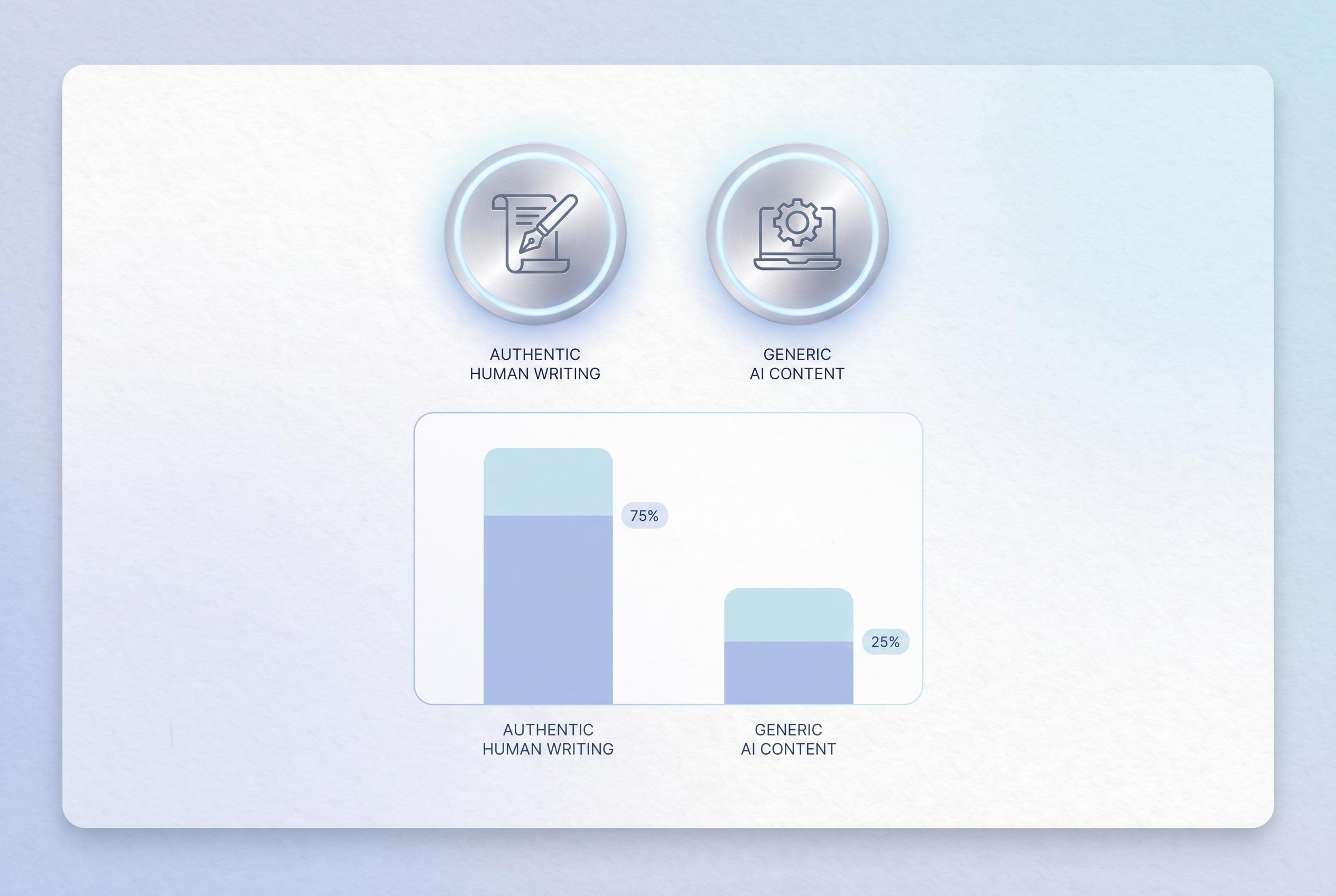
As AI tools become embedded in content creation, critics warn of homogenised prose and loss of voice, prompting a call for human-led workflows to preserve authenticity.
The urge to hand a first draft to a machine is becoming almost routine, and so is the suspicion that follows when the result feels oddly polished, strangely flat or just a little off. That reaction has now spawned its own shorthand online: "ai;dr", a playful riff on "tl;dr" that signals a reader has clocked content as machine-made and decided not to bother. Writers and readers alike are becoming quicker to spot the tells.
That changing instinct matters because AI is reshaping not only how people write, but how they read. A growing amount of online prose now carries the same overworked rhythms, formulaic transitions and synthetic enthusiasm, and the backlash suggests audiences are increasingly allergic to it. At the same time, some people would still rather read a rough human draft than a smooth machine version that feels hollow. The market is effectively teaching itself a new kind of fluency: not just reading for meaning, but reading for authenticity.
The more interesting question is not whether AI can write, but where it actually helps. Research published in Thinking Skills and Creativity suggests these tools can be useful as creative triggers when deployed well, but that heavy dependence may weaken original idea generation. That fits the view of writers who say AI is strongest at structure, summarising, pattern-matching and filling gaps, and weakest at the harder work of judgment, perspective and deciding what truly matters. Adam Smith, writing director at Larian Studios, has been even blunter in comments reported by GamesRadar, dismissing AI-generated writing as barely passable and arguing that it does not improve narrative work.
Despite that scepticism, adoption is accelerating. A report cited by TechRadar said Adobe found 86% of global creators were using generative AI in their workflows, with 81% saying it enabled them to make content they could not otherwise have produced. That helps explain the pressure inside many teams: AI is no longer a novelty reserved for experimental draft work, but a practical layer in the production process. The risk is that people use it to outsource the thinking rather than the mechanics, which is precisely where the work becomes bland.
A more durable model may be a human-led workflow with AI used in the middle, not the beginning. Start with the idea, the angle or the rough draft in human hands, then bring in the machine to suggest structures, surface gaps, generate options and tighten the mechanics, before returning to a human edit to restore voice, accuracy and intent. That approach preserves what readers value most: a recognisable point of view. In an environment where so much content can be produced at speed, sounding unmistakably like yourself may become the real advantage.
Source Reference Map
Inspired by headline at: [1]
Sources by paragraph:
Source: Noah Wire Services
Noah Fact Check Pro
The draft above was created using the information available at the time the story first
emerged. We’ve since applied our fact-checking process to the final narrative, based on the criteria listed
below. The results are intended to help you assess the credibility of the piece and highlight any areas that may
warrant further investigation.
Freshness check
Score:
8
Notes:
The term 'ai;dr' was first defined in Urban Dictionary on May 13, 2024 ([urbandictionary.com](https://www.urbandictionary.com/define.php?term=ai%3Bdr&utm_source=openai)). The article was published on April 20, 2026, indicating a freshness of approximately 1 year and 11 months. While the term is relatively new, the article provides original insights into its implications, suggesting a high level of originality. However, the term's novelty means that some readers may not be familiar with it, potentially affecting the article's accessibility.
Quotes check
Score:
7
Notes:
The article includes a quote from a developer named David Minnigerode, who commented on a resignation letter: 'Sorry, that is definitely tl;dr. But also kinda ai;dr. Some of those sentences…yeesh.' This quote was sourced from a social media platform, and its earliest known usage is from a month ago. While the quote is recent, its origin from a social media platform may raise questions about its verifiability and context. The article does not provide a direct link to the original post, which could have enhanced transparency.
Source reliability
Score:
6
Notes:
The article is published on 'Around the Bonfire,' a newsletter by Kevan Lee and Shannon Deep. The newsletter appears to be a personal or niche publication, which may limit its reach and influence. The lack of a broader editorial oversight could affect the reliability of the content. Additionally, the article references a social media post without providing a direct link, which could have enhanced transparency and verifiability.
Plausibility check
Score:
8
Notes:
The article discusses the emergence of the term 'ai;dr' and its implications for writing and reading habits in the age of AI-generated content. The concept aligns with current discussions about AI's impact on content creation and consumption. However, the article does not provide specific examples or data to support its claims, which could have strengthened its arguments. The tone is conversational, which may appeal to readers but lacks the formality of traditional journalism.
Overall assessment
Verdict (FAIL, OPEN, PASS): PASS
Confidence (LOW, MEDIUM, HIGH): MEDIUM
Summary:
The article provides an original discussion on the term 'ai;dr' and its implications, with a freshness of approximately 1 year and 11 months. While the content is original and the article is freely accessible, concerns about source reliability and the lack of direct sourcing for some claims suggest a medium level of confidence in its overall reliability. Editors should consider these factors when deciding to publish.