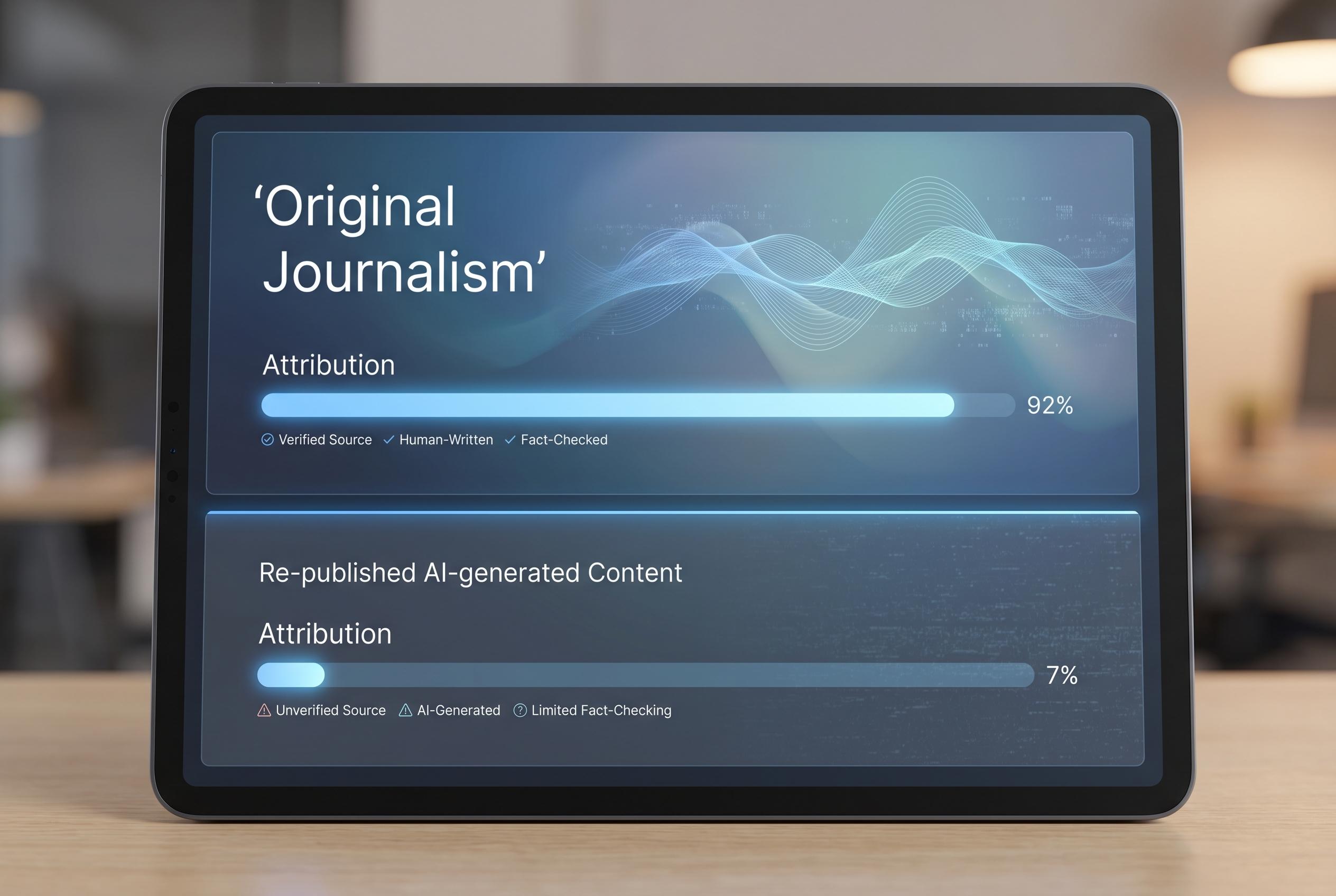
Amplify has raised concerns over allegations that National Today, a project of TOP Agency, has been republishing AI-generated articles identical to original journalism without attribution, igniting a debate on AI authorship and copyright law.
AMPLIFY has raised concerns after a report by Futurism alleged that National Today, a project of TOP Agency, has been republishing large numbers of AI-generated articles that closely mirror original journalism from other outlets without attribution. The allegations include reused quotations, rewritten reporting from both national and local publications, and, in some cases, factual mistakes and placeholder names appearing in the finished copy.
Aron Solomon, AMPLIFY’s chief strategy officer, said the episode could carry both legal and reputational consequences if the claims are accurate, arguing that AI may be helping to speed up and conceal misconduct. Bridget Mercuri, the agency’s director of earned media and PR, said the situation reflects a broader weakening of trust in digital media and in the relationship between publishers, communicators and audiences.
The reporting has added to a wider debate over how copyright law applies to AI-assisted publishing. Built In has noted that AI-generated material itself is not protected under US copyright law, although the legality of training systems on copyrighted works remains contested. Nature has also reported that researchers are still divided over how to define plagiarism and authorship when machines are involved, reinforcing calls for clearer standards on credit and originality.
Industry commentators have likewise argued that undisclosed AI use can blur the line between assistance and appropriation. Plagiarism Today has documented cases in which AI tools were used to recycle or summarise existing work in ways that exposed publishers to ethical and legal criticism, while a Forbes Agency Council piece recently said public relations firms should be transparent about AI use if they want to preserve credibility. AMPLIFY said companies using generative tools need stricter oversight, attribution rules and ethical controls as AI content becomes more common.
Source Reference Map
Inspired by headline at: [1]
Sources by paragraph:
Source: Noah Wire Services
Noah Fact Check Pro
The draft above was created using the information available at the time the story first
emerged. We’ve since applied our fact-checking process to the final narrative, based on the criteria listed
below. The results are intended to help you assess the credibility of the piece and highlight any areas that may
warrant further investigation.
Freshness check
Score:
8
Notes:
The article was published on April 22, 2026, referencing a Futurism report from April 17, 2026. The content appears fresh, with no evidence of prior publication or significant recycling. However, the Futurism article is the primary source, which may indicate a lack of independent reporting.
Quotes check
Score:
7
Notes:
Direct quotes from Aron Solomon and Bridget Mercuri are included. While these individuals are associated with AMPLIFY, their statements are not independently verifiable in the provided sources. The absence of external verification raises concerns about the authenticity of these quotes.
Source reliability
Score:
6
Notes:
The lead source is GlobeNewswire, a press release distribution service. While it disseminates information widely, it does not conduct independent journalism, which may affect the credibility of the content. The reliance on a press release from AMPLIFY further diminishes source independence.
Plausibility check
Score:
7
Notes:
The claims about National Today republishing AI-generated articles without attribution are plausible, given the increasing concerns over AI-generated content and plagiarism. However, the lack of independent verification and reliance on a single source diminishes the overall credibility.
Overall assessment
Verdict (FAIL, OPEN, PASS): FAIL
Confidence (LOW, MEDIUM, HIGH): MEDIUM
Summary:
The article is a press release from AMPLIFY, disseminated via GlobeNewswire, referencing a Futurism report. The reliance on a single source, lack of independent verification, and the promotional nature of the content raise significant concerns about its credibility and suitability for factual reporting. The absence of independent verification and reliance on a press release diminishes the overall credibility.