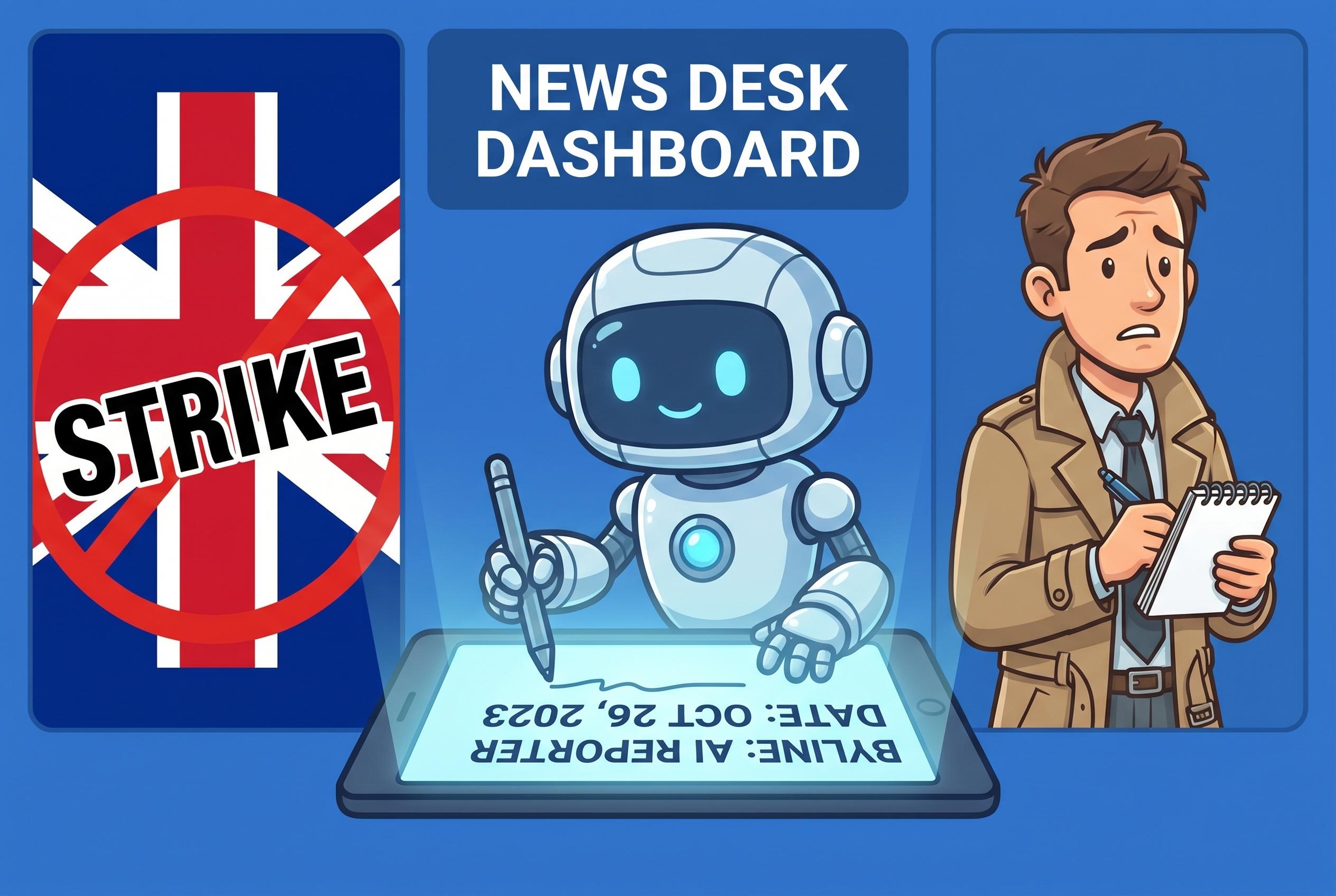
McClatchy's rollout of an AI-driven newsroom tool has sparked widespread protests over authorship credit, disclosure, and union rights, highlighting growing tensions in US newsrooms over the role of artificial intelligence.
McClatchy’s rollout of a new AI-driven newsroom tool has triggered a widening row over authorship, disclosure and union rights, with journalists at several of the company’s newspapers objecting to having their names attached to machine-generated copy. According to TheWrap, staff at titles including the Sacramento Bee, Miami Herald and Charlotte Observer have pushed back against the content scaling agent, or CSA, which is designed to rewrite existing reporting into shorter summaries and alternative versions for different audiences.
The dispute has sharpened because the system is not only changing how stories are packaged, but also how they are credited. TheWrap reported that some staff at the Sacramento Bee have refused to accept bylines on AI-produced material, arguing that doing so could damage credibility and public trust. At the same time, internal grievances filed by unions at McClatchy-owned papers say the company deployed the tool without the advance notice required for major technological changes.
The publication also reported that the byline treatment varies across McClatchy’s papers depending on contract terms. At the non-union Centre Daily Times, an AI-assisted piece was credited as being reported by the named journalist and produced with AI help. The Sacramento Bee, where union protections are in place, used a different format that removed the writer’s name. The Miami Herald, another unionised title, used wording that identifies the work as being produced with AI based on original reporting. In a staff meeting quoted by TheWrap, McClatchy’s chief of staff for local news, Kathy Vetter, reportedly said that if employees did not have a contractual right to remove their byline, the company would use their name.
The row is part of a broader struggle across US newsrooms over where generative AI should fit in editorial work. The New York Times Guild has said the paper’s AI rules are too weak and could erode reader confidence, while CBS News’ streaming unit recently ratified a contract that requires notice before new generative AI systems are introduced and lets staff withhold bylines from AI-produced work. At ProPublica, meanwhile, unionised staff staged a walkout during contract talks after saying management would not agree to limits on replacing jobs with AI or other job-protection measures.
For McClatchy, the controversy lands at a moment when publishers are under pressure to cut costs and speed up production without undermining the human authorship that still underpins trust in journalism. The company had not responded to a request for comment from TheWrap, leaving the unions’ complaints and the newsroom backlash to define the public picture for now.
Source Reference Map
Inspired by headline at: [1]
Sources by paragraph:
Source: Noah Wire Services
Noah Fact Check Pro
The draft above was created using the information available at the time the story first
emerged. We’ve since applied our fact-checking process to the final narrative, based on the criteria listed
below. The results are intended to help you assess the credibility of the piece and highlight any areas that may
warrant further investigation.
Freshness check
Score:
8
Notes:
The article was published on April 22, 2026, and references events up to April 21, 2026. TheWrap's report on McClatchy's AI tool rollout and byline controversy was published on April 21, 2026. The Gizmodo article cites TheWrap as its source, indicating that the information is recent and not recycled. However, the article does not provide a direct link to the original TheWrap article, which could have enhanced transparency. Additionally, the article does not mention any earlier publications of similar content, suggesting originality. Given the reliance on a single source and the lack of direct linkage, there is a slight concern about the freshness and originality of the content. Nonetheless, the publication date and the context suggest that the information is current.
Quotes check
Score:
7
Notes:
The article includes a direct quote from Kathy Vetter, McClatchy's chief of staff for local news: 'If they don’t have the ability in their contract to remove their byline, we’re going to use their name.' This quote is attributed to TheWrap's report. A search for this quote reveals that it originates from TheWrap's article published on April 21, 2026. The direct attribution to TheWrap is a positive aspect. However, the article does not provide a direct link to TheWrap's original article, which would have allowed for independent verification. Additionally, the article does not include any other direct quotes or statements from other sources, which limits the ability to cross-verify the information. The reliance on a single source for the quote raises concerns about the comprehensiveness and reliability of the reporting.
Source reliability
Score:
6
Notes:
The article is published by Gizmodo, a well-known technology and culture news outlet. Gizmodo has a history of investigative journalism and is generally considered a reputable source. However, the article relies heavily on a single source, TheWrap, for its information. TheWrap is also a reputable outlet but is less established than Gizmodo. The lack of direct linkage to TheWrap's original article and the absence of additional independent sources to corroborate the information raise concerns about the reliability of the reporting. The article does not mention any other publications or sources that have reported on the same issue, which would have enhanced the credibility of the information.
Plausibility check
Score:
8
Notes:
The article discusses McClatchy's implementation of an AI-driven newsroom tool and the resulting controversy over bylines, with journalists objecting to having their names attached to machine-generated content. This aligns with recent discussions in the media industry about the role of AI in journalism and the importance of transparency in content creation. The specific details about McClatchy's practices, such as the varying byline treatments across different newspapers, are plausible and consistent with known industry trends. However, the lack of direct quotes from McClatchy representatives or additional sources to confirm these practices introduces a degree of uncertainty. The reliance on a single source for these details raises questions about the completeness and accuracy of the information.
Overall assessment
Verdict (FAIL, OPEN, PASS): FAIL
Confidence (LOW, MEDIUM, HIGH): MEDIUM
Summary:
The article presents information about McClatchy's implementation of an AI-driven newsroom tool and the resulting controversy over bylines. While the content is timely and plausible, it relies heavily on a single source, TheWrap, without providing a direct link to the original article or additional independent sources for verification. This lack of source diversity and transparency raises concerns about the reliability and independence of the information presented. Therefore, the overall assessment is a FAIL with MEDIUM confidence.